WoodCentral Forums

Est. 1998 — 27 years of woodworking knowledge

Puzzzling grind on a Lee Valley Cap Iron

Posts

Puzzzling grind on a Lee Valley Cap Iron

#1

Puzzzling grind on a  Lee Valley Cap Iron

Bill Tindall, E.Tn.

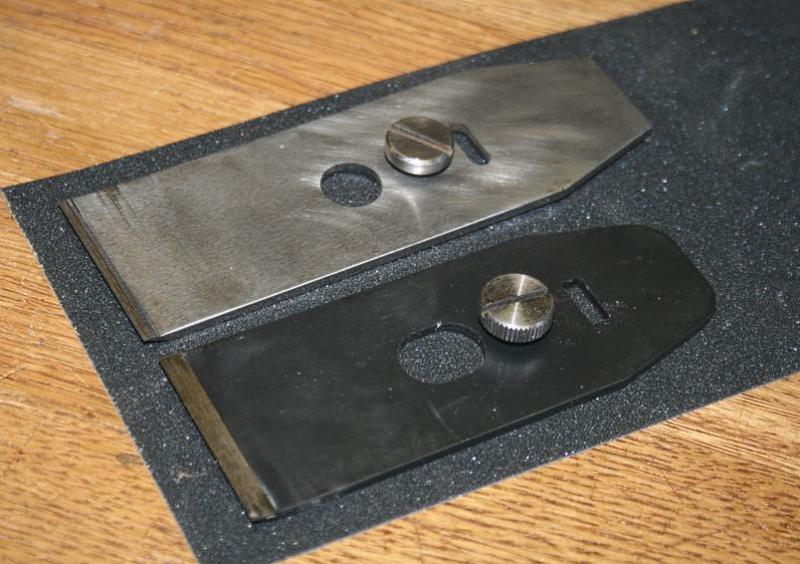
I ordered a plane blade cap iron (AKA, misnamed chip breaker) which came today. It is ground like a paring chisel, 25 degrees! Were the LV design people on vacation for the several months that cap iron angle was discussed some years ago after rediscovery of the Kato and Kawai video?

Some seized on the 80 degrees used in one video segment as a recommendation, but in fact it was just a demonstration angle In their published work 80 degrees was never used. More common in their studies, where angle was a variable, angles of 40, 50 and 60 were investigated. The center point angle of 50 degrees is likely the optimum angle but I am not certain this statement is made in any of the published work. Others have stated that 50 degrees is a good, of not optimum, angle to use to gain benefit from the "cap iron effect" to mitigate tear-out.

So why does LV supply the cap iron ground at what is probably a useless 25 degree angle, at least useless in employing the cap iron to control tear-out?

It is a simple matter to put a 50 degree angle on the edge of the cap iron and only a 50 degree slope the width of the thickest shaving is necessary. Stanley cap irons were not designed to simply hold the blade in place. These designers knew what was required to plane less than ideal wood grain.
Re: Puzzzling grind on a Lee Valley Cap Iron

#2

Re: Puzzzling grind on a  Lee Valley Cap Iron

Don Stephan

What did Lee Valley customer support say?

Re: Puzzzling grind on a Lee Valley Cap Iron

#3

Chipbreakers/Cap iron factors

Derek Cohen (in Perth, Australia)

Bill, ALL the makers supply chipbreakers/capirons with a 25 degree leading edge. ALL of them ... except the Stanley Bailey, which is rounded and approximately 45 degrees.

While it is a seemingly straightforward procedure to add a 50 degree secondary bevel to the leading edge, there is a complication which asks that you do this with care. Going from 50 degrees to 25 degrees removes steel from behind the edge. However, going from 25 degrees to 50 degrees removes steel from the edge. This is relevant since the amount of steel at the edge varies between makes.

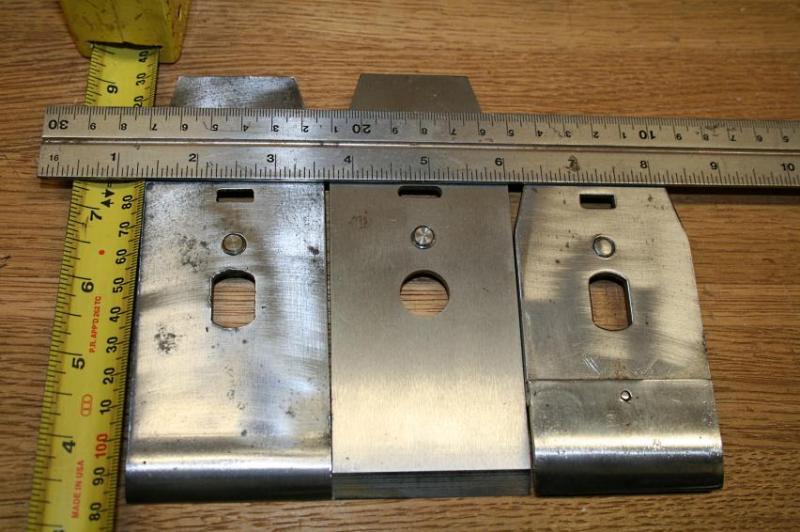
Below is a photo of LN (on the left) and Veritas (on the right) chipbreakers ...


Note that the "ledge" at the leading edge is much smaller on the LN. This ledge is used for registering the chipbreaker behind the blade's edge. It is possible to reduce this significantly with a secondary bevel that is very large. Keep it small and there should not be a problem.

There is also an argument whether the leading edge should be rounded or flat. I have tried both and cannot find a difference in practice. Logic says the rounded leading edge should offer less resistance when a shaving exits.

Two other factors of relevance: the first is that the projection adjuster slot is placed at a difference position for these chipbreakers. There can be 1/4" difference. This effectively means that you cannot use a Veritas chipbreaker on an LN plane. It will not allow the chipbreaker to be closed up and still have enough blade length length to extend out of the mouth.

LN in the centre, Stanley to the left and Clifton to the right:


The other choice is the chipbreaker screw. As insignificant as this may seem, the Veritas is the thickest and has the best knurling. The LN is smooth. The Veritas is the easiest to set with fingers (see photo above).

Regards from Perth

Derek

Re: Puzzzling grind on a Lee Valley Cap Iron

#4

Not "ALL" of them

Bill Tindall, E.Tn.

"Bill, ALL the makers supply chipbreakers/capirons with a 25 degree leading edge. ALL of them " The Hock has a primary bevel of 35 degrees and a secondary bevel too small for me to measure with my protractor but it looks about right.

At least for a time LN did not "believe" in the cap iron effect for tear-out mitigation. Helps them sell bevel up planes I suppose. And with their cap iron I suppose the customer would not see any effect either. It looks to me like Ron got it right and the rest are in denial.

Re: Puzzzling grind on a Lee Valley Cap Iron

#5

Good information, but....

Bill Tindall, E.Tn.

The question as to why LV, and LN, don't grind the cap iron at 50 degrees was not answered, or speculated. Why would a company supply a cap iron unsuitable to set up for tear-out mitigation? Where were they during all these discussions?

As far as regrinding, I thought I made it clear that only a tiny amount of the bevel needed to be reground. I certainly was not suggesting any need to regrind the entire bevel.

Re: Puzzzling grind on a Lee Valley Cap Iron

#6

Re: Good information, but....

Derek Cohen (in Perth, Australia)

The question as to why LV, and LN, don't grind the cap iron at 50 degrees was not answered, or speculated. Why would a company supply a cap iron unsuitable to set up for tear-out mitigation? Where were they during all these discussions?

I do not have an answer. The designs predate the discussions in 2012. They were not altered later, perhaps because it is costly to so, and buyers are free to do so ... much in the same way as we decide the bevel angle for blades.

As far as regrinding, I thought I made it clear that only a tiny amount of the bevel needed to be reground. I certainly was not suggesting any need to regrind the entire bevel.

I find the secondary bevel at the leading edges needs to be about 1/16" ... even 1/32". However I have read complaints on forums where an 1/8" or so was removed, and this removed the ledge below.

Regards from Perth

Derek

Re: Puzzzling grind on a Lee Valley Cap Iron

#7

can you imagine why 25 degrees was chosen

Bill Tindall, E.Tn.

costly to so, and buyers are free to do so ... much in the same way as we decide the bevel angle for blades. .. ;

Plane blades come ground not only at a useful angle but the angle that almost universally is preferred. It certainly isn't more costly to take less metal off and grind at 50 degrees.

I hope someone from LV chimes in to explain why the cap iron is supplied in a configuration where it can not perform the task that it traditionally performed, namely tear-out mitigation. A useful invention has been turned into simply a blade holder.

Re: Puzzzling grind on a Lee Valley Cap Iron

#8

Yes.....

Mark Hennebury

Maybe people who's job it is to know their job...don't.

Re: Puzzzling grind on a Lee Valley Cap Iron

#9

Why ask here?

Gary Smyth

Why piddlle around here where no one knows for sure. Go to the source. Ask, then post the results. I see no point in speculation when the answer rests with the manufacturer. You dwell on a observation that may have no effect on the product. I suggest getting the answer from the "horses mouth"

Re: Puzzzling grind on a Lee Valley Cap Iron

#10

Because the horse is watching...


Re: Puzzzling grind on a Lee Valley Cap Iron

#11

Re: Puzzzling grind on a  Lee Valley Cap Iron

Mark Nowicki

I pity the customer service rep that gets THAT call...

Re: Puzzzling grind on a Lee Valley Cap Iron

#12

did I misunderstand.....?

Bill Tindall, E.Tn.

"You dwell on a observation that may have no effect on the product."

Are we talking about the 25 degree bevel? It has a critical effect on the product. With a 50 +/- degree bevel the cap iron is the most effective way of controlling tear-out when hand planing. It's a game changer when you learn to take advantage of it. It is no doubt why the cap iron (double iron, or any of its other names) was invented for hand planes. And why Stanley and other planes come equipped to take advantage of it in knowledgeable hands.

I didn't use to plane. The result was too unpredictable. Now a plane stays on the bench and gets used in every stage of furniture making.

Re: Puzzzling grind on a Lee Valley Cap Iron

#13

Yes, the bevel angle

Gary Smyth

My post was that you noticed the angle. You also identified data that seems to contradict why that 25 degree angle is optimal. My question was why seek the answer to your question here on WoodCentral when the solution is to contact the manufacturer (who is known to respond to questions similar to yours) directly. With the answer from them (the proverbial "horses mouth") in hand, you can then post your observation, and the reply, and we get both the reasons for, and the more accurate result. Speculation from WoodCentral responder's is not relevant. Put in the simplest terms, go to the source first.

It seems to me unreasonable for LV to respond to your observation on a third party site (WoodCentral) when the query should have better sent to them to get their thinking on the better angle and why they chose it.

I've no dog in this fight, with the exception of members constantly asking here for opinion that goes nowhere when contacting the source directly gets both accuracy and a faster result.

Re: Puzzzling grind on a Lee Valley Cap Iron

#14

answers

Bill Tindall, E.Tn.

1. I have no confidence an email or phone call to customer service will get an answer from someone that knows. Derek, who is well connected at LV and participates in product design, might have known, but didn't and allowed the decision might have been made long ago.

2. Lets assume there is a good functional reason for 25 degrees that I am unaware of. Among the broad swath of users on this Forum someone would point out what I didn't know which could lead to myself and others taking advantage of this knowledge.

3. The fact that the cap iron is not useful for tear-out mitigation at 25 degrees might not be known to those that bought this device, and the question would serve as a warning to those contemplating buying that the device will have to be modified to be useful for tear-out mitigation. To this end Derek provided useful information on making the modification.

4. A public discussion could motivate LV to change the angle to something useful if there was not a better reason to keep it at 25 degrees.

Re: Puzzzling grind on a Lee Valley Cap Iron

#15

comment

Bill Tindall, E.Tn.

"There is also an argument whether the leading edge should be rounded or flat. I have tried both and cannot find a difference in practice".....glad to hear that result

"Logic says the rounded leading edge should offer less resistance when a shaving exits" The cap iron works by exerting a longitudinal force on the exiting chip, which in turn is transferred to the point ahead of the blade tip where tear-out begins. Lessening this force is not heading in the favorable direction. I believe the tight mouth works the same way and not by the piddly amount of downward force of the plane sole.

Re: Puzzzling grind on a Lee Valley Cap Iron

#16

Re: answers

Derek Cohen (in Perth, Australia)

Bill, if you were LV, LN, Clifton, Hock, Quangsheng (maker of WoodRiver, Juuma, Quangsheng, etc), Stanley, or any other bevel down planemaker, what angle would you believe is the ideal for the leading edge of the chipbreaker?

We seem to have settled on 50 degrees. I think that you and I, and perhaps a few others here, use this. However, this is something about which there is still debate. The Kawai and Kato video was not clear here, and the interpretation, as you have mentioned too, left a suggestion that it could be as high as 80 degrees. Some have decided that it be 45 degrees. Who is right?

Another factor is the angle of the plane's bed or frog. Simply, the higher the bed, the less critical is the angle of the chipbreaker's leading edge. For example, a bed of 50 or 55 degrees may only require 45 degrees on the chipbreaker. There are a great number of 50+ degree frogs around, thanks to both LN and LV producing planes with this option.

Another factor is that there are likely to be far more - by far - users of Bailey pattern planes who do not tune their planes by setting a chipbreaker. This has become a forum-specific hot topic in recent years, which we hope has raised the awareness of many and encouraged them to try it out, but I venture that there are the majority of users that will balk at this. Regarding the chipbreaker, are the manufacturers to cater for a small population of enthusiasts?

I wonder about the chipbreakers in vintage woodies and infills - what angle did Norris, Spier, Matherson, et al provide? They should have known about this feature, certainly it would have been more common back then. Yes? From memory, I do not recall high leading angles on chipbreakers from these makers. I am open to being educated here. I really do not have a definite answer.

So, if you were LN or LV, what would you do with your current chipbreaker design? Leave it or modify it? If the latter, to what angle? What is the current vogue? And if this changes, what then?

Personally, I treat the leading edge of the chipbreaker as I do a plane blade. Not everyone sharpens a plane blade to the same bevel angle, or the same way. Choose the angle you wish for the leading edge and hone it the way you prefer. It is even easier than honing a blade.

Regards from Perth

Derek

Re: Puzzzling grind on a Lee Valley Cap Iron

#17

If you make planes...

Mark Hennebury

Should you not make planes that work?

Should you not know all that there is to know about planes?

There is no excuse for anyone remotely interested in handplanes not to know how they work.

You can research on the internet and find every bit of information known to mankind from the beginning of time.... if you care to look.

You can carry out your own studies, it is not too much effort to check a few different angles and make a plane that works.

This is not fashion, not what's currently cool, the style de jour, flavor of the week, this is about function, it hasn't changed since the chipbreaker was invented.

What works works, always has, always will.

Someone is asleep at the wheel.

Re: Puzzzling grind on a Lee Valley Cap Iron

#18

Re: If you make planes...

Derek Cohen (in Perth, Australia)

Someone is asleep at the wheel.

Mark, is that "someone" or everyone other than Leonard Bailey?

The closest to Stanley is Clifton/Record SS, with the removable toe. The rounded shape is closer to the angle of Stanley, however it was not designed to this end. My personal view is the removal toe is a disaster as it does nor retain a good connection. There is slight movement. I've had them drop off (and land on my toes). The removable toe was to aid honing.

Even Hock is only 35 degrees ... still 15 degrees too little.

LN used to use Stanley-style chipbreakers, and then replaced them. I think the idea of the thicker flat design was then (as now) was to stiffen the blade. Should we suggest that LN returns to the chipbreakers of old? I cannot recall, but I suspect that LV did the same.

If Leonard Bailey indeed invented his chipbreaker to control tearout (and not, as in his 1869 patent, to stiffen the blade), then I wonder if later directors of Stanley manufacturing understood this, and continued to design them in line with his aims .... or just because the design was established?

Regards from Perth

Derek

Re: Puzzzling grind on a Lee Valley Cap Iron

#19

How many times do I have to clarify!

Bill Tindall, E.Tn.

"The Kawai and Kato video was not clear here, and the interpretation, as you have mentioned too, left a suggestion that it could be as high as 80 degrees. "

I have clarified the video numerous times. You get around Forums way more than I. Spread the word. Once more........

1. According to Kato, the video was prepared for a conference to demonstrate the capability of the research planing machine. Period!

2. Kato sent me all the research papers he published as well as those he referenced. In none of the research papers was an angle higher than 60 degrees ever used.

3. When a range of angles was studied the range was invariably 40 to 60 degrees, with a center point of 50.

4. When a single angle was used in the research the angle was 50 degrees.

Conclusions derived from these facts.

1. 50 degrees is optimum for the planing machines used. Optimum for the planing machine involves optimizing not only surface quality but also blade and cap iron life, and perhaps other factors I did not detect.

That said, a tutorial was also written for their students on setting up the cap iron on a hand plane. Here the effects of cap iron angle and distance of cap iron tip to blade edge was demonstrated. Once again the center point was 50 degrees.

Re: Puzzzling grind on a Lee Valley Cap Iron

#20

My Hock ......

Bill Tindall, E.Tn.

As stated in the earlier post, I thought clearly, my Hock cap iron has a small secondary bevel. I never altered it because whatever it is it works for me. Hock cap irons are sprung, which seems a superior arrangement to the others. The cap irons for the wood planes are curved and sprung like Stanley.

It seems that LN never intended to enable their users to employ the cap iron effect for tear-out mitigation. As you pointed out, the flat is too small to allow much alteration of the angle.

Re: Puzzzling grind on a Lee Valley Cap Iron

#21

Whatever company....

Mark Hennebury

That i worked for making planes would produce a plane that worked.

There would be no one on this planet that could ask me a question about handplanes that i could not answer, if it where my job to know, i would make it my job to find out.

Some people take their job and their responsibilities seriously.

I do, maybe you do too.

If you make planes, know planes, make planes that work.

No excuses.

Re: Puzzzling grind on a Lee Valley Cap Iron

#22

Re: Information

David Weaver

1) Most of the cap irons are supplied like that, presumably because it's easy and if you do more, customers will complain that you didn't do it the way they like.

2) Ideal for the leading edge of the cap iron is 50-60 degrees, rounded gradually (similar to the shape of the stanley leading edge). That's how the old ones arrive to me when they're not beat, too. The rounded area should be some multiple of the shaving thickness because the shaving may not run perfectly against the iron. No big foul will be had if it's a little too short. If the entire cap iron is set to 60 degrees, then the top part of the bevel might cause feeding problems in some planes. That's a good reason to not supply the cap irons with a blunt 50 or 60 degree bevel.

3) The vintage good quality caps for wooden and infill planes are generally the same. A long slightly sprung slab of steel that's either unhardened or lightly hardened, the bevel occurring in two steps - a long primary bevel that's probably 20 degrees or less (to allow clearance in a wooden plane - some later infills may be a bit steeper in the primary), and a small rounded secondary bevel that meets the iron.

I don't know why rounded works better than a flat secondary bevel, but it does seem to work a little bit more nicely. It's not critical. I don't know if the old ones are rounded because that's an easy motion to do or if they just thought it worked better. Not too many other than infills are in great shape when you get them.

Nothing on any plane works better to control tearout, so if there is a cap iron on a plane, assume it's meant to control tearout no matter what else is on the plane (e.g, a fine mouth on an infill is probably a display of skill and maybe a backstop for an uneducated user, but the planes are very purposely made with the mouth sloping toward the bun to accommodate the cap iron set close.).

I don't think Lee Valley knows how good the cap iron is to use, but from a business sense, how much do you think the average person buying a plane uses the cap iron for? I doubt many do anything with it - I think 98% of the planes being sold now remove planer chatter and that's about it. Until you do a little bit more than that (or unless you're being stingy and want to use a stanley plane for everything - which is perfectly fine), you don't get a sense of how useful the cap iron is.

It also mitigates the need for:

* obsessive accuracy in most parts of the plane

* thick irons

* irons that are uber hard (because you'll be removing more wood per pass for the same or better surface, which allows you to work to a greater point of dullness, and the dullness will have very little effect on the surface. Both a thicker shaving AND the cap iron in place extend the cycle between sharpening. For a skilled user, it's probably a factor of 5 in terms of work done between sharpenings

If the technical advisor for lee valley doesn't know any of these things, I doubt it would cost them anything because little of the buying public is aware, either.

Re: Puzzzling grind on a Lee Valley Cap Iron

#23

a case study

David Weaver

A friend of mine about 13 years ago introduced me to woodworking. A tiny part of what he did was using planes - he usually didn't use them at all.

He had four LN planes. One of them, he prepared the leading edge on, which to him (Because there was no information in the package) meant honing off the step that comes on LN's cap irons.

Those cap irons are annealed, very soft. They hold up very well with a leading edge rounded over at 50-60 degrees. He didn't do that, he didn't know to, and at the time I didn't know much about planes other than that they looked much more interesting than multi routers.

He immediately dented the front of the cap iron severely, because the first thick chip that came through his plane was more than 25 degrees or so of annealed steel could handle.

He sent it back to LN, they told him he prepared it wrong and sent him another one for free. Great company. They definitely don't know what to do with the cap iron because they sent out hundreds or thousands of irons and cap irons where the adjuster ran out of travel before the cap iron was set at the edge of the iron. If you never get closer than a 16th inch from the edge, those planes worked great.

My friend was angry because the literature didn't come with the plane to tell him what to do with the cap iron. I've demonstrated for him (I've lapped him in woodworking, he's still trying to shim things and trim them on the multirouter, which makes for very arduous work - and all of his plans come out of autocad. Having a generalized proportion and then fitting things together without knowing the measurement is horrifying to him - he's an engineer), he's still suspicious about whether or not he could learn to work with hand tools because of tearout, inaccurate work, etc. I think he is the typical customer for premium planes.

If he calls and gets LV's technical advisor (he has some LV tools, too), then I guess he'll be talking to someone who already knows too much to learn any more (if you know what I mean by that).

Re: Puzzzling grind on a Lee Valley Cap Iron

#24

Disclaimer....

Mark Hennebury

"These planes are built for resale only; not intended to be used"

Re: Puzzzling grind on a Lee Valley Cap Iron

#25

Spring the chipbreaker

Derek Cohen (in Perth, Australia)

Bill, one of the mods I make to all the flat chipbreakers, whether LN or LV, is to add a little bend to create some spring. Spring is important in tensioning the connection between the chipbreaker and the back of the blade to create a tight fit. The amount of spring in these thick, flat chipbreakers in original form is quite absent. Not much is needed to tension the blade.

One of the dislikes I have with Stanley chipbreakers is that they compress very easily, and too much pressure from tightening the chipbreaker screw can squeeze the leading edge over the end of the blade.

Regards from Perth

Derek

👍 This page answered my questions

Your vote helps other woodworkers quickly find the answers and techniques that actually work in the shop.