WoodCentral Forums

Est. 1998 — 27 years of woodworking knowledge

Curly Maple Top!!!

Posts

Curly Maple Top!!!

#1

Curly Maple Top!!!

Tom Norton

About 5 years ago I started on a new dining room table. The plan comes from a FWW article by Christian Beckeworth(sp?). Ok a bit slow!

It is a Shaker style tresle. The base is cherry.

So today we took a ride out to a Amish lumber yard and picked out the Curly Maple 5/4 for the top.

So now for a few questions.

The plan calls for breadboard ends but I really don't like so wondering if a "cleat" underneath is called for? If so what would you suggest?

Now for the finish. Saw a video where the fellow sprayed a brown alcohol base dye stain, then sanded it off leaving color in the figure. Doing this a few times to get where you want to be.

So I am open to all suggestions!!

Thanks!

Re: Curly Maple Top!!!

#2

Re: Curly Maple Top!!!

John McGaw

On the matter of breadboard ends: I hate them because they never fit right when weather changes move the body of the top -- there will always be a little too much or not enough. I've changed over to cleats when structure is needed to keep a wide surface flat and there is no apron to do the job. Just be careful to allow for the inevitable movement. For a wide top elongated countersunk slots with screws and washers are easy and quick and will never let you down. Another option is figure-eight clips which do the same job -- I used these on my trestle table.

Re: Curly Maple Top!!!

#3

Ellis Walentine

Couple thoughts

Ellis Walentine

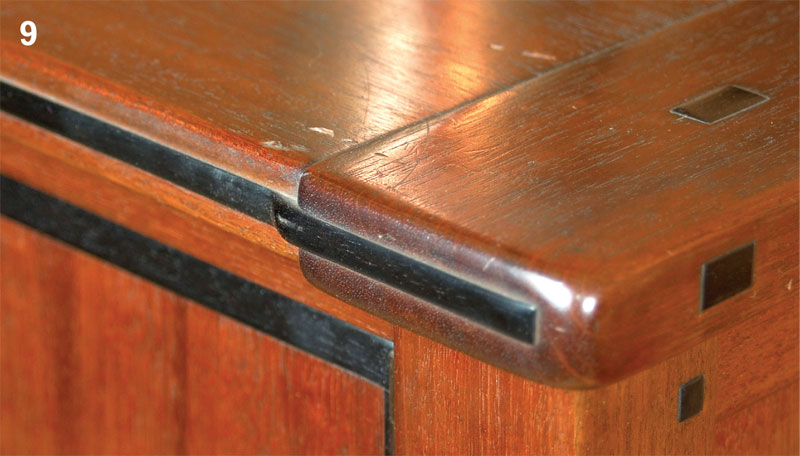
Breadboard ends are really good for a lot of reasons. They restrain the top in a linear fashion rather than the lopsided constraint you will typically expect from a cleat. Of course, they won't shrink lengthwise as the top contracts widthwise, so you'll always have a step of some sort at the ends of the breadboard where it meets the main top. And, they're a lot more work, but, IMO, worth it.

As far as emphasizing the figure of the wood, run some tests and make sure you're happy with the results before you get started. The method you described is quite common, but, in my mind, can be somewhat overwhelming and artificial looking.

Ellis

Re: Curly Maple Top!!!

#4

Finishing

David Yoho

The method you saw for highlighting the figure is one I've employed many times. However, you might skip all of that and just go with a clear topcoat. I think it would look great with the cherry. I just completed a rolling kitchen island with those woods and the curly maple looks real good with the cherry.

If you still want to highlight the figure more maybe I'd suggest a light honey colored dye that you sand off then follow with the clear. Either way you should prepare some samples before committing.

Re: Curly Maple Top!!!

#5

Re: Finishing

Tom Norton

Thanks for the replies!

So while I have your attention!!

I will need to hand plane the surface as there is some tearout and just a tiny bit of twist. Not having dealt with figured wood like this I am looking for so e hand plane suggestions. Not sure is my #5 is the correct item. I did a bit of reading and a few suggestions were bevel up plane and also wetting the surface before put the plane to it.

Re: Curly Maple Top!!!

#6

Re: Curly Maple Top!!!

William Duffield

Breadboard ends are not supposed to "fit right". Wood is supposed to move with the seasons. Instead of trying to hide them, you should celebrate them, as demonstrated by Greene and Greene.


If you don't like working with wood, make your table tops from Corian. :D

Re: Curly Maple Top!!!

#7

Re: Finishing

Hank Knight

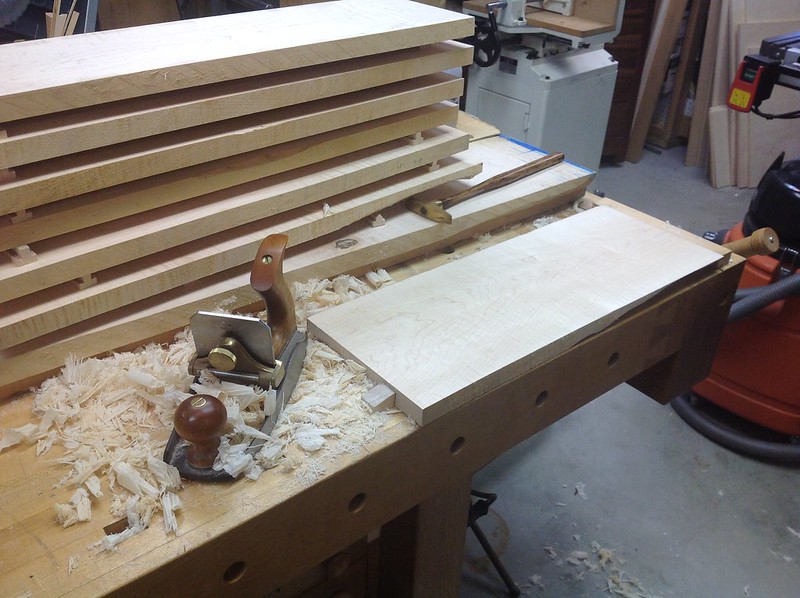
Curly maple is a bear to hand plane. You might get by with a smoother with a very close set chip breaker. Didn't work well for me so I resorted to a 112 scraper plane. It was the only thing I could find that worked.

[url=https://flic.kr/p/26h2eV3][/url][url=https://flic.kr/p/26h2eV3]IMG_1556[/url] by [url=https://www.flickr.com/photos/158680038@N03/]Hank Knight[/url], on Flickr
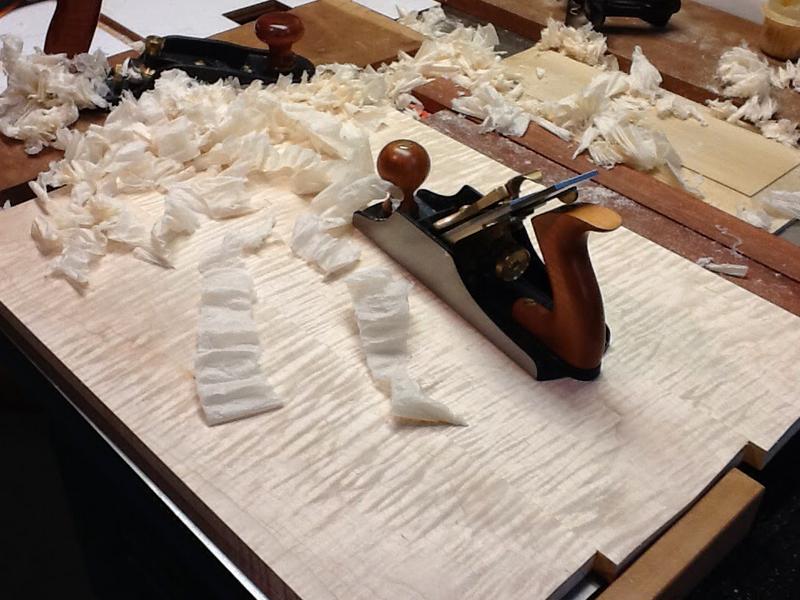
I also agree that staining to emphasize the figure is unnecessary and yields an artificial look. I just used a clear oil-based finish and was very happy with the results.

Re: Curly Maple Top!!!

#8

Re: Finishing

Tom Norton

Hank, thanks for your reply! I had not considered a scraping plane as I was looking at a bevel up low angle smoother. In use does the scraper have the ability to "remove" a lot of material? I know it would take longer but I am trying to get a feel for the process. Or do you use your regular bench plane and then follow up with the scraper? Your advice is appreciated!

Re: Curly Maple Top!!!

#9

Re: Finishing

Hank Knight

Tom, my scraper plane doesn't remove a lot of material. I dressed my rough lumber with my tailed jointer and planer and finished with the scraper plane.

Re: Curly Maple Top!!!

#10

Re: Finishing

Tom Norton

Thanks. Another few questions about your scraper. What angle do you grind the blade? Also which manufacturer?

Re: Curly Maple Top!!!

#11

Re: Finishing

Joe in a Cleveland suburb

Tom, aren't you in NE Ohio? Can you share your lumber source?

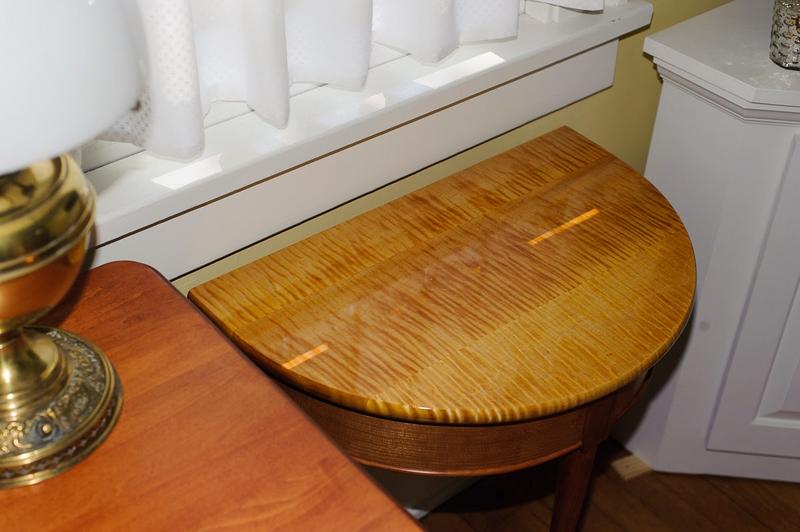
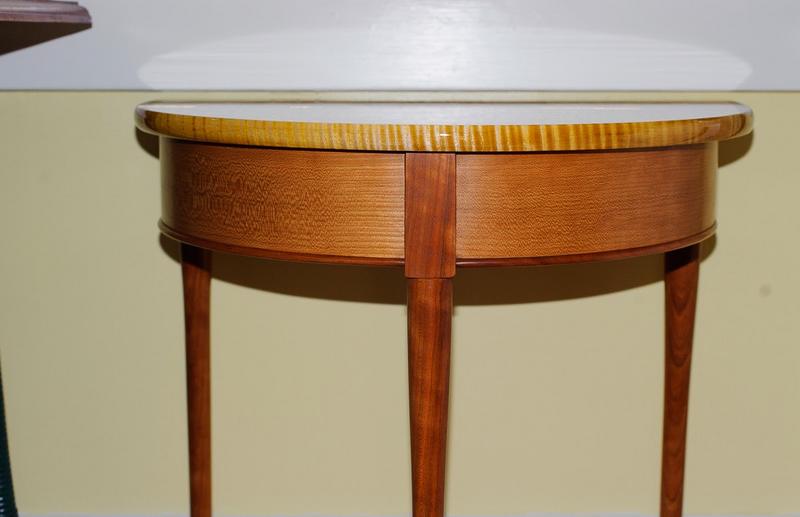
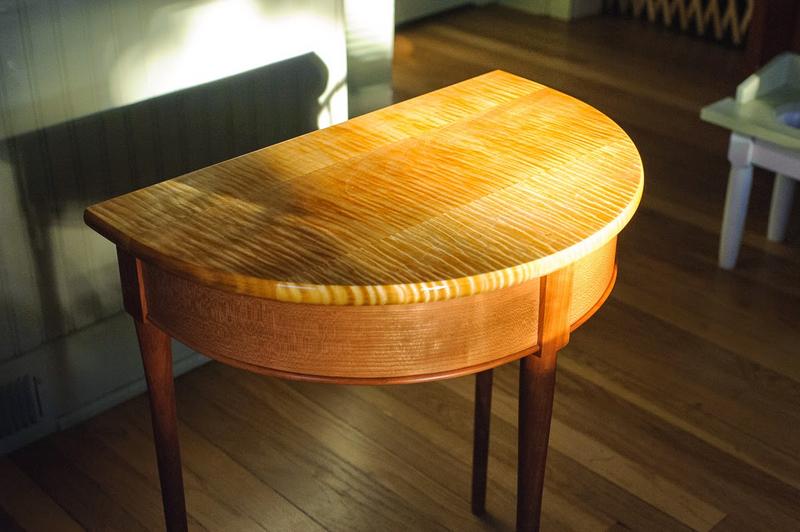
I'm no expert for sure, I always need the help of the folks here, but when I made the below table, I used (best I can recall) Tran-Tint water based Early American Maple, sanded, then (I think) BLO, followed by oil based poly of some sort.

I sometimes wish I used water based finish and no BLO. It's yellowed a lot. I think that wouldn't have happened as much if I used water based.

With Curly Maple and finishing, I often refer to the article by Jeff Jewitt in FWW #135–Mar/April 1999 Issue.

Before the board goes through the planer I mist it with water. Helps with tear-out. I used to use paint thinner then someone here suggested that wasn't a great idea.

After the planer I just use planes as Hank suggested. I probably also used a card scraper where needed.

#1


#2


#3


#4


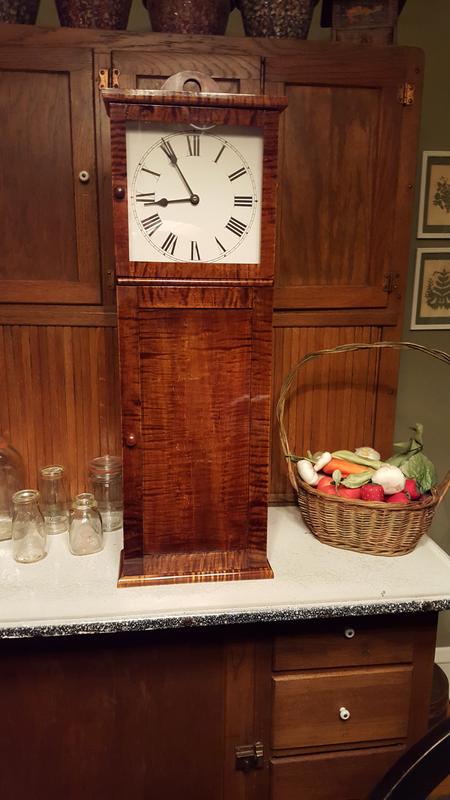
I think this clock was the same as the table except a different color of Trans-Tint. Also, the final finish was shellac which I recall Mr. William Duffield helped me a lot with.


Good luck. Show us some pictures.

Re: Curly Maple Top!!!

#12

Re: Finishing

Tom Norton

Joe,I am in the Chardon area. Got the material at Byler's on Navoo Rd. east of Middlefield.

Re: Curly Maple Top!!!

#13

Re: Finishing

William Duffield

Hank's is a Lie-Nielsen #112.

https://www.lie-nielsen.com/product/scraping-planes/large-scraping-plane?node=4075

The relief angle is not important, but most people grind it at between 45° and 60°. I berlieve that over the years, L-N has changed the factory supplied grind angle, but mostly due to insufficiencies in the available sharpening jigs at the time. The cutting (or maybe "attack") angle is adjustable, and is usually set at around 110°.

Re: Curly Maple Top!!!

#14

Re: Finishing

Tom Norton

Thanks William. A question, how does the Lee Valley planes compare to The LN?

Re: Curly Maple Top!!!

#15

Re: Finishing

Joe in a Cleveland suburb

Ok Tom. You may have told me that before... Thanks.

I have a few Golden Retriever breeder friends over in Chardon and Hambden.

Maybe I can check that place out sometime when I'm over that way.

Good luck with your table top.

Thanks.

Re: Curly Maple Top!!!

#16

Re: Finishing

David Yoho

Not William but I'll chime in. I have the Veritas scraper plane. Can't say how it compares to the LN but it works well. I actually reach for my Stanley #80 cabinet scraper more often.

When prepping the stock for thickness I joint one face first. My jointer has a Shelix head so no tear out. I have a Delta 2 speed lunchbox planer that does a good job on curly maple. If I notice tear out I wipe the surface with a damp sponge before feeding and that usually helps a lot.

Re: Curly Maple Top!!!

#17

Re: Curly Maple Top!!!

Don Stephan

Often I have gotten very helpful suggestions from Lie Nielsen. My experience with occasional tearout under a semi gloss finish was that areas worked tightly with a card scraper were so noticeable under the finish I had to strip and go over the entire surface with a jointer plane and smoother. Then I was careful when I had to use a card scraper was to work out gradually to a 12" x 12" square before applying the finish. I've also used a block plane and a low angle #62. I don't have a scraper plane. All my planes are Lie Nielsen because I like the traditional look, but I've always expected the Veritas planes would be equal in performance.

Re: Curly Maple Top!!!

#18

Re: Finishing

Hank Knight

Tom, I didn't mean to ignore your question. We were out of town yesterday and today and I wasn't able to check this site. William pretty much nailed the answer I would have given you. My scraper plane is a Lie-Nielsen 112. I don't use it very often, but on really difficult curly woods, like curly maple, it's invaluable. As William said, the sharpening, honing angle is not critical; the blade angle of attack is adjustable on the plane, so the honing angle is not critical. I sharpen my blade at 45 degrees, hone it and turn a VERY SLIGHT burr (some users argue that a burr is unnecessary, but I've always done it). I then take a few swipes with the blade as I would with a card scraper to determine the best angle of attack. I put the blade in the plane and set it at that angle. It's a guess at that point. I usually have to fiddle with it to get the angle right. When it starts taking fine shaving, I lock it down. Someone also suggested a Stanley #80. I use those too. I find them really simple to use and they do a good job. For larger surfaces, however, I don't think you can beat a 112. I don't own any Veritas planes, but I understand they are excellent. I think either one would serve you very well. Hope this helps. Good luck with your project.

Re: Curly Maple Top!!!

#19

Re: Finishing

Tom Norton

Thanks Hank!

Re: Curly Maple Top!!!

#20

Re: Finishing

William Duffield

I alos have an L-N 112. I agree with Hank's assessment. I've also used a Stanley #80 and probably have one laying around somewhere, and have some understanding of the Veritas large scraper plane. It has one advantage over the L-N: In addition to the thick, basically unbendable blade like other incarnations of the old Stanley #112, it can also use a thin, bendable blade, like the Stanley #80. This blade, and its bending mechanism, allows a cambered scraping action so that tracks from the corner of the blade are not left in the surface being scraped. With a #112 and it's ilk, you accomplish the same thing by relieving the corners of the blade when you are honing it.

You can also equip either the L-N or the Veritas plane with a toothing blade, for flattening very difficult figured wood or for preparing the substrate for gluing veneer to it.

Mostly, I use card scrapers, but since applying a clear finish can very clearly show the dubtle differences in the surface left by a scraper vs. a high angle plane vs. a double iron plane, I tend to follow Frank Klausz's advise, especially for table tops: "First you plane; then you scrape; then you sand."

Variations on the #112

http://supertool.com/StanleyBG/stan12.htm#num112

http://www.leevalley.com/us/wood/page.aspx?cat=1,310&p=48431

https://www.lie-nielsen.com/product/scraping-planes/large-scraping-plane?node=4075

http://supertool.com/StanleyBG/stan3.htm#num12

Variations on the #80

http://supertool.com/StanleyBG/stan10.htm#num80

http://www.leevalley.com/us/hardware/page.aspx?p=46266&cat=41182,68491

Warning: If you find a green one (Kunz) out there, run quickly in the other direction, but note that the #80 is a much simpler tool and therefore much more difficult for the Horror Frights of this world to screw up.

Re: Curly Maple Top!!!

#21

Re: Finishing

Tom Norton

Thanks William. This afternoon I pulled bout my Stanley #80 and worked on the blade then gave the curly Maple a bit of a go! I think I will go after these boards for the first go round with my planes and #80. I decided that this was the time to flatten all my Waterston Ed and get everything set before I rush into this project.

Re: Curly Maple Top!!!

#22

Re: Curly Maple Top!!!

Tony - Memphis

I would definitely do some tests to see what looks right to you. I have used a stain to get a 'period look,' but not to pop grain. Honestly, I don't like the look as much as I do a 'clear' finish. I agree with Ellis - that method can be a bit much for my eyes. I have done several pieces in just plain finish using oil based and water based. Both seemed to work well. One thing to note is that it takes a few coats to see the real "pop." So, take that into account when testing. Sounds like a really nice table. Good luck with it and post some pics!

Oh, I'm in the "I like them" camp for breadboard ends. Its a subjective thing. I really like the look with square pegs showing.

Tony

👍 This page answered my questions

Your vote helps other woodworkers quickly find the answers and techniques that actually work in the shop.