WoodCentral Forums

Est. 1998 — 27 years of woodworking knowledge

The artist comments on furniture design

Posts

The artist comments on furniture design

#1

The artist comments on furniture design

Bill Tindall, E.Tn.

I am fascinated by design theory, probably because I don't know much about it. I sent my artist friend that designs furniture and furnishings two pictures, one of something I made and another something that is going to be inspiration for the corner cupboard. I found her comments interesting and perhaps some of you will too.....


"Yes! The cherry piece is just right. The arches lead the eye to the crown top making a kind of visual logic. Arches are an architectural device to hold something up. Of course in furniture, they are an esthetic device not spanning anything like a doorway or river, but we still bring our functional association of those uses to our interpretation of their use in furniture. " (that is an arch in furniture must have something above it to hold up)

more arches


"So, if they aren’t holding anything up{or in this example holding up little}we intuitively know something is wrong.

she went on....

" In order to be able to think logically about design, it helps to know where the idea originated in the first place. I think those people in the furniture magazines didn’t take their art history class when they did their training (if they ever got any) There are whole chapters inn the big Abrams Art History book on cathedrals, temples, tombs, etc. including types of arches, columns, roof beams, mouldings, etc. The furniture in those buildings echoed the architecture so everything was harmonious. It also reflected the cultural style and taste of the users, but that is too complicated to get into.

and she added a critique of much "studio furniture"

Modern furniture makers have never traveled, have no sense of the traditions and treat the different elements like items in a catalogue— “I have one of these, and one of those”. They are more interested in a tour de force, making something heavy stand on some prissy little foot{like in the second picture}, than in visual harmony or logic. I am sure the other furniture makers understand what they are trying to do, but it is lost on me!"

What she has instilled in my novice designs is simplicity. Every element must serve a purpose and these elements must be harmonious. I don't know the names for design style names so I can not name examples. But, when I show her something I am interested in, but it seems to have some problem to my eye, she will often say things like "what is that all about (ie. it needs to go), or why did they mix XXX molding style with ZZZ legs, or some such.

I once showed her a desk out of College of Redwoods. It had about a dozen design elements, seemingly everything the student had learned in design 101 and some were from widely different styles. Purged of the extraneous and dis-harmonious, it became a pleasing desk.

When I can get her to comment on something I am contemplating working on she improves it. I wished she lived closer so we could collaborate more.

Re: The artist comments on furniture design

#2

Jack Guzman from Maine

Great resource

Jack Guzman from Maine

You are fortunate to have her in your corner.

Re: The artist comments on furniture design

#3

I wish there was a means to collaborate

Bill Tindall, E.Tn.

Many of us know how to put stuff together. Some find an outlet by reproducing grand designs of the past. Hence, the growth of Society of American Period Furniture Makers. Others copy or get inspired by what they can find in books and the like, with a result for better or worse.

No doubt there are people somewhere that spend their idle time sketching attractive furniture, who can't build a saw horse, for lack of tools or experience.

I don't mind paying several hundred dollars for lumber and hardware. I would be willing to pay someone that could design to consult on a project. But how would we even find one another?

Re: The artist comments on furniture design

#4

Clint Searl

Re: The artist comments on furniture design

Clint Searl

Good design is like good porn; I can't define it, but I know it when I see it.

Re: The artist comments on furniture design

#5

Re: I wish there was a means to collaborate

Barry Irby

I absolutely agree. Perhaps someone who is into social media could tell us how to connect with that person that doodles great designs.

Like you, I have the tools and the wood and if I can "see" it I can build it.

I have watched a number of the "flip this house" and have flipped quite a few houses. What I see on the shows is they have someone, usually the guy, who does the grunt work and someone else as the designer, usually the wife or girlfriend. On one of my houses a friend walked in and said, "This is the Kitchen". The light went on for me, and I had been working on the house for weeks.

I am building furniture for my two sons. One of them knows what he wants and can sketch it for me. The other points out something I have already built and says, "the same, yet different".

When I see something I like, I recognise it. When I see lots of things I don't like I know that too. But, If I sit with a blank piece of paper not much happens....

Re: The artist comments on furniture design

#6

Re: The artist comments on furniture design

Clementine

Bill,

I have a book titled “Perspectives on American Furniture” edited by Gerald W. R. Ward that might be very interesting to you on the subject of design. There are twelve essays in this book that come out of the Winterthur Conference in 1985 entitled “Changing Perspectives on American Furniture.” Lots of pictures and drawings. If you’re interested in furniture history and research, this book is a worthy study.

Here are some of the essays:

“American Furniture in an International Context” by John T. Kirk.

“The Study of American Furniture from the Perspective of the Maker” by Edward S. Cooke, Jr.

“Timothy Loomis and the Economy of Joinery in Windsor, Connecticut, 1740-1786” by William N. Hosley, Jr.

“Gossip, Rhetoric, and Objects: A Sociolinguistic Approach to Newfoundland Furniture” by Gerald Pocius.

Re: The artist comments on furniture design

#7

Enormous Subject

Thomas Skaggs, Foothills of Mount Level

Bill,

Not only do I have a degree in Art and Design, but I have spent 25 years studying furniture design, all the way from period design to contemporary. Yet, by no means do I feel I'm an expert. I can only say that furniture design is a really big topic!

I am glad that your friend has offered you good advice. Unfortunately, I am not in complete agreement with her. With her art background, I am surprised that she doesn't comprehend artistic/or studio furniture design. While she made some good design points, they seemed to be in the context of more traditional thinking.

If you seek artistry in design, you must be willing to express your ideas and aesthetics. Otherwise, it's not really art. Take a look at the work of Garry Knox Bennett. Given your freind's comments, I might think she would not be fond of his work. Yet, Bennett is a world known designer. In his case, he often takes his designs outside of function and creates it as pure art form. No function? Is that bad design? Not if the intention is to create art.

Look also at the work of Wharton Escherick. In his work you will see an interesting intersection of function and art. Symmetry was not always a priority. Escherick was a pioneer in "studio furniture". He did a lot of exploration of organic forms (as did Wendell Castle). The traditional furniture concepts are challenged once organic forms enter the picture.

One more designer to check out is Tommy Simpson. He is a true artist. He is now 80. Tommy's work is in museums and is sold in the highest level studio furniture galleries (NAGA, Pritam and Eames, Moderne etc.) His work is very whimsical. He is much about surface design and using furniture as a canvass for his expressions. By the way, Tommy and I are relatives. In terms of mentoring, Tommy has given me a lot of great insight into design.

None the less, successful design in furniture requires the same basic ideas as in art. Color, balance, composition, form, negative/positive space, texture and movement (eye). Sound construction goes without saying. Level of function is entirely up to the artist/craftsman.

As for me, I am 25 years into the exploration of design and I admit that I feel there is still much for me to learn. But it is a fascinating journey! I am attaching a photo of a piece I did a few years ago. I post it only for an example of my interest in pursuing art in the design of furniture.

Best of luck in your own journey!

T.

Re: The artist comments on furniture design

#8

500 cabinets

Bill Tindall, E.Tn.

Susan might well find the work of those you referenced excellent. I never heard of any of them so I have never been inspired by their work to build something similar or offered her an example to critique. My interactions more typically are of the example provided. I see something I like for my socks but sense there is something wrong- prissy feet or unemployed arches. But I usually don't know what is wrong or how to fix the design. Prissy feet get sold so clearly someone disagrees, or ignores the fault; fine by me. There remains value in discussing the design.

I bought the book "500 Cabinets" erroneously thinking I would find 500 examples of furniture to store my socks. I have no doubt that the editors picked the finest design examples they could find. I expect that socks were stored in few of these pieces. Rather they were bought, I suppose, to be admired for their colors, textures and shapes, and if they even vaguely resembled a cabinet they could be called such and included in the book. By analogy, I spent most of a day at a pottery mecca looking for a cereal bowl. I saw hundreds of containers in wonderful colors, shapes and textures and none met the needs of an attractive cereal bowl. I judged them all "lacking" by this criteria. If the potter called the work a "bowl" I thought it fair game to judge it according to a place to pour Cheerios. Otherwise truth in labeling would have called it a self decoration.

When we critique furniture design perhaps there is a fundamental distinction between critiquing the design of a place to store your socks vs an art project to decorate the living room, that is labeled a cabinet.

Re: The artist comments on furniture design

#9

Re: 500 cabinets

Thomas Skaggs, Foothills of Mount Level

Perhaps I misunderstood your original post. It seems to me that if you design a piece that meets your functional need (say, storing socks) and it is pleasing to you, then haven't you succeeded? Why seek the critique of others?

T.

Re: The artist comments on furniture design

#10

“Why seek the critique of others?”

Bruce, a MN Galoot

Not answering for Bill, but for myself.

We seek input from others to answer the question of what else can I do with this? That’s what we do here. I go to galleries and museums to see what has been done, maybe get ideas of what I can do with my next project, find refinements that might give some better perspective than I’ve brought to the current project. I can build pretty much what I want, but I can’t design worth a hoot. My brother once told me that everything I make tends to look like danish modern. I don’t know about that. I’ve seen much of Bills work, clean, straightforward, very well built, not a surfeit of embellishments. Yet, like him, I look for something better, too.

I saw some of your work last year at the gallery at the Baltimore in Asheville. I was very impressed by the designs that would never have occurred to me. That’s what I look for. Someone has to do that thinking. I just wish it could be me.

Re: The artist comments on furniture design

#11

Re: “Why seek the critique of others?”

Thomas Skaggs, Foothills of Mount Level

Thanks for the kind words about my work Bruce. I see your point, and it's well taken!

Given that my work leans to the "artsy" side, it tends to be critiqued somewhat differently. Since my work sells in galleries, I have come to realize the only critiques that matter most are those of the patrons. In art, beauty is in the eye of the beholder. Some people connect with my work and some don't. I have had good fortune with sales, but once in a while a piece will sit in a gallery for a long time. Those are the pieces that cause me to second guess, and they tend to be the ones that teach me the most.

On that, I think I can relate to Bill's situation. Thanks again.

T.

Re: The artist comments on furniture design

#12

Bruce got it

Bill Tindall, E.Tn.

I don't feel that those that have artistic talent understand the situation of those that don't.

I strive to make the best constructed furniture I can. Acquiring this ability only requires commitment. I also strive to make the most attractive functional furniture I can. This goal might involve just copying something attractive, the route the Period Furniture reproducers take. I find that route boring and it would not motivate me to build.

Typically I begin with something I like. My life's philosophy is that I have never seen anything that couldn't be improved. But, improving design requires skills I don't have and have no chance of acquiring. That gene never got expressed in this engineering mind. What you lack you try to acquire by some means, in this case consulting with anyone talented I can pester for advice.

Take the case of the desk I wrote about above.

The desk was a student project out of College of Redwoods. It had about a dozen design elements, seemingly everything the student had learned in design 101, and some were from widely different styles. Purged of the extraneous and dis-harmonious, it became a pleasing desk, to my eye and that of the critics I rely on. I did not have the talent to create the theme of this desk. However, I recognized it was a sound creative theme with some challenging engineering design to ramp up interest. With some help and validation from an "expert" the design was improved.

I am reminded of writing. Some think they write perfectly as I did in my youth. As I matured I discovered that I was not a skilled writer. So, I consult with a skilled editor, and listen to them, vastly improved my writing. Now when I write for a wide public audience I seek out someone that will edit. (BTW, Ellis is one of the best I have worked with) I have come to believe that furniture design can benefit from skilled editing too. In your case it is gallery managers.

Re: The artist comments on furniture design

#13

Yup, he sure did!

Jesse Cloud

I like Bruce's point that he goes to see "designs that would never have occurred to me." I do that too. Its important though, to take the time to analyze your view - What is it that I like about this piece and why? Could something like this be incorporated into the stuff I make? Make some sketches when you get home and next time you are in design mode, take a look at them.

Two ideas that have guided me are 1)Michael Fortune's 'A piece should have no more than three major design elements, or they will compete' and a teacher of mine who once asked "Why would you want to make something that someone else has already done?".

Re: The artist comments on furniture design

#14

the second question is silly

Bill Tindall, E.Tn.

"Why would you want to make something that someone else has already done?".

The implications of that comment is that the only motivation for making stuff is to satisfy creativity. While that might be the motivation of some it is certainly not the only motivation of most.

Three valid reasons:

Because it is a technical challenge to reproduce. You will find this to be the primary motivation of the Period Furniture folks

Because it is perfect for one's needs or desires

If you can't design, copy

Re: The artist comments on furniture design

#15

Ellis Walentine

Great discussion

Ellis Walentine

We're indeed here to inform each other, which may include critiquing each others' stuff. Nobody is immune to others' opinions, whether they like them or not. The point I took from Bill's original post is that we are all bound within our own experience and biases, and that there can be a profound amount of insight that may be gained from someone who has spent their career learning about all styles and aspects of design -- preferably, in the case of woodworking, someone with an understanding of skills and best practices -- and who can articulate it in a constructive and convincing way.

I've judged a lot of competitions over the years, and the folks who are being judged are unanimously eager for insights from someone who is viewing their work from a broader perspective. I'm very glad to see that Bill has brought his own expert connection to this discussion, because I think he's getting a different kind of feedback than he'd be getting from fellow woodworkers.

This of course begs my favorite question: What is design anyway? A topic for much further discussion.

I mentioned to Bill in a PM today that we might want to try having some real time critique sessions in our newly enabled chatroom, ideally with some outside design eyes to contribute to the discussion. I have a 50-user license for the new chat, so there's plenty of room for a good-sized group to swap pictures and comments. I'm looking for a champion other than me to spearhead a proof-of-concept trial sometime and possible regular sessions. Chatroom is open 24/7 so drop by if you haven't and kick the tires.

Ellis

Re: The artist comments on furniture design

#16

Re: Great discussion

William Duffield

I was thinking the same thing about the potential usefulness of the new chat room after I saw Bill's comment. My experience the other night confirmed my estimation of its utility, after we started a discussion about a shop appliance I built and I found out how easy it was to post pictures I had taken of it and had stored locally. We didn't have time to investigate a lot of features. Only Bill can determine whether the new chat tools would be of use, with his slothful internet connection, after he tries it out.

BTW, the record of the chat, including any posted pictures or drawings, can be accessed after the chat is over, I assume until Ellis deletes them.

Re: The artist comments on furniture design

#17

Alan Young

Lots of interesting thoughts in this thread

Alan Young

Bill -your Cherry cabinet will no doubt store socks and keep them in line.

So would this


But I would without hesitation choose your "Sock Solution"

In my college days I was studying-Music-specifically the composing and arranging of Choral music-Although I did not pursue this as a vocation-I had five years of fairly intensive study with an outstanding composer and arranger who began his musical career in the big Band Era but spent his last 30 years teaching,conducting and writing choral music.. Listening to his mature works as a choral composer and arranger, I could see/hear the root of "Jazz" in his work but his music had a distinct flavor all it's own-Other than a specific Jazz arrangement he might have done here and there I would not have called him a "Jazz Arranger" because his tonal palette was distinct-His work had a sound that my ear picked up even though I was just learning the "Theory" in his harmonic structure. In my first year of Choral Arranging class we were assigned to arrange a Christmas Carol. I wrote an arrangement that I thought "Sounded" great. I brought it into his studio and he played two measures then stopped-looked at me and said-"I want to see you walk before you run". I know he saw that I was copying his sound-But he wanted to see that I knew the basics of part writing before I went off "creating"....I was bummed-but an as "Educator" his responsibility was to make sure I learned and could demonstrate the basic foundations of part writing before I took off with creativity. When I started into furniture making I tried to keep that lesson in mind-access to Good Ol' American Woodworker Magazines (Thanks Ellis) allowed me to learn solid techniques while opening my eyes to design possibilities.

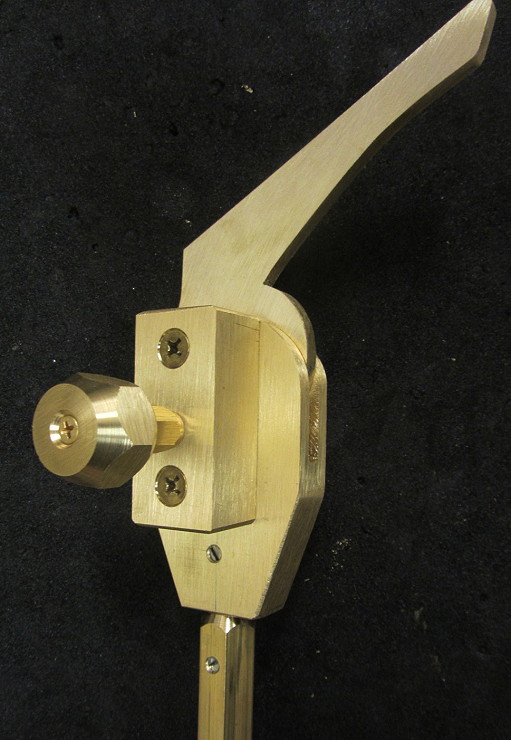
Most recently I have been trying to refine my music stand designs. I'm getting closer to something I like- I am working on two more stands-they will not be a pair this time but will have the same basic joinery. One stand will use the brass adjustment mechanism I designed and used on several stands.


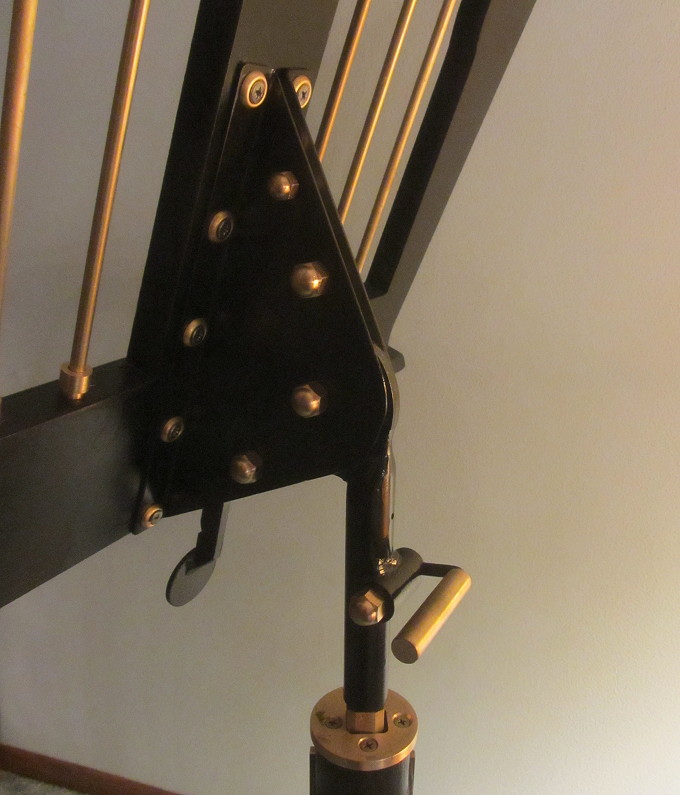
the other will utilize the new mechanism designed and built by my Dad.


I really like the function of Dad's design but it is "artistically" just too big. If I was going for a full out Steam Punk design it would be absolutely perfect. Dad's method of design was always to efficiently solve a mechanical problem. I gave him only the request to make a better functioning design. I thought I would then adjust the design in future iterations for artistic purposes.. Dad's design was based on "Random sized" pieces he had lying around-It is really a prototype-I didn't have time to work with him on refining the "artistic look" before he passed. Now-this may or may not happen. I have 6 of the mechanisms Dad designed- and I can fabricate more of my own earlier design. So I can offer two designs for potential clients-Once the "Dad design" is used up I will need to redesign the jigs he made if I want to alter the artistic form factor.

As our family sorts through Dad's things we will be deciding who ends up with what-I am apparently the likely heir to a lovely Cherry High Boy that my mother had made or bought-when were were very very young...

It is similar though not exactly like this one:


The more I ponder "owning" this piece the more I question the reason why. It's design is beautiful and the workmanship is as well-Yet it's "function" seems to have little in common with my current and expected needs. I am asking if this piece will be worth the effort required to transport it from North Dakota to Michigan. Some would want it just for it's beauty-no matter how well it can be used for our "modern" storage needs. But practicality may win the day and over ride all other justifications for a lovely piece of furniture.

I seem to be rambling a bit now.... but the skills of design vs fabrication ie execution or building do sometimes seem to be separate but I think the better one gets at fabrication the better he should be at design-It is a matter of use- One- off work comes at a price and that currency fluctuates over time.

Re: The artist comments on furniture design

#18

The Five Orders.

TomD

A lot of people refer to this article by Mack Headley. I will see if I can dig it out. It is on the FWW web site if you have access. I don't, and I just threw out a complete set of the magazines, and all of Wooden Boat and Woodworking.

I found a copy, FWW 43, for one thing there is a bibliography. I am looking to see if any of those texts are free out there. Keep you all posted.

Meanwhile, feed on this:

https://archive.org/details/ERIC_EJ1096686/page/n3

https://archive.org/search.php?query=chippendale&page=2

This book goes into the five orders, which is what Hedley was on about.

https://archive.org/details/practicalbuilder00pain/page/n45

--------------------------------------------------------------

Archive is a great resource for digging up out of print stuff from the 19th century, which quite likely would have furniture art moreso than the modern guys who idea of the golden mean is the 4x8 sheet of plywood. I was looking for information on how to make traveler's jackets. These are sports coats that are pretty much completely unstructured, and unlined. They are easy to carry and allow one to look a little more respectable when one is say backpacking. Anyway, turns out that is how jackets were made say around 1880. There are tons of books on how to tailor and cut them and structure them, from that period.

Re: The artist comments on furniture design

#19

Re: The artist comments on furniture design

TomD

Hey I remember that, I did a drawing in some other thread:


What I don't like about the piece you built is the way the eyebrows are cut through the molding. Maybe that is a standard detail. To me it ruins the flow of the molding. But I don't know hardly anything about old furniture.

Re: The artist comments on furniture design

#20

May I add this?

Clementine

MY FIL taught me this truth and I recently discovered its origin:

It is the pervading law of all things organic and inorganic, of all things physical and metaphysical, of all things human and all things superhuman, of all true manifestations of the head, of the heart, of the soul, that the life is recognizable in its expression, that form ever follows function. This is the law. Louis H. Sullivan (teacher of Frank Lloyd Wright), “The Tall Office Building Artistically Considered,” Lippincott’s Magazine, (March 1896): 403-409.

Re: The artist comments on furniture design

#21

Re: the second question is silly

Jesse Cloud

Might explain a bit about the second question to know that in this school, Fine Woodworking is in the Art Department.

Re: The artist comments on furniture design

#22

Re: The 10 Books of Architecture FREE

TomD

So here is Hedley's first recommended book:

http://www.gutenberg.org/ebooks/20239

If you don't have an EPUB reader installed, I use SUMATRA. When I download some freeware I go to WIKI and proceed from their link to avoid some of the malware folks out there. I don't know if that is smart, but it is what I do.

https://en.wikipedia.org/wiki/Sumatra_PDF

Re: The artist comments on furniture design

#23

Re: May I add this?

TomD

In certain cases, but it doesn't always guarantee perfection. So you would end up with some of the most disastrous public housing projects of all time on that basis. And then again how do you deal with ornament. Well maybe ornament goes back to the Golden Section and that is the functional repeating element in a sea shell. Sea shells are functional but kinda distant from ornamentation.

Also while FFF doesn't best explain fins on cars. Every functionally beautiful, say sports car, the designers thought they understood function, but the evolution of the automobile proved otherwise. There seems to be a built in bias to the fact that we actually understand what is functional. Like say a functionally elaborated wooden plane made in the West versus a Japanese plane. One overemphasizes the blade, and the other the handle. Some of the function of the Japanese plane relates to sediments from which they could develop great sharpening stones, which is good luck for them but points out the essentially random nature of function. Morse when he saw the Japanese plane in use clearly thought it the most basic and functional plane he had ever seen, and that Western carpenters should have taken not (had they known back then). How was he to know it evolved from the clash of cultures that led to the Westernization of Japan the banning of the sword, and the emergence of a tool fetish culture.

Or take the Japanese chisel which is clearly superior, in FFF terms, particularly in traditional times, to anything made in the west then or now. However, it could be argued that it overshoots the mark substantially. I have multiple sets of Japanese tools, but they don't add anything functionally to chopping dovetails in pine through cherry. In the sense that if you put them in the hands of someone like Klauzs, I don't think he would cut joints any faster. Even if he had to sharpen. Best thing about using them might be that by the time you learn the intricacies you have become pretty skilled with tools. Admittedly in metal work.

Re: The artist comments on furniture design

#24

Re: da Vinci  & The 10 Books of Architecture

TomD

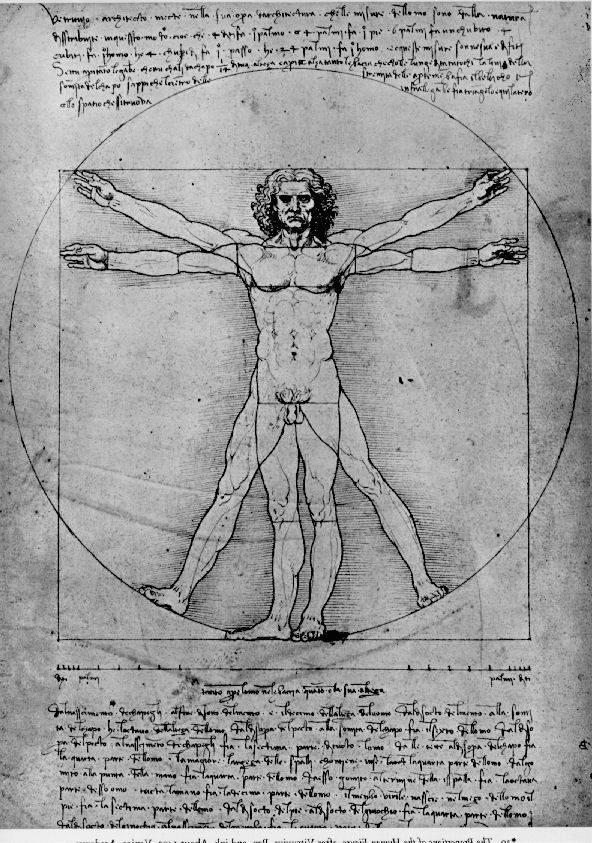
According to Hedley, da Vinci derived the proportions for this famous picture of Vitruvian Man by using the principles from the above book by Vitruvius Pollio


So Hedley goes on to show that the proportions of his card table and their ornaments can be derived from the module of greek architecture incorporated in the various greek collumn forms.

Re: The artist comments on furniture design

#25

Re: The First Point is Silly, Too

William Duffield

Consider "The emperor has no clothes."

https://en.wikipedia.org/wiki/Reductio_ad_absurdum

👍 This page answered my questions

Your vote helps other woodworkers quickly find the answers and techniques that actually work in the shop.