First time here? Did you find what you were looking for?
Support WoodCentral when buying things you need

WoodCentral Forums

Knowledge You Can Build On — Est. 1998

Coperhagen Curves vs Lee Valley bows

Posts

Coperhagen Curves vs Lee Valley bows

#1

Coperhagen Curves vs Lee Valley bows

Bill Tindall, E.Tn.

I have the Lee Valley bows and have used them on many occasions. On the plus side they are infinitely adjustable and produce a curve adequate in many cases.

On the minus side:

an arc made with mine is not exactly symmetrical about the center of the bow

they are cumbersome to hold while marking

The bow forms only one kind of arc that is neither a section of a circle or any other common geometrical form. Its shape is described by the same mathematics used in statics to calculate loaded beam deflection.

For the project I am working on I initially used the bow to design an attractive arc. When it came time to actually transfer the arc to the wood I recalled the problems of holding the bow and the fact that the curve would not be exactly symmetrical about the center. I went to the Copenhagen curve collection and in short order found a curve that closely matched the curve of the bow. I wanted to steepen the initial rise and to do so was a simple matter of sliding the Copenhagen curve along its length to achieve the desired result.

Conclusion: I think I will find good use of the Copenhagen set as a compliment to the Lee Valley bows.

Re: Coperhagen Curves vs Lee Valley bows

#2

Re: Coperhagen Curves vs Lee Valley bows

TomD

This is one of those commonly repeated inaccuracies in woodworking magazines. Bows of even stiffness produce parabolic shapes, not arcs, as Bill points out. In general, these are ugly when pressed into use where arcs are needed. If the Lee Valley bows are tapered it is still difficult get real arcs over a range of deflections, and there are more reliable ways.

1 is to use drafting ducks and splines. These are weights that hold a spline in place, one could use nails. The basic technique is to say raise the center of the a 36" spline over a base line by one inch, to form an arc of 1 over 36. This will be a parabola and not an arc. So you simply use other ducks to raise the spline so that it is a fair arc. This can be done by eye reliably, but baring that, there are simple workshop jigs that will show any change in the rate of change in an arc.

2 Another method is to know how high above a line various points along an arc will be. From the center at 100% (one inch in the example above). The first quarter from the center is at 93.4%; The next/midpoint is 73.6%; the next is 41.7%. You can plot these elevations for any line. There are a few other things about this method, but that will generally work.

3 If you have a lot of space you might use the crossed sticks method. You can probably find that online.

4 Cad is mostly what I use. Some curves are really difficult to layout in the workshop. In guitar building folks use jigs with 15', 25', and sometimes 40' radii. Sometimes these are used to make jigs only a few inches long, and they need to be accurate. In the past there was a lot of discussion over how one could do these layouts. People actually built full size tramels, but they deflect. In cad it takes about as long it does to write this sentence.

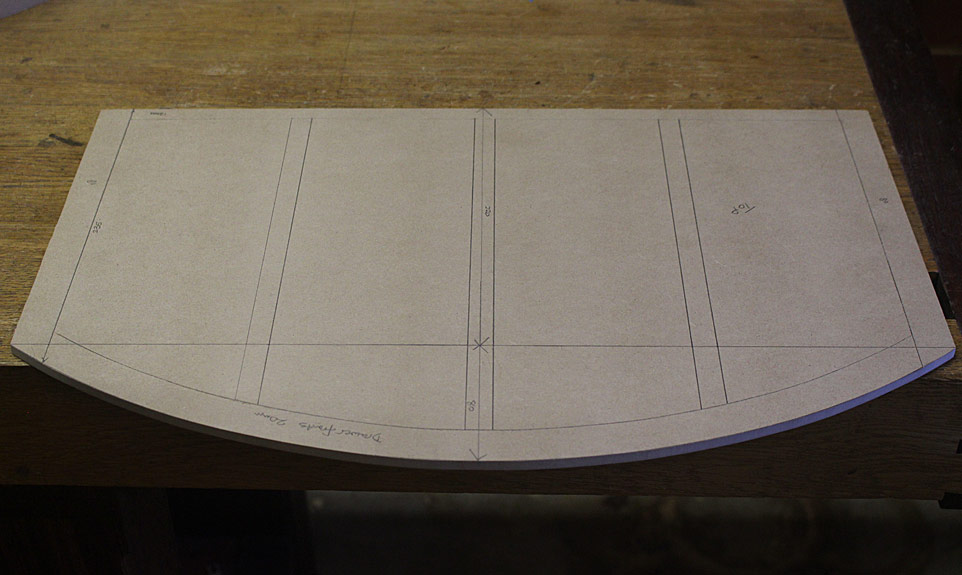
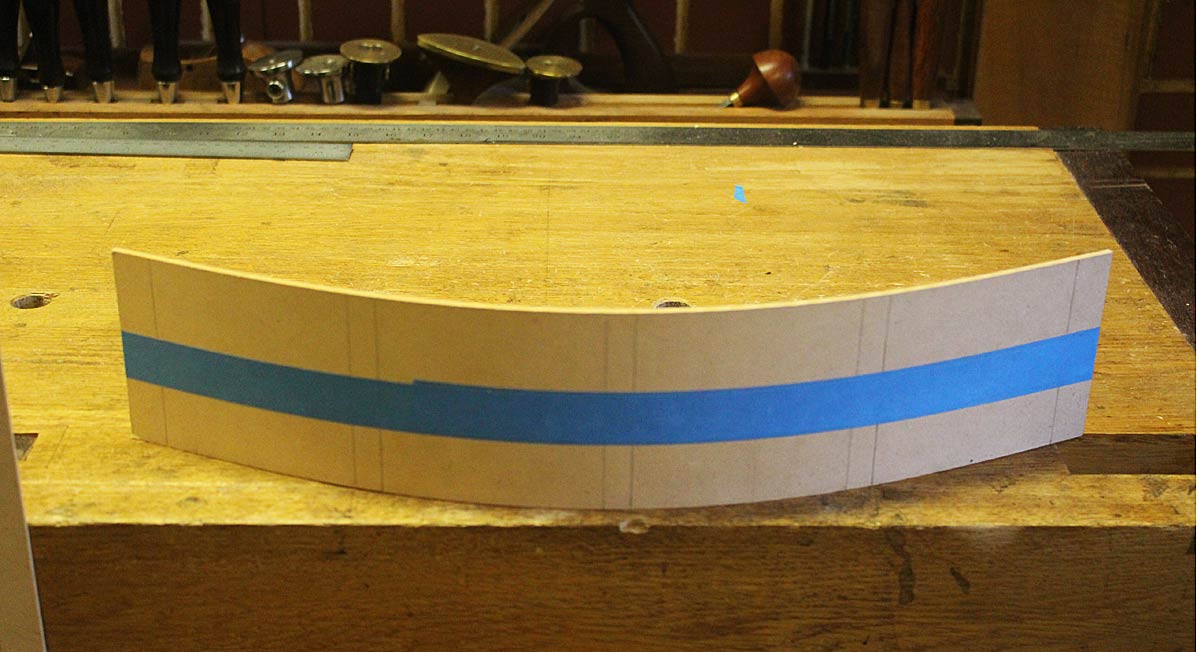
Here is a curve I worked on in CAD for a while, it has 3 pieces a side. A drop, an ellipse, and an arc. It all had to be fit in so that the web was not less than 4 inches, and that took some doing. With the end result, I will initially be able to plot full size parts for a 1' - 1" model, and later either patterns or run a cnc router. And it can be rescaled or have the aspect ratio changed ad infinitum.


Re: Coperhagen Curves vs Lee Valley bows

#3

Re: Coperhagen Curves vs Lee Valley bows

Derek Cohen (in Perth, Australia)

This is one of those commonly repeated inaccuracies in woodworking magazines. Bows of even stiffness produce parabolic shapes, not arcs, as Bill points out. In general, these are ugly when pressed into use where arcs are needed.

I agree.

Recently, when laying out the bow at the front of the Apothecary Chest, it was tempting to go with this ..


Instead, I used a trammel to draw a correct arc ...


I've been eyeing out a set of curves as well.

Regards from Perth

Derek

Re: Coperhagen Curves vs Lee Valley bows

#4

Jesper, Denmark

Re: Copernhagen Curves vs Lee Valley bows

Jesper, Denmark

I guess I should know, but I don’t.

What the hec is A Copenhagen curve?

In the lokal lingo, a “Københavnerkurve” is A Way to cut off a cyklist at A stop light😏

Re: Coperhagen Curves vs Lee Valley bows

#5

bows do not produce parabolic curves

Bill Tindall, E.Tn.

"Bows of even stiffness produce parabolic shapes, not arcs, as Bill points out."

Bows do not produce parabolas. I don't know if the bow shape has a geometrical name; not one I know about. The mathematics describing the shape is the same as that for a bending beam under center load.

Re: Coperhagen Curves vs Lee Valley bows

#7

Where the bow finds gainful employment

Bill Tindall, E.Tn.

Some disparaging words were offered about the shape rendered by a bow. I find this shape does have valid applications.


To my eye the bow makes an attractive end, or side, or both to a table. The curvature lessens as the distance from the center increases. This shape makes a smooth transition into space in the case of a table top, or into some parallel arrangement.


Another application is a "bow front" chest of drawers.

The arc of a circle will make the front of a chest of drawers or table end stick out more, for better or worse depending on the observer. Personally I like this shape as did those that invented the bow front chest of drawers.

Re: Coperhagen Curves vs Lee Valley bows

#8

nit picking

Bill Tindall, E.Tn.

"Instead, I used a trammel to draw a correct arc"

Definition- Arc

1.

a part of the circumference of a circle or other curve.

synonyms: curve, bend, bow, arch;

The word arc is not limited to describing a portion of a circle. Without allowing this broader definition some of what I wrote on this topic doesn't make sense.

Re: Coperhagen Curves vs Lee Valley bows

#9

Re: bows do not produce parabolic curves

TomD

You may be right, though I thought that was a definition of a parabolic curve. Same thing with a beam simply fixed with a load at one end. Words mater, but the point either way is you don't have a segment of a circle, which is what people thing they will get, judging by many examples I have seen in project diaries. A LV bow may be shaped to reduce the rate of change in the center of the bow, so that would be a particular case.