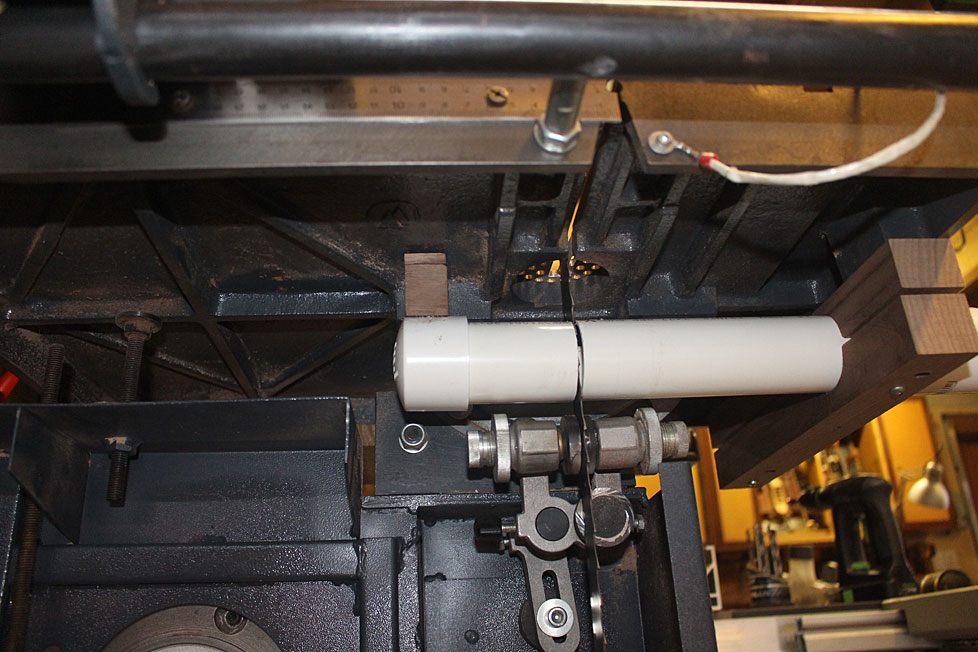
A few weeks ago Derek introduced us to a refined means of collecting dust from blade. My Delta vintage 20" saw was not designed with dust collection in mind. The port is near useless even with my Oneida sucker attached to it. There is more escapeage that collection.
Inspired I rigged with baling wire and chewing gum a 4" flex hose perpendicular and next to the blade, and just below the table. Did some resawing today and the dust collection results were a vast improvement. Thanks for the tip.
I wedged a 6" bolt into a hole in the side of the table. Stick end of 4" flex hose up against the blade and perpendicular to it to get cross flow of high velocity air. Fastened hose to bolt with cable tie. I needed to resaw and any improvement over what I had was desirable. It could be improved with a permanent and better hose holder, but realistically I will never get around to it.
There is not free room beyond the blade (left of blade from front of saw) so options are limited.
Without a lot of digging, I can't show you previous examples, but I know I've seen several band saw dust collection solutions, most of which involved building a box of some description to mount around the lower blade guide area, with a simple vacuum hose coming out the back or bottom. I'm sure I've seen such arrangements cobbled together from sheet metal and/or plywood. You shouldn't need the CFM provided by your dust collector to pick up the dust; a shop vac could be made to work.
Maybe somebody can point us to some of these rigs.
I don't know the minimum requirements for sucking most of the dust from the blade. But for anyone thinking about spending time doing something more elaborate than the simple pipe that Derek described, or the even simpler hose I described, here is the dust problem to solve.
Without dust collection we know that dust is dragged by the teeth 360 degrees around the travel of the blade and shed everywhere. This fact suggests to me that the challenge is to get enough cross flow below the wood being cut to yank this dust from the tooth gullet. The larger the saw that faster they run. The higher the blade velocity the less time this cross flow has to yank out the dust as the blade crosses the dust pickup area. So what might just work for a Delta 14" will likely fail for a larger saw with higher blade velocity.
The other problem to solve is being about to change the bade with whatever convenience is desirable.
Bill, I have been using the bandsaw dust "pipe" collector for a month now. Much of this has been on a daily basis, and had the chance to really test out the worth of this jig.
I am frankly so impressed with the results! The bandsaw has never been this clean inside! There is a minimum of dust deposited at the bottom of the cabinet.
The bandsaw is a 17 1/2" Hammer N4400. I am not sure how fast the 4 hp motor runs, but during this time it was exclusively used with a 1" resaw blade (Lenox carbide Woodmaster CT 1.3tpi).
For those that missed it the first time, this is the dust collector ..
At first it was powered by a Festool CT26E vacuum cleaner (and a 5" hose at the lower end) ...
Later, the pipe was connected by a 2 1/2" hose to the 5" hose. This worked as well, if not better.
>>>...I know I've seen several band saw dust collection solutions, most of which involved building a box of some description to mount around the lower blade guide area, ... Maybe somebody can point us to some of these rigs.
I wrote (with photos) about what I did which solved my dust problems.
In the same thread Jim DeLaney provided a PDF of his bandsaw dust collection box.
I designed mine to address the cross flow of air which I decided would help pull dust from the blade gullets. Air comes from the hole in the left side of the box as well as from behind the guides.
My box is held in place with magnets and removable without tools to change the blade and adjust the guides. The clear box make it easy to make sure nothing has accumulated around the guides. However, the cardboard prototype worked so well it was years before I got around to making the plastic box.
Saws with an extra port near the lower guides make this type of solution easier with no modification to the saw needed. The downside of the box solution is the table can't be tilted with the box in place, something I rarely do.
BTW, I've devised a similar scheme for the table saw, not yet tested. The TS, and extreme bandsaws, may benefit from a bit of compressed air from carefully placed nozzle to blow the dust from the gullets.
Of course, there is lots of variation in bandsaws, which requires custom adaptations for each model. Here is some analysis and construction of one solution to the problem from a few years ago:
I have a 14" Delta with riser block. Turns out Delta used to make a sheet metal port for it, but I don't think they still have it. I made one out of an "End Boot" for four inch duct work. It create a 2" x 10" vertical slot that hangs on the side of the saw. It hangs from an eye bolt that loops over the bolt that is the Snap for the door. There is a blast gate attached and to remove it to change the blade, you open the lower door Fiddle the eye bolt of the stud and lay the pickup in the floor. Assemble in reverse order. Does a good job. Did not require modifying the saw. Out of the way. Hooks to my DC. Also allows for the table to til to 45*, but I cant remember the last time I tilted it.
I originally cut a hole thorough the door and installed a hose there. Did not work as well and interfered with opening the door to change the blade.
I am amazed at Derek's pipe. Does not look like it would permit enough air flow to pick off the sawdust. To me it looks like it would work better without the end cap.
I have considered hooking my air compressor to it to blow across the blade to knock the dust out of the teeth. I also thought about that on my Contractors TS. I added DC to the TS by fabricating a box around the blade that drops down into a DC hose through another end boot and comes out the front of the saw so the blast gate is near the switch. My blast gates have micro switches on them that turn the DC on.
I am amazed at Derek's pipe. Does not look like it would permit enough air flow to pick off the sawdust. To me it looks like it would work better without the end cap.
Barry, I tried the pipe without the end cap. It works better with it on. In fact, I have covered the outside of the vertical slot (where the blade is located) with tape to seal it up even more, and this improved matters as well.
>>>I am amazed at Derek's pipe. Does not look like it would permit enough air flow to pick off the sawdust. To me it looks like it would work better without the end cap.
I had the same thoughts and voiced them. However, if you look at the 4th photo earlier in the thread (at the link I provided), you can see how he cut away a section of the top of the PVC pipe. That evidently provides enough air flow.
Neither my 20" Delta nor my 14" Powermatic could accommodate the collection device you employed. In both cases there are parts just to the left of the blade and almost touching it. The most I can do in both cases is to put open ended collection near the right side of the blade and just below table.