Disc sander- homemade?
Tom Norton
I think I would like to make one this winter but have a question. It is the disc construction. Have snyof you fellows built one? How did you construct the disc?
Thanks
Knowledge You Can Build On — Est. 1998
Disc sander- homemade?
Tom Norton
I think I would like to make one this winter but have a question. It is the disc construction. Have snyof you fellows built one? How did you construct the disc?
Thanks
Re: Disc sander- homemade?
John McGaw
I did it but will be the first to admit that I cheated. I needed/wanted a large disk sander for shaping and tapering the tops and bottom of Shaker boxes and went about it by mounting a piece of melamine-covered MDF to a heavy faceplate and mounted it on my lathe (coating makes it easier to remove the adhesive-backed abrasive) and fabricated a simple table of sorts to mount on the lathes's ways. Crude but effective and it has the advantage of having continuously variable speed.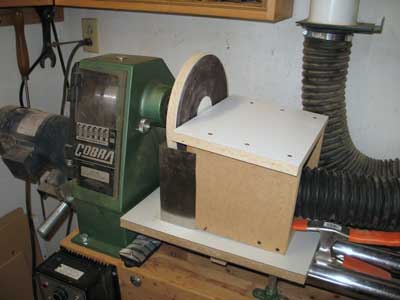
Re: Disc sander- homemade?
Tom Norton
Some of the examples show using a v belt pulley drilled out and attached to the disc. Thoughts?
Re: Disc sander- homemade?
TomD
The only one I have "made" was one I made for my table saw. I just installed the blade backward, and used spray adhessive to attach the paper. Worked great, but all I was sanding were stations for canoes so the max thickness was about 3/4". Later I bought a steel plate that was designed to be used in a table saw, and didn't have any teeth on it. And then later still I got one of those combo sanders. They are so cheap that I don't know why one would build one, which is pretty much what one can say about any project with China upstream.
The deal is you want something stiff, so normally they are say 1/2" aluminum plate, or probably a casting. If you look at what Al plate costs around here, it is probably cheaper to buy a second hand sander.
There are a lot of big faceplates for lathes, that would work, but you would need the capability to transition them to whatever shaft you are using. I have metal lathes and milling machines, so I don't have a problem there.
Disc sanders are great, because the surface rotates at different speeds down to 0 in the center, it a dynamic fence were you can index off the slow material and cut on the fast. There is this one guitar maker whose whole production line is about half disc sander jigs.
Re: Disc sander- homemade?
John McGaw
I'm sure that such an arrangement could be made to work given two stout pillow blocks for the shaft (or some other means of bearing support but lacking a machine shop the blocks are probably the easiest) and some accurate spacers between the pulley and disk to keep the belt from rubbing. The bearings will need to be as far apart as possible within design constraints to ensure that the shaft has no chance to wobble. But as I wrote, I was looking for quick and dirty so the lathe was the obvious choice since it has most of the requisites already in place.
Re: Disc sander- homemade?
Derek Cohen (in Perth, Australia)
Tom, I will be the dessenting voice: it is not worth the effort.
I have had a small 6" x 9" combo disk/belt sander for at least 15 years.
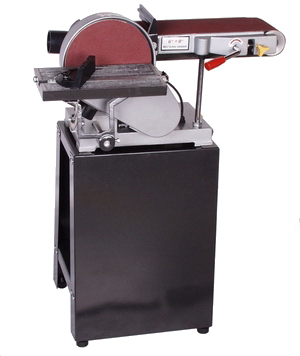
For many years I used the 9" diameter disk sander to shape end grain. The 6" belt sander was largely unused. One day, out of curiosity, I raised the belt vertically and added a horizontal platform in front of it. This was so much better as a sanding tool. With the disk sander, you get uneven scratches, plus the speeds are uneven across the face. With the belt, the scratches are uniform and vertical. Control is so much better.
Forget a disk sander and, if you insist on building something, create a vertical belt sander instead.
Regards from Perth
Derek
Re: Disc sander- homemade?
Dick Coers
My opinion is the ONLY reason to make one is to be able to run the disc at a slow speed. The purchased disc only machines, run way too fast for my taste. Really all hobby machines run too fast for my taste. I worked in an Industrial Design model shop. The 20" disc sander was a very commonly used tool. But, even the industrial machine ran too fast and we would cycle the motor on and off to achieve some precision work. I'd suggest using a VFD on any DIY or purchased machine for variable speed.
Re: Disc sander- homemade?
Ray Mtn. Home Ar.
I built one with a 24 X 1/2 aluminum plate. Mounted it on the output shaft of a 1 H.P. DC motor. It runs off a variable speed controller. I'll try to find a pic of it later.
Re: Disc sander- homemade?
Mike in Zuni Va
Google homemade disc sander. Your hardest decision will be which one to make.
Mike in Zuni Va
Re: Disc sander- homemade?
Larry
There was a nice one some time back in Shopnotes
Tom, how will you use it?
John K Jordan
>>>Forget a disk sander and, if you insist on building something, create a vertical belt sander instead.
Like many things in the shop, how you use it might make a difference. I have three disk/belt sanders of various sizes. The one I use the most has a 10" disk and a 6" belt. I tried the belt vertical and far prefer it horizontal for what I use it for.
But the 10" disk sander works better than the disk for several things I commonly do.
Another one has a 6" disk and a 1" belt. I prefer the belt in the vertical position, again for what I usually do with it. (It's easy to switch)
I though about making one for the lathe and the slow speed is appealing, but it seems the dust would be a problem. The 10" disk/6" belt has pretty good dust collection with a 4" port.
JKJ

^^^Best Suggestion^^^^
Re: Disc sander- homemade?
AZ in Colorado Springs
I made something very similar to that, but the top can swivel down to create miters.
I put a piece of 1/2" MDF on a faceplate. Plenty stiff. I use 12" diameter adhesive backed sanding discs from woodcraft.
It works great. It's about four years since I made that. Someone commented that the sanding dust would wreck the lathe bearings, but that's not been a problem.
dust at the lathe
John K Jordan
>>>Someone commented that the sanding dust would wreck the lathe bearings, but that's not been a problem.
Hmm... Dust from a disk could be a big problem for the lungs and a nuisance in the shop but I can't imagine it being a problem for lathe bearings. If so, there would be a lot of wrecked bearings since some people make clouds of dust with power sanding at the lathe and some don't use use any dust collection.
With over a 1/2 century history of asthma, I wear a respirator when making any kind of dust. I like this type:

Inexpensive, comfortable (I think), and excellent filtration without restricting air flow. I keep several sizes in the shop for visitors.
JKJ
Re: Tom, how will you use it?
Derek Cohen (in Perth, Australia)
John, if I was to purchase or build a sanding machine, it would be one like this, rather than a disk sander ...

There is just no way that a disk sander can offer the same even sanding pattern or squareness for edges.
After using a disk sander for many years, and even at one time planning to buy a large version, I am blown away with the ease of use and finish off my 6" vertical belt.
Regards from Perth
Derek
agree with John
Bill Tindall, E.Tn.
My preference parallels John's. The fact that Industrial strength 24"? disk sanders are built and bought suggests that a vertical belt is not universally preferred.
I have a 12" disk with 4 x 48 belt. I use both formats about equally. I don't experience the limitations with the 12" disk that Derek describes. I find the varying speed across the 12" disk a significant advantage.
Re: dust at the lathe
Don Stephan
Are these vet students getting residuals every time one of their pictures is used? 
vet school subsidies
John K Jordan
>>>Are these vet students getting residuals every time one of their pictures is used?
Oh yes. Fame and fortune. Or maybe fame. Or at least free wood and shop time and the joy of hanging out with me. (Yeah, right) I'll ask next time they come - this week they are both immersed in semester final exams.
In the interest of gender equality, here are some pictures of some others, but unfortunately not preparing to make sanding dust.


JKJ
Video
Derek Cohen (in Perth, Australia)
Came across this today.
Here's a video of a vertical belt sander. Take note of the comment made at 7:30 about the 12" disk sander alongside.
https://www.youtube.com/watch?v=-rSXxgzaAcg
Regards from Perth
Derek
Interesting video
John K Jordan
That sander would be an incredible tool for the shop. Unfortunately, one or two of us hobby types may not have one of that quality. Mine has a dinky "table" for the belt that doesn't even have a miter slot, but it does have a good cast iron table on the disk.
I use the disk to round corners instead of the belt as shown in the video. Besides having a real table, the table on a combo sander is typically lower for the disk than the belt making it easier to see when sanding to a line. But I'm not surprised that some people have trouble with the disk if they don't understand how to use it. (I heard an unbelievable rumor that some don't even read the manual... [gasp])
The disk on mine, properly used, excels at certain tasks such as squaring and sanding end grain on a 2x2 for a perfectly flat. I often use the belt to simply sand the flat sides of turning squares and blanks for auction or gifts to make them easier to see the actual color, figure, and evaluate the blank for defects. (Fact: each process step can increase the value to a potential bidder at the wood auction - compare a chainsawn chunk of log with bark to a stack of smooth-sided turning blanks with beautiful figure and no visible defects.)
The disk is also ideal, for me, to smooth bandsawn curves of these blanks before turning. I also run blanks like this through the drum sander so I can better evaluate to make final decisions before turning. I far prefer to avoid avoidable surprises after committing to, for example, which side of a blank will be the top.

to make this kind of thing

JKJ
Re: Interesting video
Bill Tindall, E.Tn.
I have a traditional Delta 6 x 48 machine. I bought it to make(years ago) reproduction Tackle Blocks like what was being salvaged from Liberty Ships, but no longer available. I sanded miles of arcs with the disk. Never considered this approach had any shortcoming. Delta didn't make this machine hoping someone might find both sanding formats optimum for various tasks.
Huge disk-only machines were common in furniture factories. It is unlikely someone on UTube came up with a better idea for whatever these machines were used for. Maybe Derek has not discovered the benefit of adjusting the abrasive velocity by simply adjusting the position on the disk, or that the disk is dead flat unlike a belt that may have more or less curl at the edges.
I used to adjust miters with the disk until I discovered shooting boards.
Re: Interesting video
Derek Cohen (in Perth, Australia)
Bill, my combo machine is, as mentioned earlier, a 6"x9" (6" wide belt and 9" diameter disk). The machine is built from cast iron and has a 3/4 hp motor running at 1450 rpm.

I have used the disk for many years and have a reasonable touch on it. What I dislike is that it cuts very aggressively and will burn wood if not careful. The disk does not have a large working area (one effectively can only use one side), and the degree of sanding varies across the surface (minor sanding at the centre, and increasingly aggressive as one moves to the outside).
The belt sander sports a MDF platform on top of the adjustable table (it switches around from the disk to the belt). The belt sits absolutely flat on the platen. In any event, I sand on the centre third. The belt sander has an even removal of waste, and the slower speed plus long belt reduces heat to a minimum. There is no burning of end grain.
Regards from Perth
Derek
Re: Interesting video
Ian Neuhaus
9" disks are a piss-poor alternative to a 24" or, better yet, 36" disk.
with the larger disks -- we had a 24" one at tech -- you do indeed get a usable range of speed across the face of the disk, and a fence to set to the miter angle.
I can easily see where a 6" or 8" belt would be preferred over a 12" disk sander.
Re: Video
Kneale Brownson
I have that belt sander without the disc. There is a miter gauge and slot in the table and the end cover comes off for inside rounding. It has fair dust collection through a port.
I do disc sanding on a combo disc/small belt machine.


