Home Articles Forums Gallery Marketplace Videos
Have a question? Ask Woody!

WoodCentral Forums

Knowledge You Can Build On — Est. 1998

Proposing an experiment as salt substitute

Posts

Proposing an experiment as salt substitute

#1

Proposing an experiment as salt substitute

Bill Tindall, E.Tn.

I wonder if a sprinkling of #8 lead shot would embed and keep pieces being glued from skidding? The lead would be harmless to saw blades or anything else that encountered them. Easy to obtain. If a 25 pound bag was not available in the shop one could just buy a box of shells and cut the ends off to free the shot.

Will try it when I get a chance, or someone else can.

Re: Proposing an experiment as salt substitute

#2

Re: Proposing an experiment as salt substitute

Don Stephan

Couldn't lead shot act like ball bearings until forced into the wood? Response to a general Internet query found two sites saying salt crystals are cubic.

Re: Proposing an experiment as salt substitute

#3

Re: Proposing an experiment as salt substitute

Don Evans

What about finely ground Mica which can be purchased at hobby store, come in lot of different color, not that that is important in this application.

Don

Re: Proposing an experiment as salt substitute

#4

Clint Searl

Re: Proposing an experiment as salt substitute

Clint Searl

Or the little glass beads used in reflective paint.

Re: Proposing an experiment as salt substitute

#5

JL

Shark Grip paint additive *LINK*

JL

It consists of small plastic spheres. I have used it with polyurethane as part of a non-skid coating for an indoor ramp. When I salvaged the ramp after a few years, it was quite easy to cut the wood and plane it without damaging any planer blades.

I don't know if the spheres would be too large. They are really small though and suspend well in polyurethane, paint and other things. They would suspend well in glue.


Shark Grip

Re: Proposing an experiment as salt substitute

#6

Re: Proposing an experiment as salt substitute

Derek Cohen (in Perth, Australia)

I wonder if a sprinkling of #8 lead shot would embed and keep pieces being gluedIfrom skidding?

Might impact on the advantages of a rubbed joint, Bill :)

Regards from Perth

Derek

Re: Proposing an experiment as salt substitute

#7

Re: Proposing an experiment as salt substitute

Ralph Lipeles

I thought that lead in shot was replaced with steel to reduce negative envitonmental impact on birds and other animals that might ingest the lead.

Re: Proposing an experiment as salt substitute

#8

only the case for waterfowl hunting

Bill Tindall, E.Tn.

The problem was at "Refuges" (where the birds were lured to get shot) where concentrations of hunters shooting in limited areas accumulated significant shot on the bottom where birds fed. A bird ingesting larger shot treated the shot as gizzard stones for grinding up food. Shot plus stones resulted in the shot being ground to form enough soluble lead to affect the bird. Elsewhere the incidence of a bird picking up a shot was nil.

Never-the-less lead shot was banned for water fowl hunting. It could be practically banned because hunting migratory waterfowl is regulated Federally. It is doubtful that many states would have passed the lead ban. Various replacement shot metals are available including steel and bismuth. Steel shot is less effective in killing waterfowl than lead, among its disadvantages. It is unclear to me whether the incidence of steel shot wounded birds eventually dying is less than death from lead injection.

Re: Proposing an experiment as salt substitute

#9

Re: Proposing an experiment as salt substitute

John McGaw

I can't really say that I've had a lot of problem with "skidding" in real-world situations. The few times I've had to tackle it I just tapped a tiny brad into the wood and snipped the head off with diagonal cutters providing an anchoring point. If I was worried about saw blades (why would you be cutting the joint is beyond me but that is just me) I guess I could tap in a copper tack from my Shaker Box supplies and snip it off with the same results.

Re: Proposing an experiment as salt substitute

#10

I would have to agree

Bill Tindall, E.Tn.

Thanks for the dose of reality.

On the rare occasion that I need to eliminate skidding, or a take-on-and-off repositioning situation, I just use 2-3 tiny brads. I have on rare occasions sawed a joint apart. The occasion where I used a brad and needed to saw apart would be like odds of winning the Powerball Lottery. And I am not sure that 3 tiny brads would have any adverse effect on a saw blade. I don't think brads are hardened like pin nails. For those worried the copper tack would eliminate concern. I'll forget the shot experiment.

Re: Proposing an experiment as salt substitute

#11

Re: Proposing an experiment as salt substitute

Sgian Dubh

From time to time Bill, I've sprinkled a few grains of very fine builder's sand between parts that might slip. It works well. And, to be honest, I've not ever worried about the sand subsequently blunting cutting edges. There's too little sand for it to be a significant concern, at least to me.

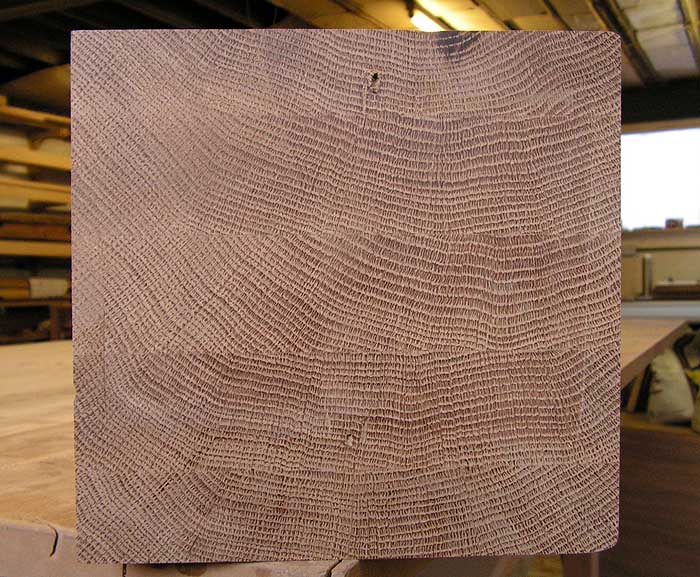
However, drifting away slightly from your original topic title, I've quite often needed to make larger columns or pedestal leg type structures out of layers (laminates) of wood glued together. Below is an example from a refectory style table that finished up 225 mm (~9") square prior to subsequent shaping. My methodology is to cut all the pieces to the same length some fifty or so mm (~2") longer than the planned finish length, line each part up dry to its partner below, bore clearance and pilot holes to guide the screws, and drive a screw at each end at an angle through the end grain of the upper piece into the laminate below. I build the complete dry stack like this, then disassemble the lot, apply the adhesive and screw all the laminates back together again (or do the reassembly in a couple of glue-ups if necessary) and apply as many G clamps, F clamps, whatever other clamps I have to hand as I can get on to the glue-up.

In the image below of a table pedestal lamination after it was glued and cured, then cut to length, it's still possible to see a couple of screw holes that weren't completely removed at the finished length. Slainte.

Re: Proposing an experiment as salt substitute

#12

Re: Proposing an experiment as salt substitute

AZ in Colorado Springs

I've done something similar for table legs. Cut boards long then drill clearance holes for a nail through all but the bottom board of the glue up. Apply adhesive, stack the boards, use the nails (at each end) for alignment with a light tap into the bottom board, and clamp it.

After the glue sets up, or the next day, it's simple to pull the nail.

×
WoodCentral
× Share

Share on

✉ Email this page