WoodCentral Forums

Est. 1998 — 27 years of woodworking knowledge

Installing drawer stops

Posts

Installing drawer stops

#1

Installing drawer stops

Bill Tindall, E.Tn.


In a traditionally made drawer (one where the bottom slides in from the back) it is a trivial matter to install drawer stops that accurately position the drawer front relative to the face of the cabinet.


The drawer is wedged in place and the stop is installed against the back of the drawer front with a rub joint. Two stops are installed for a wide drawer, one for a narrow drawer. I add two small brads after the glue is cured in case the glue fails in a century or two.


Re: Installing drawer stops

#2

Re: Installing drawer stops *LINK*

Derek Cohen (in Perth, Australia)

That looks neatly done, Bill. This installation does depend on having the back of the cabinet open, as well as the drawer bottoms out of the drawers.

A while ago I posted the drawers stops I designed for the apothecary chest, which were installed at the end of the build, after the back and drawers were completed. They are adjustable.


Regards from Perth

Derek


http://www.inthewoodshop.com/Furniture/ApothecaryChestTheDrawersAreDone.html

Re: Installing drawer stops

#3

Re: Installing drawer stops

John in NM

Adjustable is sometimes preferable, but I've found that it is often best to get things in the right place and allow no freedom of movement. I guess it comes down to the question of whether there is a way to organize assembly such that you have access to the back of the casework to fix the drawer stops where they go.

I came to this way of thinking at the day job, where degrees of freedom are the bane of my working day - it seemed like half of the first two years at this job I spent fixing un-necessary adjustments that had slipped and caused a problem (usually a safety interlock that then prevented normal operation of the telescope). So I now see the value in minimizing adjustments if you can possibly just put things in the correct place the first time. That is a rather long way of saying that I have really learned to appreciate it when things will not require tweaking in a few years - or beyond a couple hundred thanks to some brads! :D

However, I do appreciate seeing your solution, even if I would not choose it myself. There are probably only a handful of posters here (and I'm not one of them!) who produce the quality and quantity of work that you and Bill regularly put up for discussion, so hat's off to you both :D

Re: Installing drawer stops

#4

Re: Installing drawer stops

Don Stephan

A solution I saw years ago is a small L shaped stop mortised into the front drawer blade. The instructions were to make the stop slightly wider than necessary, and then carefully shave with a block plane until the drawer front stops at the desired place. On almost every drawer I use a pair of these stops. I make through mortises and attach the stops with hide glue so removal is possible in the future if necessary.

As long as the mortises are made before the drawer box is assembled, the stops are easily inserted and shaved afterwards.

Re: Installing drawer stops

#5

Amen

Henry (Raleigh NC)

"However, I do appreciate seeing your solution, even if I would not choose it myself. There are probably only a handful of posters here (and I'm not one of them!) who produce the quality and quantity of work that you and Bill regularly put up for discussion, so hat's off to you both."

Amen to that! Thanks Derek and Bill.

Henry

Re: Installing drawer stops

#6

back access not essential

Bill Tindall, E.Tn.

Any drawer that has access from above or below can have a stop rubbed into position. I, in fact, usually install them this way because it is a long reach from the back for my short arms. Where the procedure won't work is with drawers that do not have removable bottoms.

A drawer without a removable bottom will be harder to repair when it gets worn in a century or two, so removable bottoms are desirable. I would argue that they are easier to make than fixed bottoms, at least for any drawer larger than a jewelry case drawer.

Re: Installing drawer stops

#7

Screw choice

Bill Tindall, E.Tn.

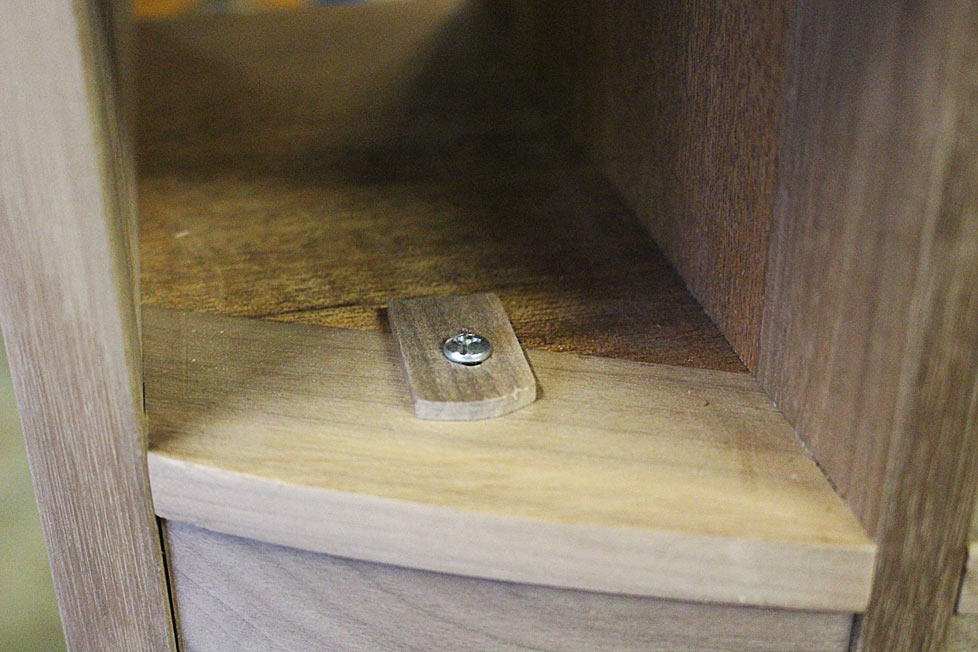
The screw you pictured I would call a "confined screw". They are commonly encountered when installing a top, as well as the situation you picture, and others.

Confined screws can be difficult to get securely engaged with a screwdriver. I find it hard under any circumstance to securely tighten a Phillips head in hardwood. In these confined situations I use "Roberts" or square drive screws. The design resists cam-out, something that Phillips are designed to do.


In a confined space I drive these screws with a 1/4" drive ratchet as shown. As little as 2.25" of clearance is needed above the screw head.

👍 This page answered my questions

Your vote helps other woodworkers quickly find the answers and techniques that actually work in the shop.