Home Articles Forums Gallery Marketplace Videos

WoodCentral Forums

Knowledge You Can Build On — Est. 1998

Have a question? Ask Woody!

Life Cycle bee questions/observations

Posts

Life Cycle bee questions/observations

#1

Life Cycle bee questions/observations

Barry Irby

I am replacing the windows in my house. On the north side I pulled the trim off and removed the old window. Then I rip the old cedar trim down and use it as filler under the new window. This time I hit a tunnel made by wood boring bees, what I call bumble bees. At least 19 bees came out. I know that because I killed 15 and at least four got away.

The tunnel was about 24 inches long and the bee drilled straight into end grain and stayed abut 1/16 to 1/8" from the surface. I knew the bees were working on the north/coller side of my house. I always thought the female drilled the holes and deposited several larva in there and then they would hatch and emerge. It never occurred to me there would be a whole colony of them in a single hole.

Anybody know more about this than I do? The next step is to install vinyl siding. Any thoughts on eliminating the bees?

Re: Life Cycle bee questions/observations

#2

Re: Life Cycle bee questions/observations

del schisler

they drill a 3/8 hole in the wood , what i did was wait tell dusk , most or all will be in the hole , spray some killer spray and drive a 3/8 dowel rod in their , that will take of that nest, if you want cut off dowel rod and sand down worked for me

Re: Life Cycle bee questions/observations

#3

Re: Life Cycle bee questions/observations

Don Stephan

The absolute first step is to identify the type of bee. Since you have 15 dead ones an Internet search should provide a fast identification.

I don't believe bumblebees bore in wood, and I've read that the typical nest, started by a solitary queen in the spring, is outdoors. The only bumblebee next I've encountered was in a pile of shredded leaves stacked the prior fall.

Re: Life Cycle bee questions/observations

#4

Pretty sure the holes are 10mm....

Barry Irby

Just kidding, thanks for the Idea.

Re: Life Cycle bee questions/observations

#5

Re: Life Cycle bee questions/observations

Barry Irby

I will research them. After my frenzy of killing them I felt bad, or at least had mixed emotions, they were slowly destroying my house.

Re: Life Cycle bee questions/observations

#6

Carpenter bees

Dick Coers

I get them around my garage every year. So far I've taken no measures against them, we live a fairly natural life style. But when it comes to me getting spider bites, then it's time for war. It's been a bad year for me getting bit. Had a horrible looking bite on my ankle, pretty sure it was a spider. Almost went to the doctor, but nearly healed now.

Re: Life Cycle bee questions/observations

#7

Re: Life Cycle bee questions/observations

Keith Newton

Yes, Carpenter bees. They have a more or less bare abdomen, while Bumblebees aremore hairy, and are ground nesters. The females do all the work, and can sting, but the males which hang out buzzing at intruders can’t sting.

They are important indigenous polinators, and should be left alone whenever you can.

Re: Life Cycle bee questions/observations

#8

Re: Pretty sure the holes are 10mm....

Jesse Cloud

If they bees are drilling metric holes, they must be Canadian. ;)

Re: Life Cycle bee questions/observations

#9

Re: Life Cycle bee questions/observations

John K Jordan

You might have opened the wood just as the batch of new carpenter bees were about to exit. I once ran into dozens behind a board in the barn where the females must have laid their eggs in sawdust and old hay accumulated in a hollow.

I understand carpenter bees will try to come back to the area where they hatched so you can look for them next year. They will reuse the same holes for years, tunneling more and more until the wood is mostly hollow. You can discourage them by waiting until they have exited the holes then stuff them with steel wool and caulk over them. (The caulk won't stop the bees but the still wool will.) You will have to watch for them next year.

They are so destructive to the house and barn I personally get rid of that generation permanently and see almost none the next few years. However, I've heard several stories recently of people hanging a stuffed paper bag near where they nest. This evidently resembles a hornet's nest which keeps the carpenter bees away.

We are fortunate to have a large population of the non-destructive bumble bees and honey bees for pollination. I keep beehives primarily for that.

JKJ

Re: Life Cycle bee questions/observations

#10

Re: Carpenter bees

Lee Schierer in McKean, PA

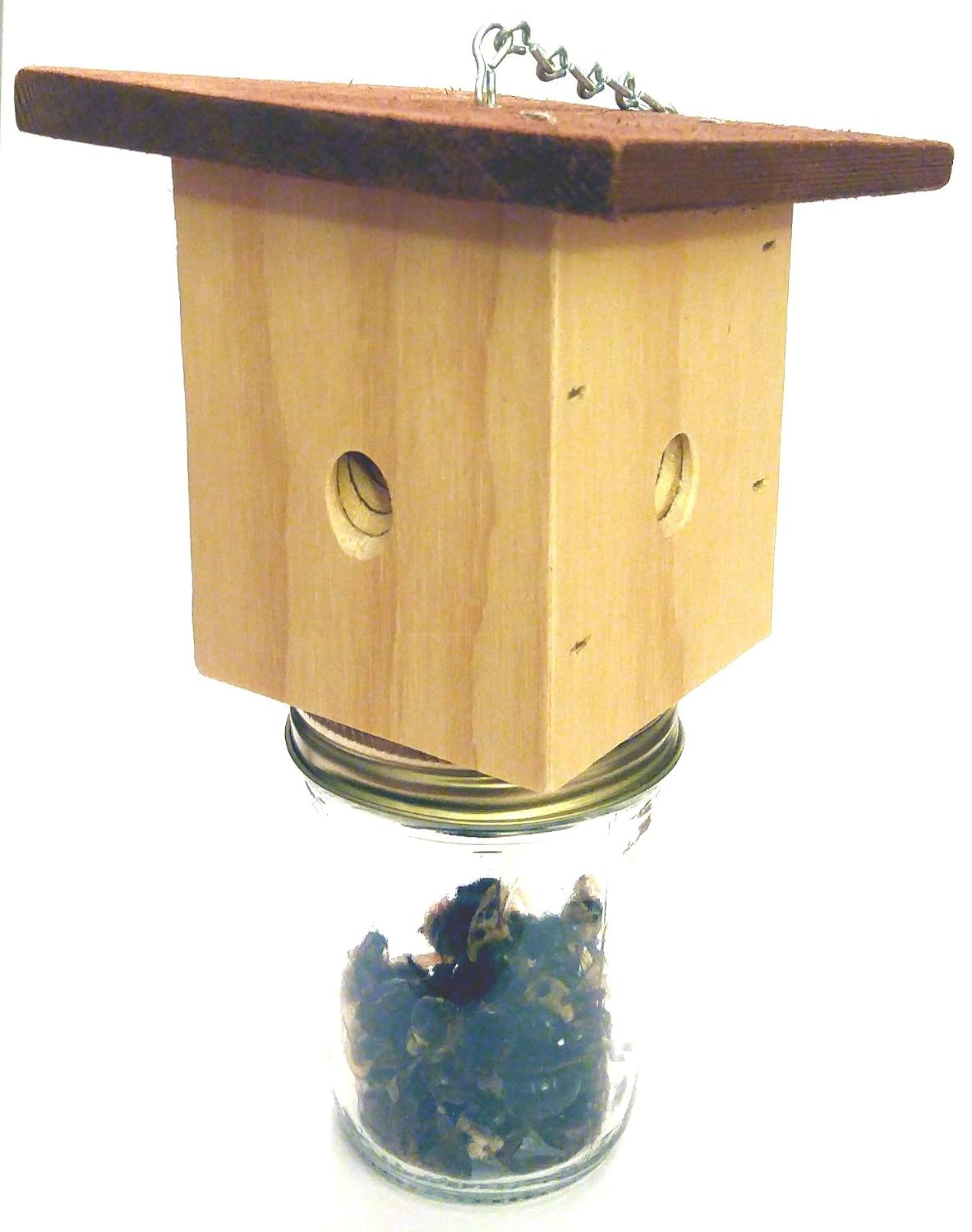
These carpenter bee traps really work. We had some installed at our church and they caught dozens of bees that were chewing on the church timbers.


Re: Life Cycle bee questions/observations

#11

Explain that trap please Lee

Tim Greif - West of Chicago

I'd love to know the details of that trap. I get carpenter bees boring holes in the bottom surface of my deck rails, but never in my cedar siding. Not sure why, but someone told me they leave painted/stained surfaces alone.