Home Articles Forums Gallery Marketplace Videos

WoodCentral Forums

Knowledge You Can Build On — Est. 1998

Premium Live Edge Slabs, Hand-Selected in the Berkshires. Shop Unique Hardwood Pieces.

A question for experienced dovetailers

Posts

A question for experienced dovetailers

#1

A question for experienced dovetailers

Bill Tindall, E.Tn.

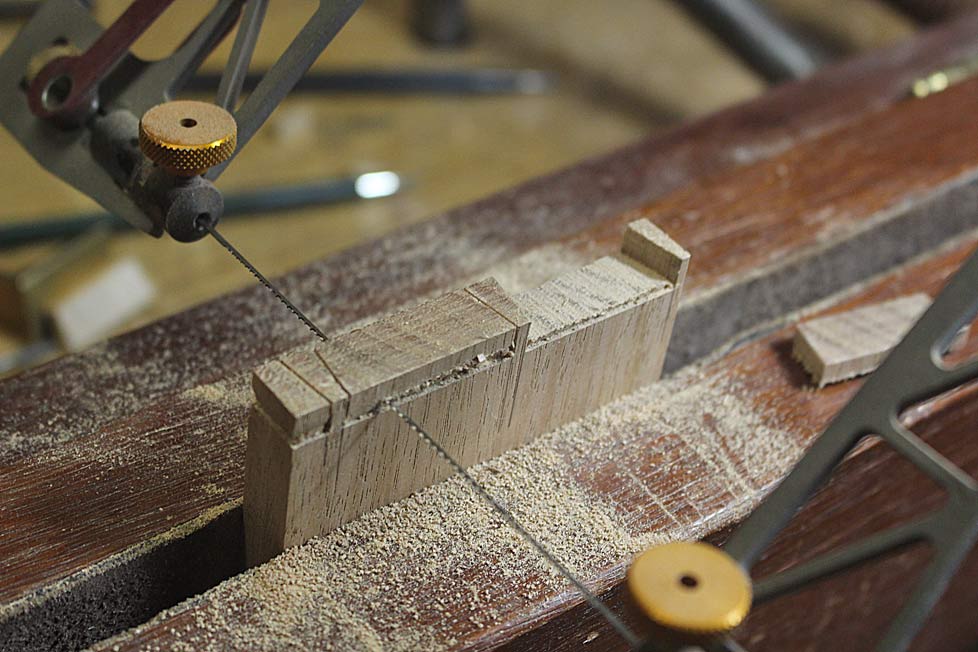
A question directed to those that have done enough dovetails that they have settled into choices for tools ......


What size chisel do you use to chop out this sort of waste? Wider is less positions to set the chisel to remove the waste, but more force on the chisel that could lead to baseline encroachment. Other factors? What is your optimum?

I am gravitating more narrow, shrinking from 7/16" to this experimental 3/8" Narex for the task at hand. And then I recalled Will Neptune using a 3/8" chisel for similar tasks.

Re: A question for experienced dovetailers

#2

Re: A question for experienced dovetailers

Sgian Dubh

Start with a narrow chisel to chop back to the base line between every pin, say 6 mm. Then switch to a 10 mm or 12 mm chisel using the slot cut by the 6 mm to the base line to register it on, again in the space between every pin, then work up to whatever width is needed for final paring, e.g., 25 mm or wider.

The reasoning is that a narrow chisel will chop successfully across end grain all across its width, and once an opening is made then each successively wider chisel has only to chop a narrow end grain section of wood whilst still being able to use the existing registration of the shoulder line as its guide.

Typically when chopping out waste between pins I have between four and six chisels readily to hand. Slainte.

Re: A question for experienced dovetailers

#3

Re: A question for experienced dovetailers

Don Stephan

I'm a bit slow on the uptake sometimes, Richard. So one whack on the 6 mm, use that "recess" to register half the 10mm and give it one whack, same with 16 mm and so on until you are using a chisel that pretty much spans the area between pins? Sounds interesting.

While we are talking chopping dovetails, Richard, do you have a way to avoid breakout in the middle of the board, or just ignore it?

Re: A question for experienced dovetailers

#4

Re: A question for experienced dovetailers

Derek Cohen (in Perth, Australia)

Bill, it seems that your question is two-fold: how does one take bigger bites without pushing back the baseline?

In my recent posts on dovetailing the Apothecary Chest, I made a big deal of creating knife or chisel lines whenever possible. They may appear to be extra work, but what they do is prevent the knife line being pushed back, and in the end they lead to cleaner work with less stress. That has got to be good :)


I also always remove most of the waste with a fretsaw after creating the knife wall (it is easier to create the knife wall before fretsawing the waste) ...


Link to the post on the Apothecary Chest: http://www.woodcentral.com/woodworking/forum/handtools.pl/page/2/md/read/id/488035/sbj/apothecary-chest-through-dovetails-on-a-drawer/

Now we come to the choice of chisel! I use a 3/4" chisel to remove the waste. Wider than this, and it is too much effort, plus you run the danger of damaging the edge. Narrower than this, such as 1/4", and there is more chance of the chisel twisting and creating a gouge in the baseline. I may use a 1/4" chisel alongside the pins because narrow chisels will plunge more easily, and there is more control needed in this area. Generally I just use the same 3/4" chisel for all work on pins.

While in the recent posts I wrote of "tenting", that was an experiment. I advise chopping straight down, half way, and doing so in fine thicknesses (1mm). This will minimise damage to the chisel.


The tenting" method is something I do advise, but for the tails, since it is easy to plunge through an take out the baseline on the other side. lAngle the chisel slightly from each side, and then pare away the slight rise in the centre ...


Regards from Perth

Derek

Re: A question for experienced dovetailers

#5

Re: A question for experienced dovetailers

Brian Holcombe

Full width. I chop the heavy cuts with the bevel toward the baseline. Final cut is back against he baseline.

Re: A question for experienced dovetailers

#6

Adam of Oakland

interesting choice, brian h.

Adam of Oakland

i will try that next time.

to me, it seems like it allows is aggressive pruning towards the baseline, and then once you're close enough to not push through the baseline, you can pare/chop the minimal waste.

thanks for sharing

Re: A question for experienced dovetailers

#7

Thats what I was taught...


Re: A question for experienced dovetailers

#8

Re: A question for experienced dovetailers

Sgian Dubh

"So one whack on the 6 mm, use that "recess" to register half the 10mm and give it one whack, same with 16 mm and so on until you are using a chisel that pretty much spans the area between pins? Sounds interesting."

Not quite as you describe Don. Derek's photos in a later post serve as an illustration. He's cut close to the cutting gauged shoulder line (aka base line with some people). How far this cut is from the shoulder line dictates the position of the first cut with a narrow chisel, but the idea is to pare back to the shoulder line with it, whether in one pass or several all depending on how much material has to be removed and the hardness of the wood.

One thing I forgot to mention is I rarely use a mallet in final paring like this. With the piece lying flat on the bench, on a sacrificial board, e.g., MDF, I hold the chisel as if it's a pen or pencil in my right hand (I'm mostly right handed) for precise positioning, and my left hand wrapped around the chisel's handle, with my thumb resting on the end of the handle. Then I simply lean over, tuck my left thumb into my right shoulder and use my body's weight to push the chisel through the wood.

Once the opening is created I grab wider and wider chisels to extend the opening to the corners. I generally only cut from one side, i.e., the outside 'show' face relying on my ability to judge perpendicular to that face for a clean cut. I'm not fond of paring from both sides because it's more time consuming than I like. Dovetailing is a bit of a boring job so I prefer to get through it as fast as I can.

"... do you have a way to avoid breakout in the middle of the board, or just ignore it?

Use a sharper chisel, take smaller cuts, don't aggressively whack a too dull, too wide chisel with a mallet. Slainte.

Re: A question for experienced dovetailers

#9

Jack Guzman from Maine

Re: A question for experienced dovetailers

Jack Guzman from Maine

I always use the closest chisel to the width of the baseline. Also I cut into the baseline first with a sharp blade then lever out a thin piece of wood leaving a shelf to hold the flat of my chisel against. ---Jack

Re: A question for experienced dovetailers

#10

Same here...

John in NM

Like hand cutting a mortise.

Re: A question for experienced dovetailers

#11

Re: A question for experienced dovetailers

Bill Tindall, E.Tn.

A professional, with an impressive pedigree, member of our woodworking club does the same, so you are in good company. I tried it but I am probably too stuck on what I have been doing to change unless change provided a leap in ease.

Re: A question for experienced dovetailers

#12

clarification

Bill Tindall, E.Tn.

"Full width"?

The tail waste, an independent variable, can be tailored to some preferred chisel width and it is usually less than 1/2".

However, I specifically asked about pin waste, the width of which is a dependent variable, and typically winds up 1 or more inches long, and not the same on either side. To get specific, for example, if the pin waste for the back of a drawer is 1.78" on one side and 1.57 " on the other, what chisel, or chisels, would you employ? (refer back to Derek's or my pin board, where full width seems impossible).

Re: A question for experienced dovetailers

#13

Well, no, and some clarification

Bill Tindall, E.Tn.

"Bill, it seems that your question is two-fold: how does one take bigger bites without pushing back the baseline? "

Anyone that is an experienced dovetailer has adapted some technique that works for them for preserving scribed baselines. While it is informative, especially for the undecided, the different ways people solve this problem, that was not the focus of the question.

The question is specific for wider than most chisels pin board waste. Do you opt for the advantages and disadvantages of a wide chisel, how wide, or a narrow one? And some insight as to what influenced the choice would be informative.

For me it is entirely ease of penetration. I like the way a chisel less than 1/2" penetrates with light taps. I have no problem preserving a scribed base line at least down to a 3/8 chisel. However, I have had an inkling I am in the minority and might should consider wider, but need encouragement.

Re: A question for experienced dovetailers

#14

Re: clarification

Brian Holcombe

Bill, I have chisels up to about 2” wide in small increments. So when it doesn’t work out I just use the next size down and overlap cuts.

Japanese chisels tend be commonly available in wide sizes, I could get up to 90mm if I were so enclined, rather I have up to about 48mm though some of my paring chisels are likely wider.

Re: A question for experienced dovetailers

#15

Re: A question for experienced dovetailers

Marl P

I just made a small test on some Walnut scrap.

I tried to find how much force was needed to make

The chisel push past the baseline. Just a moderate

Tap made the 1/4 chisel move but I had to really

Drive the 1inch hard to get it to cross the line.

I follow the technique I saw Matthew Wolfe use.

Take small chip with a wide chisel then feet saw

As close to the line as possible.

Re: A question for experienced dovetailers

#16

Re: Well, no, and some clarification

AZ in Colorado Springs

I like to use a 1/2" chisel and a mallet to chop out the waste. 3/4" chisel for clean up paring cuts.

Re: A question for experienced dovetailers

#17

that is where I am at

Bill Tindall, E.Tn.

1/2" is what I have gravitated back to for the chop. For me it is the optimum of ease of penetration, light taps, and getting on with it. I pare as needed with the same chisel except half blind sides where the chisel needs to be higher than the height of the socket.