WoodCentral Forums

Est. 1998 — 27 years of woodworking knowledge

Apothecary chest - part five

Posts

Apothecary chest - part five

#1

Apothecary chest - part five

Derek Cohen (in Perth, Australia)

The previous weekend had seen the completion of the drawer blades. There were 24 to make - 6 rows with curved faces.
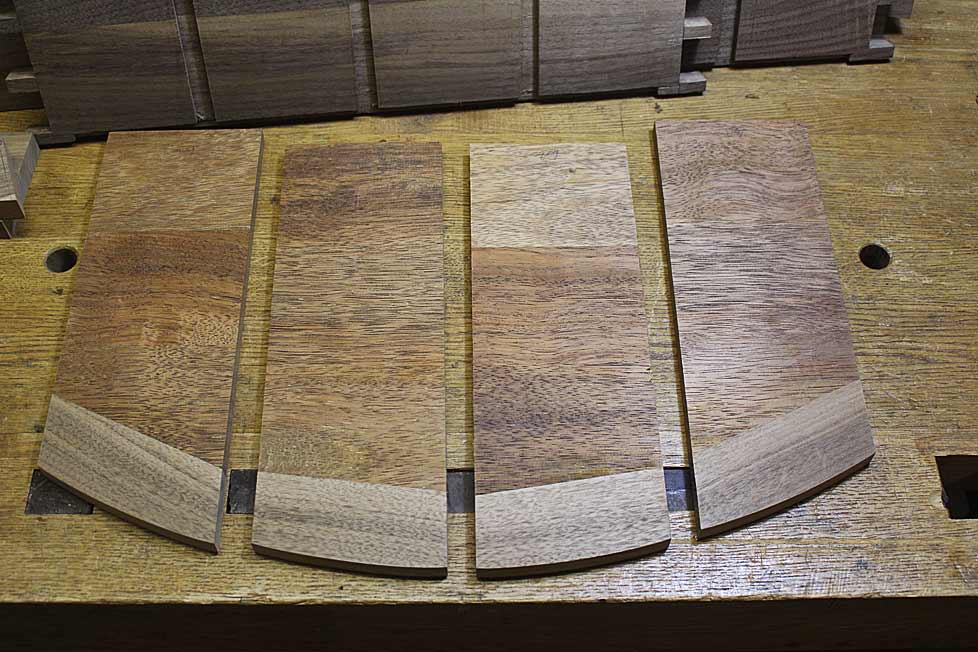

The walnut was flushed ...
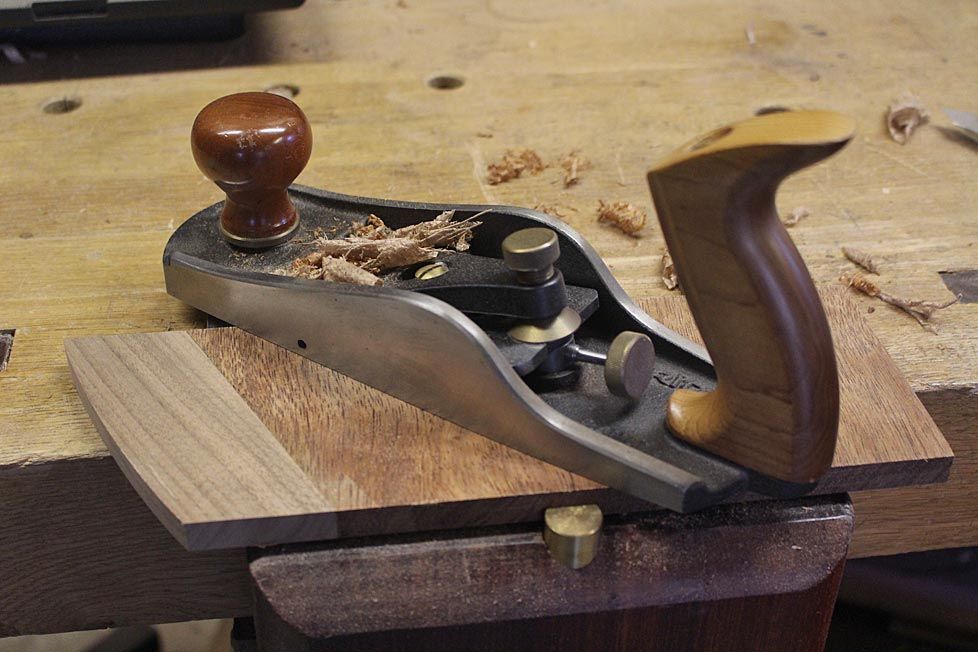

... and then were slid along the dados in the carcase ...
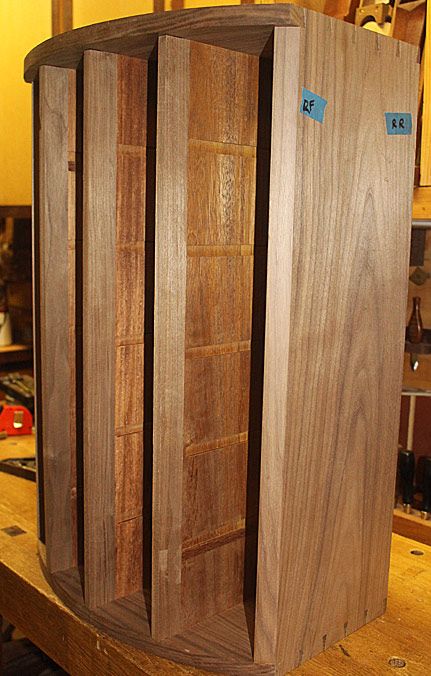

At this point the build came to a grinding halt. The drawer blades ... dados ... were not coplanar ... level ... damn! We are talking a millimetre here-and-there, but the combination looked terrible.

What went wrong?

It was the marking out. I ignored a very simple rule - I failed to use a common reference point. This should have been done with the dividers installed - with the inside base of the carcase as the reference - and not marked outside the carcase.

I could have repaired the dividers, but I decided to scrap the lot and make new ones, and cut new dados.

The carcase was repaired. The dados were filled in ...
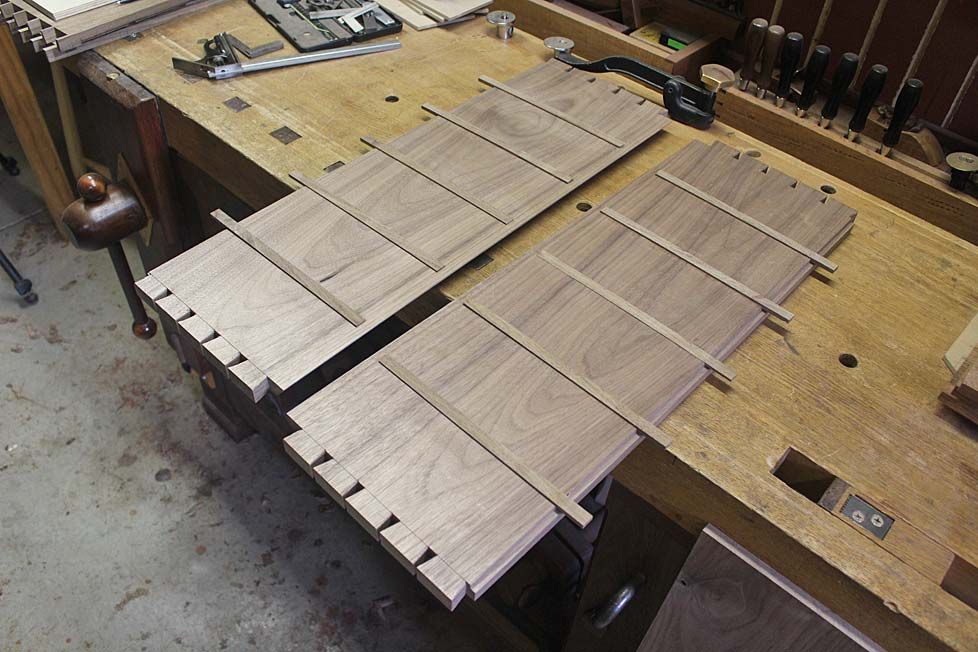

Flushed ...
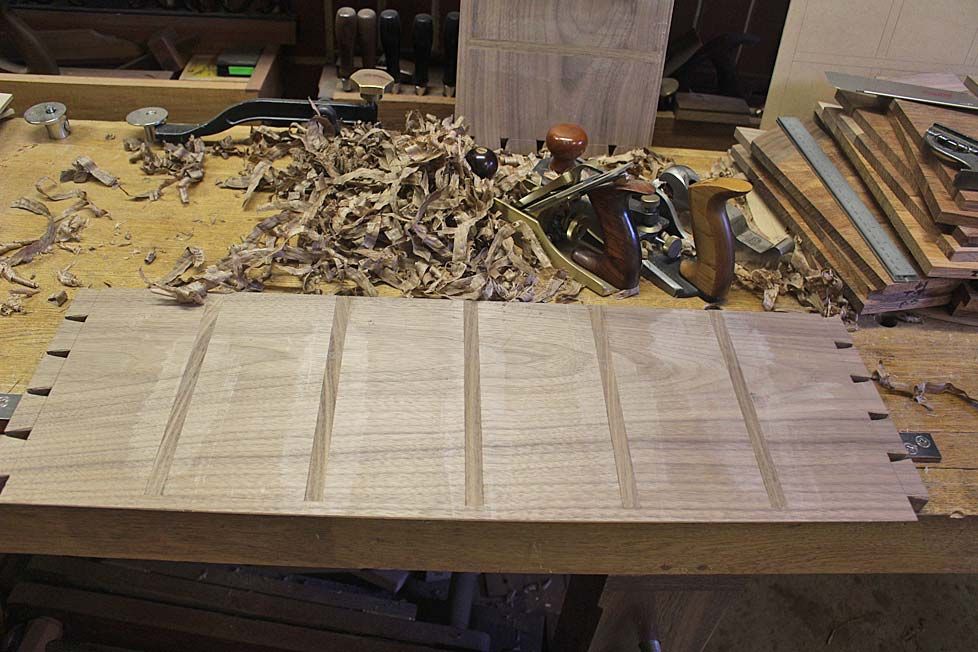

None of this would be visible when the new dados were made.

Then I did what I should have done when marking the positions of the dados - made a series of MDF templates, which could be used as left- and right hands ...

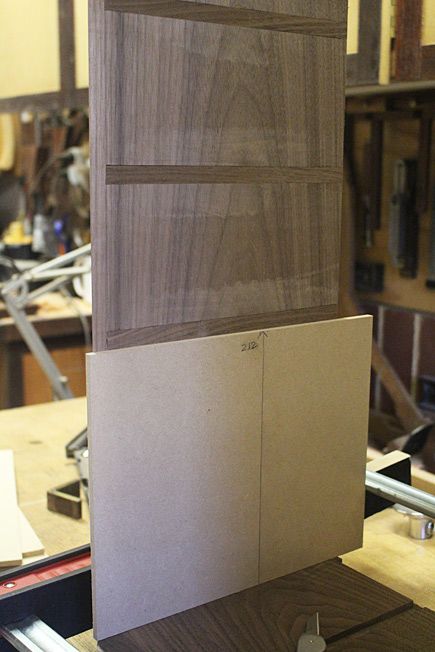
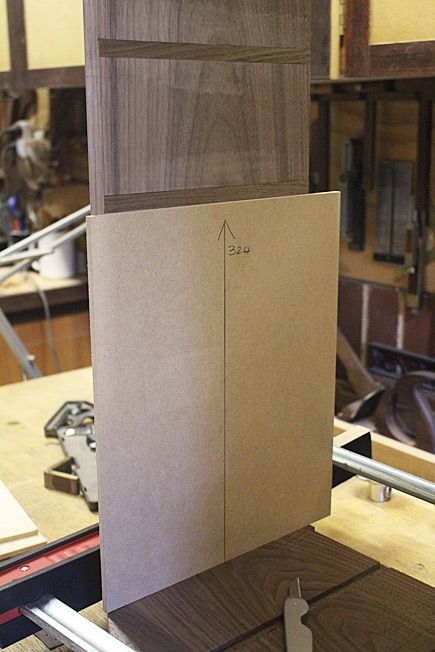
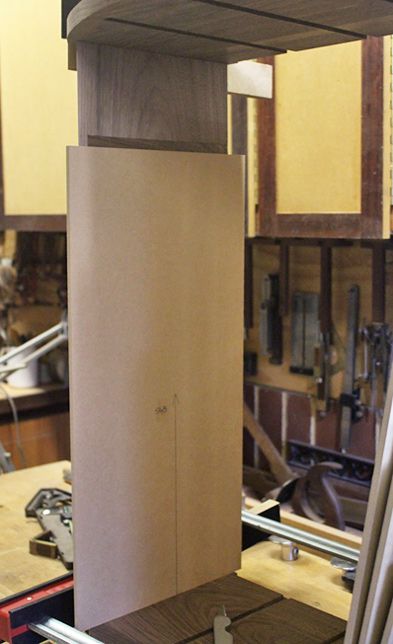

These were used for all dividers, with a line scored by a sharp knife ...
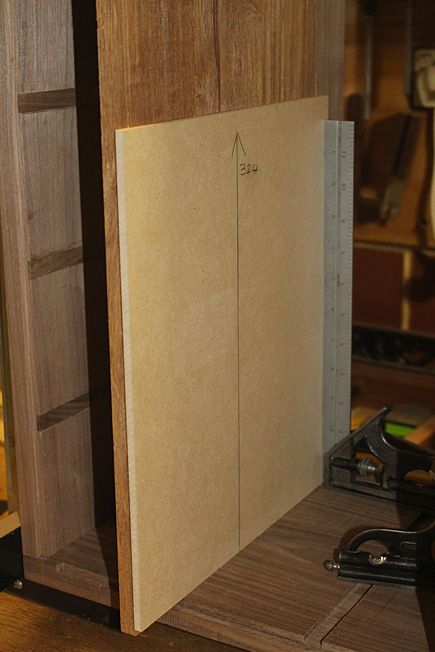

The power router and guide were used again. Tempting fate, perhaps, but I was convinced that the fault lay with the marking out, and not the cutting of the dados. I was tempted to just do the dados by hand - I do feel more in control with hand tools - but 40 needed to be done in all, and in hard merbau, before the weekend was over.

I am not going to bore you with pictures of the dados being made. It was the exact same as before ... except this time I did not cut on the wrong side of the line with one! :)

Here is the rear of the chest with the drawer blades inserted ...
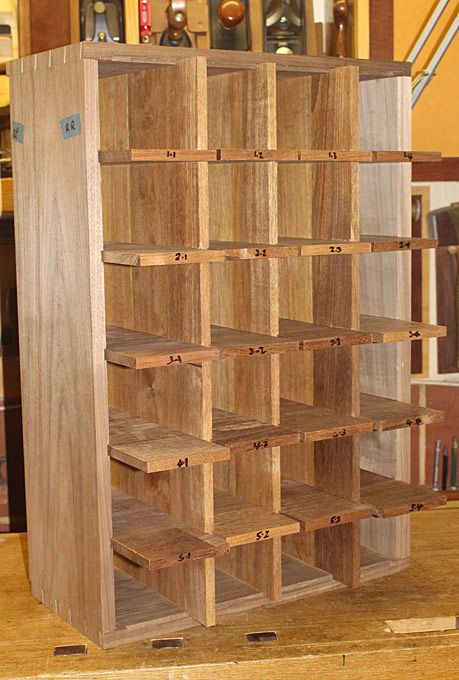

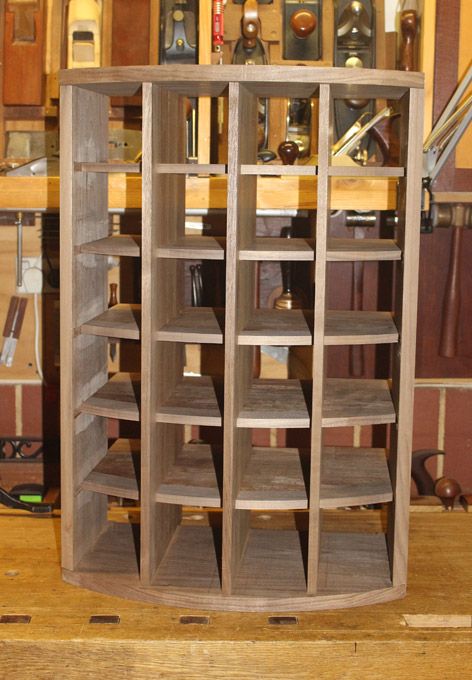
And a couple of the front ...
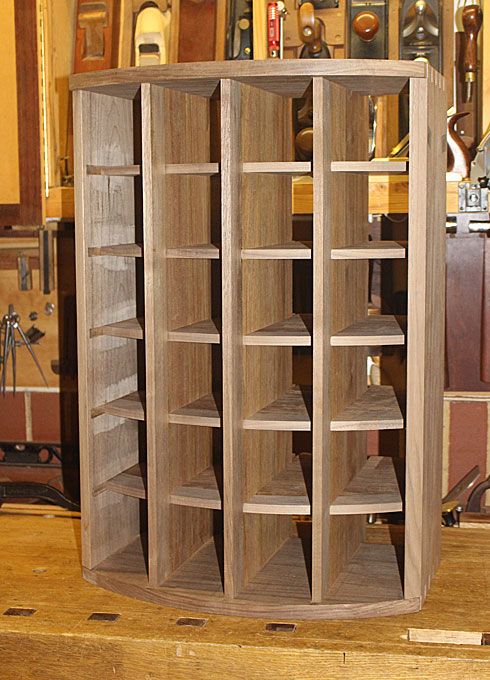

The dividers and the drawer blades have yet to rebated to fit the stopped dados, nevertheless the shape of the chest is becoming more defined.

Regards from Perth

Derek

Re: Apothecary chest - part five

#2

Alan Young

You are a better man than me.

Alan Young

I have made various construction "errors" as you have shown here- But am now only admitting it! Recovering is always a time and materials bummer-but you have shown how to recover-Congratulations. The project will finish well.

-Alan

Re: Apothecary chest - part five

#3

I have had plenty of practice ...

Derek Cohen (in Perth, Australia)

... screwing up, believe me! I cannot recall a project that did not contain at least one. Part of my amateur status. I wonder how often pros make similar errors?

Regards from Perth

Derek

Re: Apothecary chest - part five

#4

Comment: Do you find it odd.....

Gary Smyth

that an error of 1mm is glaring to the practiced eye? I've seen metal work out by a bit more than that much and pass inspection -- and don't even think about one color printing where the alignment and kerning are wrong.

Unless by your own maker standards, discovery always seems to be a battle --even if the error is right there in front of the maker. Congratulations on your decision to the correction and doing it so it is not noticed in the finished piece.

Goodonya!

Re: Apothecary chest - part five

#5

The Real Test

Mark Mandell - Gone Round In New Jersey

of a Craftsman [person ;) ] is not whether mistakes are made, we all make them. Rather, it is how well we hide them. :)

Re: Apothecary chest - part five

#6

Re: You are a better man than me.

Barry Irby

Do I understand? You filled in the rabbets and then re cut them in some cases a mm or two away from their original location? Weren't some of them correctly located the first time? And were the inserts cross grain? Will the slivers that got left behind be stable enough? Perhaps the filler strips could have been long strips of short grain wood as well? Maybe you should chop the slivers into short pieces to avoid cross grain issues?

OTOH, I admire the fact that you put on your big boy britches and fixed it. I might have thrown the whole thing away and started over, in about five years.

Re: Apothecary chest - part five

#8

Re: Comment: Do you find it odd.....

Derek Cohen (in Perth, Australia)

Gary, that 1mm adds up. It becomes 2mm at some stage. This shows. I am glad I took the time to do it over. It is now dead-on.

Regards from Perth

Derek

Re: Apothecary chest - part five

#10

Re: You are a better man than me.

Derek Cohen (in Perth, Australia)

Weren't some of them correctly located the first time? And were the inserts cross grain? Will the slivers that got left behind be stable enough? Perhaps the filler strips could have been long strips of short grain wood as well?

Barry, some of the dados were fine. But working around them was asking for mistakes. I decided that it was safer to start from scratch.

The only dados that were filled were in the side panels. The old dados are almost invisible - no one would go looking inside the cabinet anyway. But if they did, they would see - at most - a thin 1mm sliver on a few dados. Long grain is easer to use - less likely to crumble.

Thanks for the kind words.

Regards from Perth

Derek

Re: Apothecary chest - part five

#11

Ellis Walentine

JK disagreed

Ellis Walentine

I remember James Krenov likening hiding mistakes to a cat covering up his business in the litter box. Still, in the real world, fixing things can be a useful expedient, preferable to starting over. I think we all have to draw the line as to what is acceptable and what isn't.

Ellis

Re: Apothecary chest - part five

#12

Attitude *LINK*

Mark Hennebury

There are many different personalities and philosophies involved in woodworking like everything else.

Some people are okay with mistakes, and are of the mindset that we are all human and prone to mistakes, which may be true. but to accept this makes it a self fulfilling prophecy. You will tend towards taking shortcuts, lack discipline, you will expect and accept the inevitability of mistakes and be confident in your ability to cover them....And you will make mistakes.

If you refuse to accept that mistakes are inevitable, you will develop process and procedures to avoid mistakes you will discipline yourself to follow procedure, you will check and verify before every step of the way. You may still make a mistake, but when you do, it will be because you lacked the discipline to follow procedure, it will be your own fault and you will trash the part and start again.

Alex is fully committed.


Alex

Re: Apothecary chest - part five

#13

Re: Attitude *LINK*

Derek Cohen (in Perth, Australia)

Alex is fully committed.

Is he ever! :O

Mark, thanks for that video link. I have been following the blog of Eric Horst (link below). This is an area of special interest for me. Perhaps you are familiar with his writings?

With regard to your comments about the expectation or not of mistakes, my attitude is not that I expect one, but when one occurs it is just something to deal with. Not the end of the world. Do it again, but better.

In the current example, I dropped the ball. Not doubt about it. I did not follow the appropriate "process and procedures", as you termed it. A lesson learned - there is no alternative to working from a reference point. There will be another lesson to learn in the future, I do not doubt.

Regards from Perth

Derek


Self-Discipline & Commitment: The Great Equalizers

Re: Apothecary chest - part five

#14

Re: Attitude

Mark Hennebury

Hi Derek,

I was not familiar with Eric Horst, but i just read the page that you linked to and the sentiment is the same.

I was self taught, so i made many mistakes, from lack of knowledge and lack of discipline. I did sloppy joints, and bad designs, that cupped and twisted and split, i persevered, driven to do better, I studied, analyzed and developed process and procedure and discipline. Other than a slip or some unforeseen occurrence I now have no excuse to make a mistake, I now know how to plan, manage and execute a job without error, so if i make an error it will be because of a lack of discipline, It will be 100% on me. It will be because of a moment of weakness. And it will make me furious.

I have a lot of respect for you and your work, and your courage to show when you make a mistake. And it is this reason that we are discussing these critical aspects of woodworking. After gaining knowledge and experience, attitude and discipline are what define how you operate and what you will achieve. You have to believe that you can achieve perfection to pursue it.

Alex is the poster child; Cool, calm, calculated, disciplined and focused. Poetry in motion. Alex gets no do-over, one mistake and hes dead. Motivation to all of us .

Re: Apothecary chest - part five

#15

Re: Attitude

Derek Cohen (in Perth, Australia)

Being in the zone ... certainly needed when climbing, as young Alex displays.

Of course, when I am so at home working in my shop, I end up in hot water with my wife for missing dinner :)

Thanks for the kind words.

Regards from Perth

Derek

👍 This page answered my questions

Your vote helps other woodworkers quickly find the answers and techniques that actually work in the shop.