WoodCentral Forums

Est. 1998 — 27 years of woodworking knowledge

Duncan Phyfe Style Grain Direction

Posts

Duncan Phyfe Style Grain Direction

#1

Alan Young

Duncan Phyfe Style Grain Direction

Alan Young

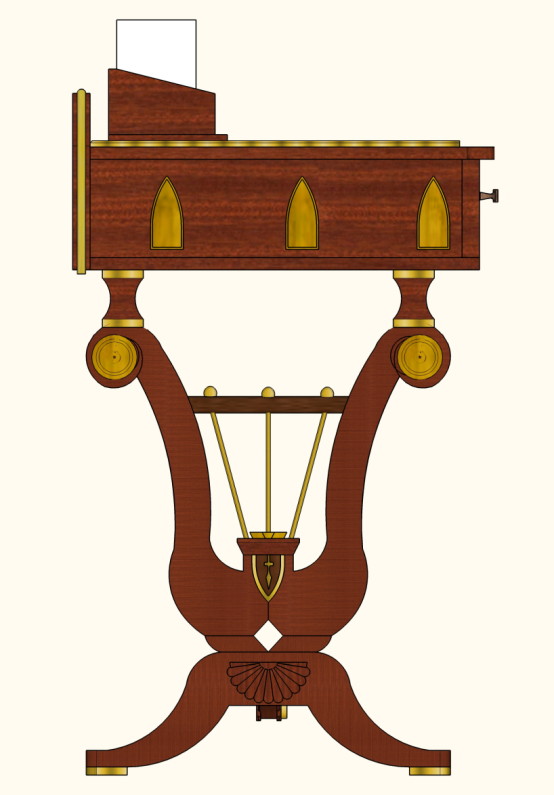
I am starting work on a piece. The base will have a Duncan Phyfe influenced shape.


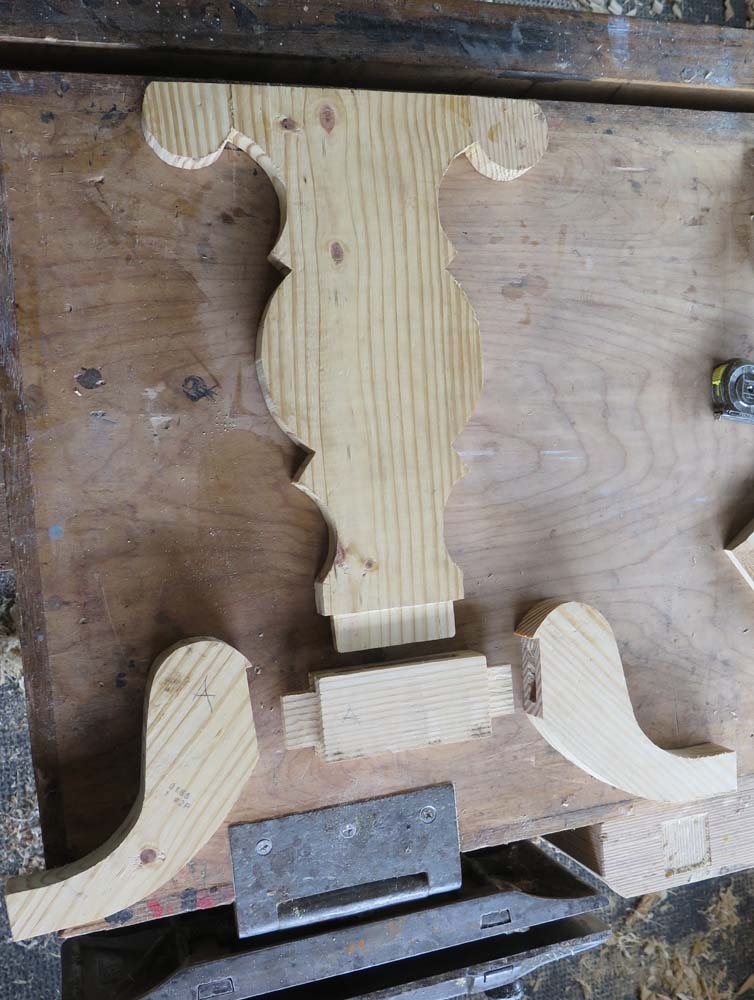
I want to make the base leg/foot from one piece. If I cut this profile from grain running straight-left to right will their be any issues with possible beaking?


Re: Duncan Phyfe Style Grain Direction

#2

Re: Duncan Phyfe Style Grain Direction

Bill Tindall, E.Tn.

I would think not.....but I think the grain vertical would look better.

Re: Duncan Phyfe Style Grain Direction

#3

Re: Duncan Phyfe Style Grain Direction

Yonak

I believe horizontal would be strongest and best looking. What direction will the top part of the base go ?

Re: Duncan Phyfe Style Grain Direction

#4

Re: Duncan Phyfe Style Grain Direction

William Duffield

Yes, there will be the distinct possibility of breaking. If you cut each leg/foot separately with the grain going as much as possible the length of the foot, and join them with a loose tenon, it will be much stronger. You can hide the joint either with the applied carved shell, or by veneering.

Re: Duncan Phyfe Style Grain Direction

#5

I’m with William

Keith Newton

While there shouldn’t be a problem with it just sitting there from the weight above, an impact like a small drop would cause it to snap across that 3” short-grain area.

Re: Duncan Phyfe Style Grain Direction

#6

Re: Duncan Phyfe Style Grain Direction

chuck wintle

Could you put a plywood spline in the leg from the underside to give it strength and then cover the spline with some of the same wood that will use?

Re: Duncan Phyfe Style Grain Direction

#7

Re: Duncan Phyfe Style Grain Direction

Bill Tindall, E.Tn.

Thinking about it more, I think frailty depends on weight, or more specifically weight and whatever level arm of the piece works with this weight to stress a member. Hard for me to look at it and judge how heavy it will be. Some antique designs could be described as delicate, think demilumes for example. But they don't weigh much so sliding them around or otherwise moving them is not stressful on spindly legs. They survive nicely for centuries. Bottom line, if this piece will be easy to pick up I think any design will be adequate.

Re: Duncan Phyfe Style Grain Direction

#8

Alan Young

Re: Duncan Phyfe Style Grain Direction

Alan Young

This was/is Plan B. It would have less waste. Still pondering

Re: Duncan Phyfe Style Grain Direction

#9

Alan Young

Re: Duncan Phyfe Style Grain Direction

Alan Young

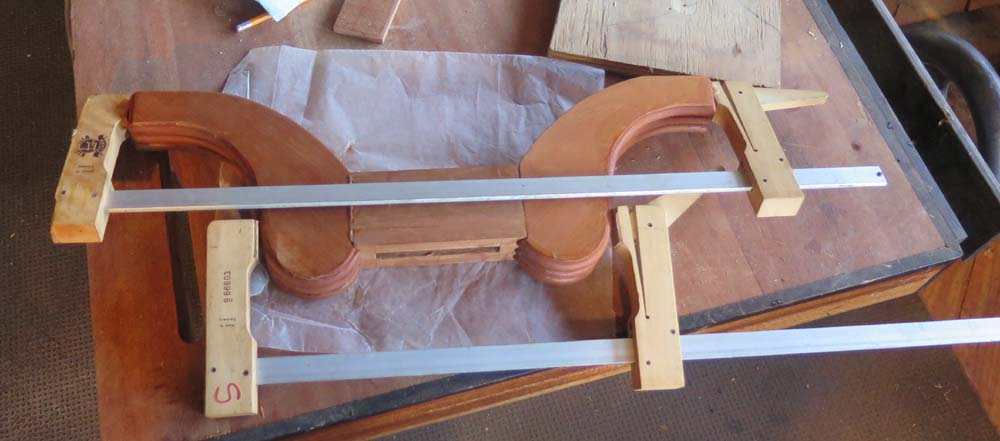
I like this concept- I did this with the legs on a set of music stands


I could maintain good visual apperance on three viewed sides- the bottom view would not matter.

Re: Duncan Phyfe Style Grain Direction

#10

Alan Young

Re: Duncan Phyfe Style Grain Direction

Alan Young

The piece will be somewhat static. It will hold greeting cards. Users will pull out the drawer-select cards and use the top to write on the cards.


So daily typic use should not cause an issue but Murphy's law being what it is I can just imagine someone sitting on it or doing something inapproprite.

Re: Duncan Phyfe Style Grain Direction

#11

Re: Duncan Phyfe Style Grain Direction

Yonak

Alan, I feel certain you have calculated that the cabinet will not tip when pulling the drawer out. Strictly figuring the greatest amount of long grain, of the two choices presented, the horizontal direction seems to be most solid.

Re: Duncan Phyfe Style Grain Direction

#12

Alan Young

Good Point!

Alan Young

The weight of the drawer when fully extended will very possibly be an issue. So when the location for this is finalized it must be fixed in place-probably attached to a wall.

Re: Duncan Phyfe Style Grain Direction

#13

Based on this wonderful rendering

Chuck Nickerson

I'd recommend you consider some form of traditional wooden drawer slides.

It's a wonderful piece but I find the metal slides jarring. As always YMMV.

Re: Duncan Phyfe Style Grain Direction

#14

Re: Duncan Phyfe Style Grain Direction

Jesse Cloud

Good to consider Murphy's Law. I asked a woodworking instructor if anything he built had ever broken. He said that the only failure of any piece of his furniture was his daughter's nightstand. When asked how it broke she said "Well, Dad, I was kind of dancing on it...".

Re: Duncan Phyfe Style Grain Direction

#15

BTW

Mark Mandell - Gone Round In New Jersey

you WILL be making the yellow parts out of brass, right?

Given your demonstrated machining skills, it'd be a bit cheezy to be just painting that trim.

;)

Edit: As a writing "desk" will you be using marble for the top surface? Pens and such will ruin a wood surface. The weight of stone will, of course, amplify the issue of leg strength.

Re: Duncan Phyfe Style Grain Direction

#16

Re: Duncan Phyfe Style Grain Direction

William Duffield

Anyone leaning on the drawer, in addition to the likelihood of tipping it over, will increase the lever arm on the short grain of the legs. These things (and tripod candle stands) often break when someone stumbles and tries to catch themselves by leaning on the edge of the top. A candle stand is reinforced with a spider, but it is also necessary to orient the long grain to minimize runout.

Re: Duncan Phyfe Style Grain Direction

#17

Alan Young

Ok you're making me think some more

Alan Young

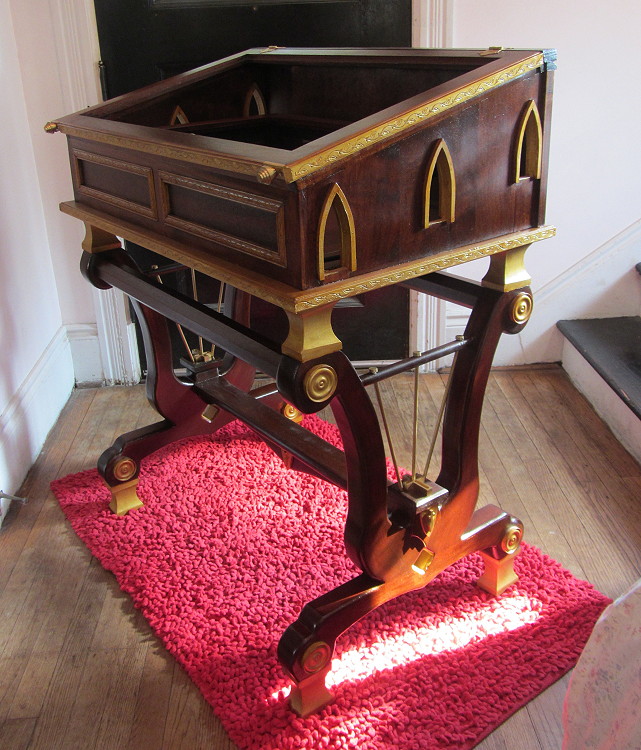
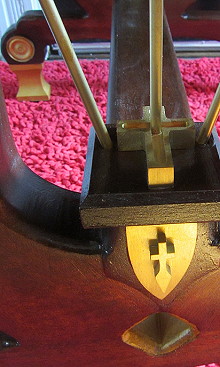
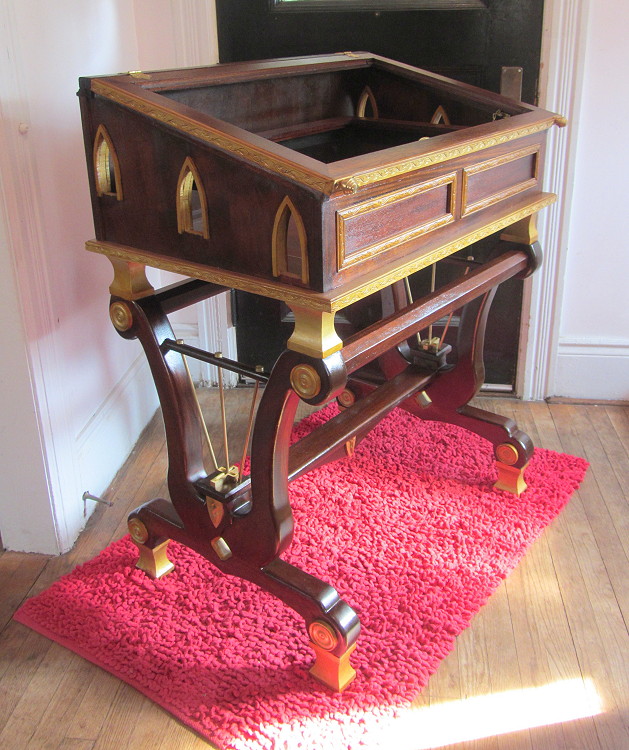
This will be a compantion piece to a case on stand I made a couple years ago. This piece was designed to contain a historic Bible. Some of the gold color is brass some of it was gilded. The gilding gives it a bit of an aged look...


For this new piece-Marble top?-no but a glass surface would probably be good...

Re: Duncan Phyfe Style Grain Direction

#18

Just Doin' Ma Job

Mark Mandell - Gone Round In New Jersey

Your brasswork has evolved since then. Your continued growth depends upon using what you've learned rather than backtracking. You client can say "We have an Early Young (from his Guilding Period) as well as a Later Young incorporating original brass parts."

So what's not to like in this scenario?

Re: Duncan Phyfe Style Grain Direction

#19

Writing on wood

Bill Tindall, E.Tn.

Actually the writing will be on finish. The hardness of finishes varies greatly and that is what will dent or not. ( there are always nit pickers lurking so, yes, the wood will dent if the finish dents severely or the build of the finish is thin) The moisture cured urethane finishes that were readily available in the consumer market 40 years ago would not dent with ball point pen writing. What won't be dented by pen today takes some searching to find.

Of course the classic covering would be leather.

Commercial finishes will have a hardness rating in their technical literature. It is measured by what hardness of pencil will dent the finish. There are finishes out there that will function successfully for this application. The hardest consumer urethanes may be adequate. Many consumer displays have test pieces for examination. Any that resist denting with thumb nail (my testing procedure) will likely hold up in this application.

As an aside......In the picture the base looks to be on the border line of being too small for the top. Most have better design skill than I. In my insecurity I would cut out the shape of the side from something (Masonite?), set it on the floor and look at the result.

Re: Duncan Phyfe Style Grain Direction

#20

Alan Young

Re: Writing on wood

Alan Young

Of course the classic covering would be leather.


So if I don't want to rely on the hardness of my finish-would you recommend leather rather than glass as a covering?


As an aside......In the picture the base looks to be on the border line of being too small for the top. Most have better design skill than I. In my insecurity I would cut out the shape of the side from something (Masonite?), set it on the floor and look at the result.

Not a bad observation. I am building this piece from the drawer outward-So the base will be the last part to be fabricated- I will adjust the base as necessary.

Re: Duncan Phyfe Style Grain Direction

#21

Re: Ok you're making me think some more

Barry Irby

Will these two pieces be in sight of each other? Why are the bases different? Are they to be a "Pair"? I am wondering why you reinvented the base. Both are beautiful, I'm just wondering.

And, an inset piece of marble or polished slate would add some heft to the piece and make it more stable with the drawer open, but also make it more dangerous if it tipped. And the added weight will add to the long term strain on the feet.

Re: Duncan Phyfe Style Grain Direction

#22

Alan Young

Re: Ok you're making me think some more

Alan Young

Will these two pieces be in sight of each other? Why are the bases different? Are they to be a "Pair"?

I'm not sure how close these will be to each other but location of the piece and a an agreed upon method to "secure it from tipping" are on a list of items to be discussed.

I am wondering why you reinvented the base. Both are beautiful, I'm just wondering.

Call it Evolution of Design. The new foot design matches the Harp feature better-in a traditional view. I like it better and so does the client.

Re: Duncan Phyfe Style Grain Direction

#23

Re: Writing on wood

Bill Tindall, E.Tn.

A leather writing surface would replicate the elegance of this traditional style and be period correct. Glass would be cheap and functional. Marble or other rock would be heavy even if you can find it in 3/4" thickness. Where I live most rock is 1 1/2" thick as that is the fashion. I was told that other regions prefer 3/4".

I have inset some nice tile into functional surfaces. Some tile comes in large squares and rectangles and might be big enough as one piece. Might be worth looking if you have a large tile store nearby that caters to high end jobs. I did a walnut coffee table with some Italian tile in brownish hues and patterns that looked elegant. The tile was picture framed by wood. Son-in-law was to take a picture for me but never did so you will have to use your imagination :) .

Re: Duncan Phyfe Style Grain Direction

#24

Re: Duncan Phyfe Style Grain Direction

Tony - Memphis

I dunno, but that is a awfully thick chunk of wood across that cross section. Can you imagine trying to break that even on purpose? I'm thinking that if the table experienced an adequate trauma to break that cross section of wood, the rest of the table would be toast as well! Heck, do an experiment. Cut one and test it.

On the other hand, you could make a laminated leg out of cheap stuff and use it as a nice opportunity for some nice veneer!

Reminds me...I was in a class making a low boy...we had one setup with no glue. The discussion was about strength, glue, etc. as we all stood around (3 or 4 students and the instructor). Then, all at once, the instructor jumped up and landed his bottom on the lowboy. We all gasped! But, nothing happened and that was his point. Not sure MY joinery was that good, but..... I was thinking the cabriolet leg ankles would have been the weak point, but they held the impact and the load after. I did see a guy crack a leg when he over-clamped it in a clamp for carving. Oops!

I made some chairs with a traditional lap type joint (scarf maybe?) where the back met the legs. I guess traditionally, that was done to conserve the good stuff (upholstered chairs, btw). I was concerned about that joint as it is at an angle and in a critical spot I would think. But, after several years, they are still holding. No joinery - just glue and screws.

Anyway, nice design. As always. I enjoy your work and posts. I'd love to learn how to work with brass from your dad!

Tony

Re: Duncan Phyfe Style Grain Direction

#25

Re: Duncan Phyfe Style Grain Direction *PICS*

William Duffield

Sorry for the late reply. I found some Duncan Phyfe desk/table construction details you should find useful, from a very recent blog post by Don Williams.

http://donsbarn.com/desk-structure-base-joinery/

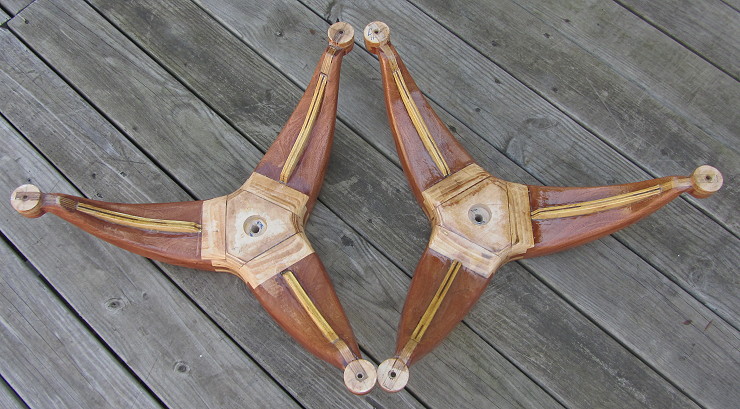
One of the detailed photos from Don's blog entry clearly shows the diagonal grain direction on the feet.


Other construction details show the three components of the foot structure joined to the legs with mortise and tenon and the legs joined to the upper stretcher by sliding dovetails. To find out how he joined the feet to the base of the legs, you need to go back to his blog entry from January 29.


The pine prototype also shows the grain direction very clearly.

👍 This page answered my questions

Your vote helps other woodworkers quickly find the answers and techniques that actually work in the shop.