WoodCentral Forums

Est. 1998 — 27 years of woodworking knowledge

Refectory Table Build *LINK*

Posts

Refectory Table Build *LINK*

#1

Refectory Table Build *LINK*

Sgian Dubh

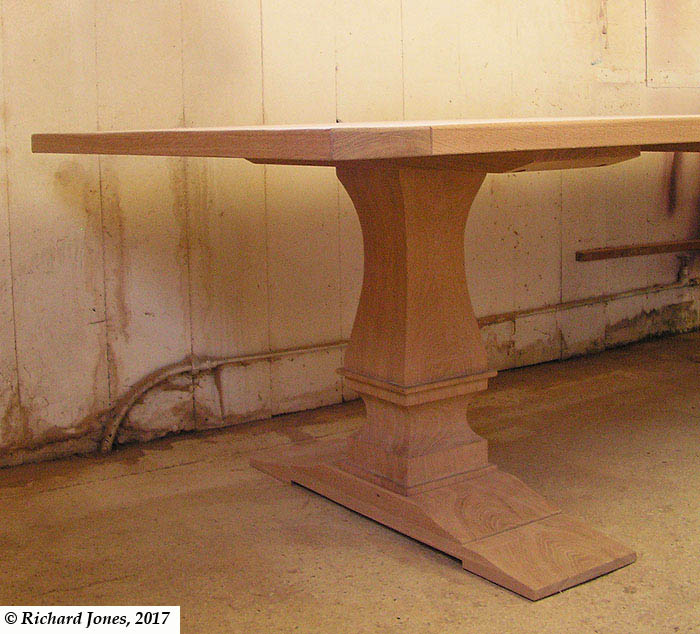
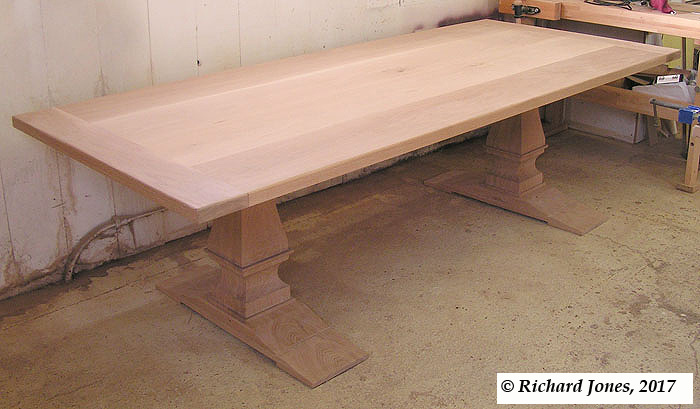
Here's a recent build of an American white oak refectory table with a pedestal leg. Dimensions are 2550 mm L X 1100 mm W X ~750 mm H (100-1/2" L X 43-3/8" W X 29-1/2" H). It's not my design and my role was to simply manufacture it on a freelance charged labour basis for a furniture business in their workshop, which is quite close to where I live.

I took quite a few photographs as I made the piece and turned them into a 'photo essay' page on my website (see link at the end) for anyone that wishes to compare techniques with those they might choose to use in a similar job. Slainte.


Refectory table build 'photo essay'.

Re: Refectory Table Build *LINK*

#2

Re: Refectory Table Build

Mark hennebury

Hi Richard, nice job on the table.

The screw inserts will probably hold up well, i have used a few of various design over the years, the cross-pin ones are great for shelving units. The ones that you used are in end grain which is probably not the best place to use them, but it is oak and that's a pretty tough wood, so i would guess that they will be fine.

I am curious why you used thinner boards in the center.

Also can you explain the large white dowels, as i don't understand the reason for them.

Thanks for posting, it is always interesting to see how others make stuff.

Re: Refectory Table Build *LINK*

#3

Re: Refectory Table Build

Sgian Dubh

Thanks for the comments Mark.

"The screw inserts will probably hold up well ..."

I suspect you're right on that. This is the second table I've made for the furniture business I sometimes do work for on a freelance basis, charging by the hour, that is. I've not heard of any problems regarding the first table on which the legsets were assembled much the same way.

"I am curious why you used thinner boards in the center."

Not my choice, although I would have done the same if the design had all been down to me. Cost and weight are all it comes down to. I think that table still has something close to 7ft³+ of oak in it (starting out with about 12ft³ of rough sawn material) and at roughly 40-45 lbs per ft³ ... well, I'll let you do the maths!

However, in a future build I'd do things differently by locally thicknessing the ends of the thinner boards to match the thickness of the two outer boards thus making it much easier to accomplish machining the tongue and three tenons in the main panel, i.e., they'd all be on the same level in relation to the top and bottom surface, which they're not in this build. That made things a bit difficult because there was resetting to do on both the tongues/tenons and the grooves/mortices. This was because the shoulder line of the middle tenon was too close to the top surface of the main panel for comfort and had to be dropped to a point where the underside of that tenon become barefaced, or virtually barefaced. The tenons in the thicker outside parts of the main panel are centred in the thickness. With the modification of making the centre boards the same thickness as the two outer boards at each end the mortices and tenons could have been simply centred, thus one set up each of the router for the tenons/tongue and the mortices/groove - simpler.

"Also can you explain the large white dowels, as i don't understand the reason for them."

Hidden by a thin covering strip of wood on the outside edge of the clamp (breadboard) is a big hole, maybe 25 mm diameter. In the hole is the head of an M10 coach screw that passes through a sloppy hole in the clamp, into the main panel, and bites into the cross grain of that large dowel - I think it might be a bit of broom handle I'd got lying around. It spreads the load across a wider area of the main panel, and also it's a bit of a belt and braces thing where I wasn't fully convinced the coach screw's thread could get adequate bite into the oak's end grain. In a similar scenario some bed rails are attached to legs with bolts, and the configuration is much like this, and kitchen counter top fasteners work on a similar principle.

Hope this answers your questions. Slainte.
Re: Refectory Table Build *LINK*

#4

Re: Refectory Table Build

Ed Wozniak-Buffalo, NY

Richard, that is one nice table. If you don't mind me asking, how many hours did it take for that build?

Re: Refectory Table Build *LINK*

#5

Re: Refectory Table Build

Mark hennebury

Hi Richard,

thanks for you answers.

So you have the breadboard end screwed into the table ends as well as tenoned and doweled. And you have used the dowel as a cross-pin as in the photo ( From Lee Valley ) and sketch.

The cross-pin is a very strong mechanical fastener, I used them on many projects.


Re: Refectory Table Build *LINK*

#6

Re: Refectory Table Build

Sgian Dubh

100-1/2 hours Ed, so far. I may be asked to apply a finish, but that depends on the customer deciding they want a finish or, if that is the case, if I'm needed to apply it - I may not be. Slainte.

Re: Refectory Table Build *LINK*

#7

Re: Refectory Table Build

Sgian Dubh

Yes Mark, a similar arrangement, but in my case a coach screw into a wooden dowel. Slainte.

Re: Refectory Table Build *LINK*

#8

Nice work!

Tony-Memphis

Nice design. Enjoyed seeing the various techniques you employed.

Tony

Re: Refectory Table Build *LINK*

#9

Well Done

Mark Mandell - Gone Round In New Jersey

[but you knew that already, right?) ;)

Re: Refectory Table Build *LINK*

#10

Oak Question

Bill Tindall, E.Tn.

But first, thank you for the description of the build. I always like to read about how others accomplish making various elements of furniture. I was particularly curious how the vertical supports were shaped. I speculated a band saw was to be involved.

It was noted that you used American white oak, for which there is currently a high demand.


When we were in the Czech Republic we saw magnificent white oak growing in parks as well as used in "ancient" architecture (see PIC). Obviously the conditions are favorable for growing white oak. However, we did not see any "wild" hardwood forests in eastern Czech Republic. Which leads to the question, is oak commercially produced in Europe.

Re: Refectory Table Build *LINK*

#11

Re: Oak Question

Sgian Dubh

Yes Bill, lots of it, mostly in France, Germany and the old Soviet bloc. What's grown over here aren't the same species as the native North American types of Quercus alba, etc. The most common species here are Q robur and Q petraea. They don't have quite same characteristics as American white oaks. For instance, they're generally considered to be somewhat more durable. Believe it or not, European oak is quite often more expensive than imported American white oak. A result of supply and demand I imagine. Slainte.

Re: Refectory Table Build *LINK*

#12

Bandsaw?

Sgian Dubh

"I speculated a band saw was to be involved."

A CNC machine would have been a good choice too. Sadly, there wasn't one handy at the time, so it was down to lots of grunt work, ha, ha. Slainte.

Re: Refectory Table Build *LINK*

#13

Re: Well Done

Sgian Dubh

Thanks Mark and Tony. As to knowing whether or not I do good work, the truth is I can't get away with knocking out too much rubbish, for two primary reasons: self respect, and clients won't pay big money for poor work in this line.

No doubt people will happily waste money on tat, but for some reason craft furniture doesn't seem to jive in the mind of buyers as something that should be tat, not at all in the same bracket as shabby chic artisanal hipster offerings of repurposed wobbly pallet wood goosed up with a bit of sloppy painting of some sort - perfect for your overpriced city centre loft apartment I imagine. I suspect you know the sort of stuff I'm talking about, ha, ha. Slainte.

Re: Refectory Table Build *LINK*

#14

Alan Young

I know the stuff....

Alan Young

I get caught in vicious You-Tube loops of such "builds" as these producers call them. I caught one fellow a while back toughting his ability to fasten breadboard ends with a Festool Domino. Without going into detail he totally missed the point of the expansion issues. What is even more depressing is the long line of comments extolling the fantastic work etc etc...

Thanks for your detailed post. A classy rendering.

-Alan

Re: Refectory Table Build *LINK*

#15

Re: I know the stuff....

Barry Irby

I think I saw the same one. As a new Festool owner I was thinking of things to do with them. First thought was "Aha! this will make bread board ends easy." Second thought was, "That's just wrong". Part of the dawning realization that just because it's on Youtube doesn't mean it's good or done correctly.

Re: Refectory Table Build *LINK*

#16

Re: I know the stuff....

William Duffield

I haven't seen the offending video, but I can imagine what he might have done. But I don't think using a Domino can be dismissed as "just wrong". The Domino tenons can be glued into the ends of the field boards, the machine can be set to cut loose fit mortises in the batten board, and all but the center tenon can be pinned instead of glued, using traditional techniques (or even a smaller Domino). You could even make very wide mortises with multiple plunges and manufacture your own tenon stock. While a full length haunch would provide even more stability, in most cases it is not critical to the ultimate success of the joint.

Re: Refectory Table Build *LINK*

#17

Re: I know the stuff....

Barry Irby

I did not mean doing it with Dominoes was wrong or impossible. I meant what HE did was just wrong. As I recall, he cut slots and without allowing for differential movement, glued both ends of all the Dominoes.

I can see how it could be done well with a Domino. I have a 500 model and I think a 700 version would be more suitable. The ones I saw that allowed for differential movement widened the hole in the domino until there wasn't much left. Might be a good place for a wider homemade domino.

Re: Refectory Table Build *LINK*

#18

Alan Young

Yes- That's the way it "should be done"

Alan Young

Not dissing the use of a Festool Domino for breadboard end applications---In the video I saw he pinned the dominos on the long table boards not the bread board ends. I had to mention it in the comment section so as to keep novice viewers from attempting to mimic his technique. And in the video he didn't tell the viewer that he he used a wider mortise setting for the breadboard mortises-My point being that woodworkers now getting into the activity can be quickly and easily led astray by so many videos that are spreading like a California wildfire.

-Alan

Re: Refectory Table Build *LINK*

#19

Re: Yes- That's the way it "should be done"

jesse cloud

My rule of thumb for U Tube instructional videos is to watch at least three on the same subject and see if they are consistent, at least. Usually I can find one that seems to grasp the problem and has a decent solution. Many are total trash.

On the other hand, they have saved me several calls to the plumber, maybe enough to afford a Domino. ;)

Re: Refectory Table Build *LINK*

#20

So English Brown Oak is?

Keith Newton

Another woodworking friend that I used to know did some projects for clients that we shared using EBO. Would it have been one of these?

Bill, I'll bet a lot of the "ancient oak" as you called it was from America when they were still logging the virgin forest here. Back when they were making the first cut, they were surely getting out more incredible lumber than the local market could consume. The lumber in that pic you posted looks to be QS, which would have had to come from some really mature trees. They were still getting a first cut here in Arkansas as recently as 1910, which wasn't that long ago historically speaking.

Re: Refectory Table Build *LINK*

#21

Re: So English Brown Oak is?

Sgian Dubh

"Another woodworking friend that I used to know did some projects for clients that we shared using EBO. Would it have been one of these?"

Brown oak and Tiger oak are the result of infection by Fistulina hepatica in a live tree. Beefsteak fungus or ox-tongue fungus are the common names for this fungus. This fungus is capable of creating brown oak out of American white oaks; it's not restricted to changing the colour of the European species.

I’ve always found brown oak slightly greasy to the touch, and compared to uninfected oak of the same species, it weighs less, it's softer and easier to work with both machines and hand tools. The colour is relatively fugitive and over a ten year time span I've noticed it fade away to be almost indistinguishable in colour to uninfected examples, although the grain does seem generally to be somewhat coarser, but that's probably related to the depredations wrought on the wood fibre by the fungus.

I'm not sure who you're directing your question to where you wrote "Would it have been one of these"?, so I'm not sure if you seek an answer from me. Slainte.

Re: Refectory Table Build *LINK*

#22

Re: So English Brown Oak is?

Keith Newton

Thanks, I didn't realize it was due to fungus. As for the question one of these, I was referring to Q robur and Q petraea from your earlier post. I just did a little search and found Hearn's Hardwood has some listed as Q petraea, with a note about the fungus.

Got to learn something new today. ha

Re: Refectory Table Build *LINK*

#23

Re: So English Brown Oak is? Tiger oak

Barry Irby

I was watching a TV show about flipping houses and the woman found a Tiger Oak dining table. From it's appearance I thought it was quarter sawn white oak with very prominent medulary rays.

Is that not true? Is Tiger Oak something different, or are we using the term loosely.

Re: Refectory Table Build *LINK*

#24

Re: So English Brown Oak is? Tiger oak

Sgian Dubh

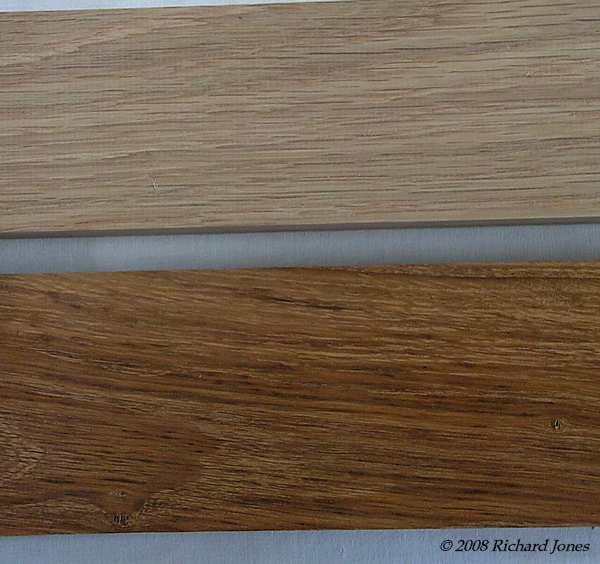
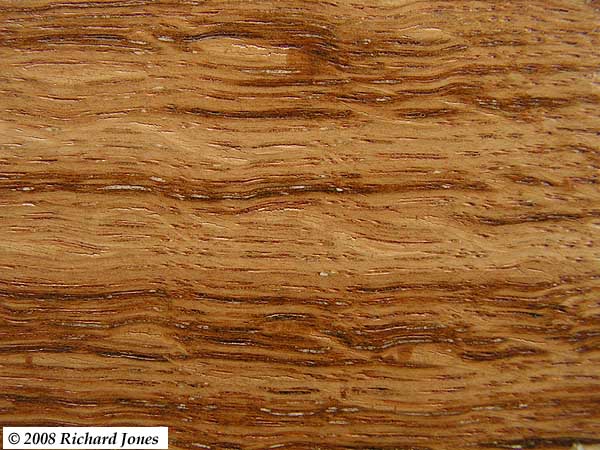
Hi Barry, brown oak results when the fungal attack causes discolouration throughout all the tissue.

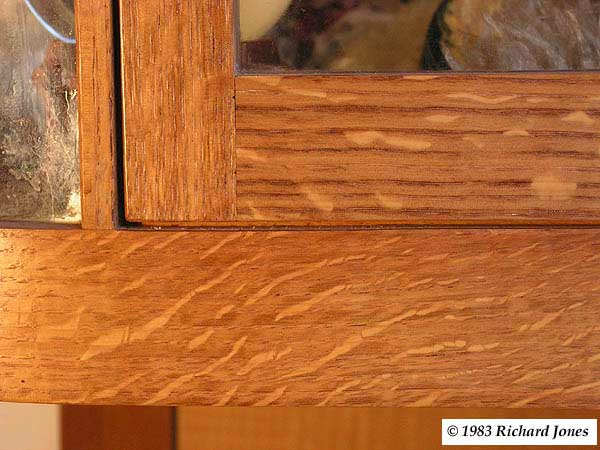
Tiger oak indicates a partial infection. The images below should convey the visual difference between the two. And the final image is of a cabinet I made thirty odd years ago with uninfected English oak for the cabinet framing with a brown oak door frame holding glass. In reality I photographed the piece to get this image probably sometime around 2005, so the 1983 date on it is misleading, but it's approximately when I made the cabinet. You can see in this image that the colours have merged towards on another, although the brown oak door frame seems a little coarser. You can still just about tell them apart, but the differences are quite subtle nowadays, whereas when new they were marked. Slainte.


Above: 'Normal' English oak colour compared to European brown oak. English oak is the same as European oak. Here in Europe we talk of, for example, German, French, English, Scottish oaks. All the country name denotes is where the tree grew, not that each is a different species to the other.


Above: Tiger oak indicating a partial infection of the beefsteak fungus. Given more time prior to felling this example in all likelihood would become brown oak.


Above: brown oak door frame inset within uninfected English oak cabinetry.

👍 This page answered my questions

Your vote helps other woodworkers quickly find the answers and techniques that actually work in the shop.