
WoodCentral Forums

Est. 1998 — 27 years of woodworking knowledge

Reinforcing an edgebanding

Posts

Reinforcing an edgebanding

#1

Alan Young

Reinforcing an edgebanding 

Alan Young

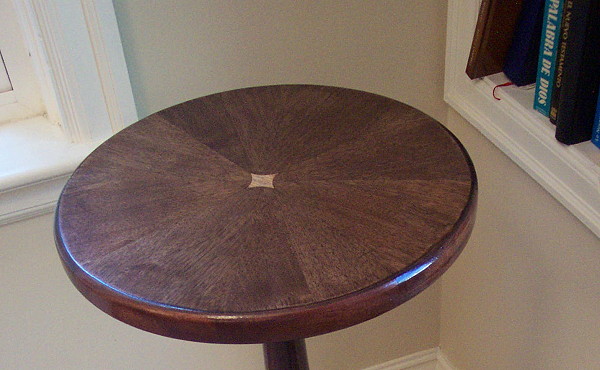
Next project in my shop to finish up is a Dutch Pullout Trestle Table. The main top finish size will be 42" wide and 72" Long. I have fabricated a plywood/Walnut veneer top that will be edge banded in solid Walnut. For a variety of reasons-all related to the space logistics of my shop- This plywood/veneer top is 39.5'" wide and 69.5" long.


So my edge banding needs to be 1.25" wide. Because of several layers of glue the thickness of the top and therefore the edge banding is 13/16".

I am planning the glue-up process for the edge banding. In the Old Days of the New Yankee workshop Norm was using biscuits on many projects from table top edge gluing to face frame/carcass glue ups etc. The biscuit usage seems to have disappeared-1. because in many cases the biscuits swelled with the glue and telegraphed through the solid wood -2 they were replaced with Festool Domino loose tenon type products.

The aspect ratio of my edge banding leaves me uneasy if I just use glue with no other mechanical re-enforcement of the glue-up. Am I over worrying this? or should I cut grooves in the banding and plywood and insert shop made solid wood biscuits....?

-Alan
Re: Reinforcing an edgebanding

#2

Re: Reinforcing an edgebanding

jesse cloud

Not sure exactly what you are concerned about? Is it the difficulty of keeping the long pieces of edgebanding flush with the top? Is it the ability of glue to make a strong enough bond? or something else?

Domino like tenons are easy to make and the mortises can be cut easily with a router.

If your concern is alignment, floating tenons would help. I don't think they would make much difference in the strength of the bond, though.

Having said all that, you have a lot of labor invested already, so it might be wise to take an extra step like floating tenons to ensure that no mistake at this point will ruin the valuable piece.

Re: Reinforcing an edgebanding

#3

Alan Young

All of the above!

Alan Young

I think I'm mostly concerned about the glue line-I shouldn't be as every demonstrated joint failure I've every seen has been in the wood not the glue line-well unless you had a poorly prepared set of pieces and or too much pressure so glue squeeze out was excessive etc... mostly I want to avoid any telegraphing through of inserted devices-biscuits or shop made tenons....

-Alan

Re: Reinforcing an edgebanding

#4

I'd suggest an experiment to put your mind at ease

Dick Coers

Take some scrap. Butt glue up a piece of that size hardwood to the plywood and let it sit overnight. Then try and break it off the plywood. I'm betting it takes a strike with a hammer to break the joint. That said, If you want a really good registration method, run a groove around the table top with an 1/8" slotting bit, same with the edge band, and glue in a ripped piece of hardwood for the spline. When I was in business, I usually used 1/8" untempered hardboard for the spline. Never had one come off. I consider a loose tenon overkill for this application.

A question, have you ever seen that biscuit swelling issue in person? I never have and I used the biscuits by the thousands in business. But, I don't consider it the best method for precise alignment.

If I was building the table, I would have applied a narrower edge band to the plywood and then veneered over that assembly. Just my preference, but with color differences between veneer and hardwood, I think the top presents better. Also no worry about bringing the edge band flush to the veneer.

Re: Reinforcing an edgebanding

#5

Re: I'd suggest an experiment to put your mind at

Barry Irby

I agree with Dick.

I would use a 1/4" slot cutter and a spline, but dick seems to think an 1/8" spline will work and he is most probably right.

I have used hundreds of biscuits and have never seen the swelling problem, but out of fear I generally don't bother to glue them into the slots. They are looser than I thought they should be. Dominoes work better.

Re: Reinforcing an edgebanding

#6

PS....

Barry Irby

If you are edge gluing to plywood the only part of the joint that "counts" is the plies that are edge grain.

Re: Reinforcing an edgebanding

#7

Alan Young

Re: I'd suggest an experiment to put your mind at  *LINK*

Alan Young

A question, have you ever seen that biscuit swelling issue in person? I never have and I used the biscuits by the thousands in business. But, I don't consider it the best method for precise alignment

No I have not seen it. I have seen articles (such as the article I have linked below) that encouraged me to move away from biscuit usage-perhaps unnecessarily as your experience documents.

If I was building the table, I would have applied a narrower edge band to the plywood and then veneered over that assembly. Just my preference, but with color differences between veneer and hardwood, I think the top presents better. Also no worry about bringing the edge band flush to the veneer.

Yes! I like this technique and have used it in other projects


In general I try to plan my work out in detail from the beginning anticipating any obstacles that may arise and a plan to conquer them as fabrication proceeds. In this case I gave a lot of thought as to whether the top would be solid wood or veneer. After weighing many factors I decided on a veneered top-knowing this issue would arise in due course I felt it was one obstacle I was willing to deal with. As far as biscuits- I rarely used them in the past for registration -maybe I had sloppy technique with the biscuit cutter but I always had alignment issues so I moved away from the biscuit and have more often gone with hard wood splines and loose tenons.....I like your suggestion re: a matching groove on plywood and edge banding with a spline in the groove....


Telegraphing biscuits

Re: Reinforcing an edgebanding

#8

Yup! Spline is a great idea!


Re: Reinforcing an edgebanding

#9

Re: Reinforcing an edgebanding

AZ in Colorado Springs

How will you clamp the assembly? 13/16" x around 70" long means a long, flexible piece of edge banding. If you make up a small test as Dick suggested, be sure to replicate the spacing and cauls you'll use on the bigger project, or you'll have a solid sample that may not be representative of the final product. And the ends are shorter, but do you have bar clamps with more than a six foot reach?

Re: Reinforcing an edgebanding

#10

Re: I'd suggest an experiment to put your mind at

Sgian Dubh

"A question, have you ever seen that biscuit swelling issue in person? I never have and I used the biscuits by the thousands in business."

You weren't asking me that question Dick, but I can report seeing oval depressions in solid wood panel glue-ups that reveal the position of biscuits. Similarly, I've witnessed a furrow along the joint line where the joint has sometimes included the addition of a slit feather (aka loose tongue). The fault was clearly visible on horizontal panels, but not so easily spotted on vertical panels, which is largely to do with the way light reflects off horizontal and vertical flat surfaces.

This phenomenon occurs when the maker hurries the job, i.e., panel glued up first thing in the morning, and prepped and polished by the end of the working day. Yes, it happens; I've seen it in workshops under pressure. The cure is to leave as much time as possible between glue-up and the prepping and finishing to allow the water swollen areas to shrink down again, whether it is a plain edge joint or one reinforced with biscuits, dominoes, slit feathers, etc. Two or three days is good, and a week is better still.

Interestingly perhaps, I can't recall seeing this fault where solid wood lipping has been attached to a veneered board with the lipping either just glued on or with reinforcements or alignment aids, e.g., a table top, although I can envisage it occurring. Perhaps my memory is failing me, but if there had been some sort of local swelling still evident at prep time, then it's possible the prep work could have removed the veneer locally to reveal the ground underneath.

The link to the article provided by Alan discusses the same fault, its possible causes and strategies for eliminating it. Slainte.

Re: Reinforcing an edgebanding

#11

Re: Reinforcing an edgebanding

jesse cloud

Good point on clamping difficulties.

When I do large curved pieces, I put the piece on a sheet of ply or osb and glue small blocks (cauls) near the edges. Then a couple of wedges between each block and the workpiece/wedgeband will apply good pressure. Just be sure to have lots of the cauls and wedges.

Good use for scraps.

Re: Reinforcing an edgebanding

#12

Re: Reinforcing an edgebanding

Brian Holcombe

I'd likely just cut a tongue and groove .

👍 This page answered my questions

Your vote helps other woodworkers quickly find the answers and techniques that actually work in the shop.