WoodCentral Forums

Est. 1998 — 27 years of woodworking knowledge

Drawer fitting

Posts

Drawer fitting

#1

Drawer fitting

Bill Tindall, E.Tn.

While few notice the details of how a drawer is built everyone that opens one experiences how smoothly it works. I spare no effort to make them work smoothly, which depends on an accurate fit. The fit on this drawer is still a bit tight.


I begin by building a drawer around a front that has been fitted tightly to its opening. This results in a too tight drawer which must be planed to fit properly. Sides are trivial to plane by hooking the bottomless drawer over a piece of plywood hung over the edge of the bench. I shoot for a drawer to be 1/32" less wide than the opening. I try to cut the height of the sides so they do not need adjustment, a goal not always achieved.


In the case of these arched fronts the sides need to be profiled to the arch opening once the drawer is assembled. Two planes are employed, one set for a coarse cut and the second for a finer cut.

I have never come up with a satisfactory way to hold a drawer for planing the top edge of the side. Does anyone have a suggestion?
Re: Drawer fitting

#2

Re: Drawer fitting

Thomas Skaggs, Foothills of Mount Level

If you have a vacuum pump I suppose you could build yourself a bench top vacuum clamp. Just a thought. T

Re: Drawer fitting

#4

Re: Drawer fitting  *LINK*

William Duffield

I use a patternmaker's vise (e.g., an Emmert or a Veritas Tucker), and rotate (not tilt) the jaw 90°. Reference the link at the bottom for more information on patternmaker's vises.

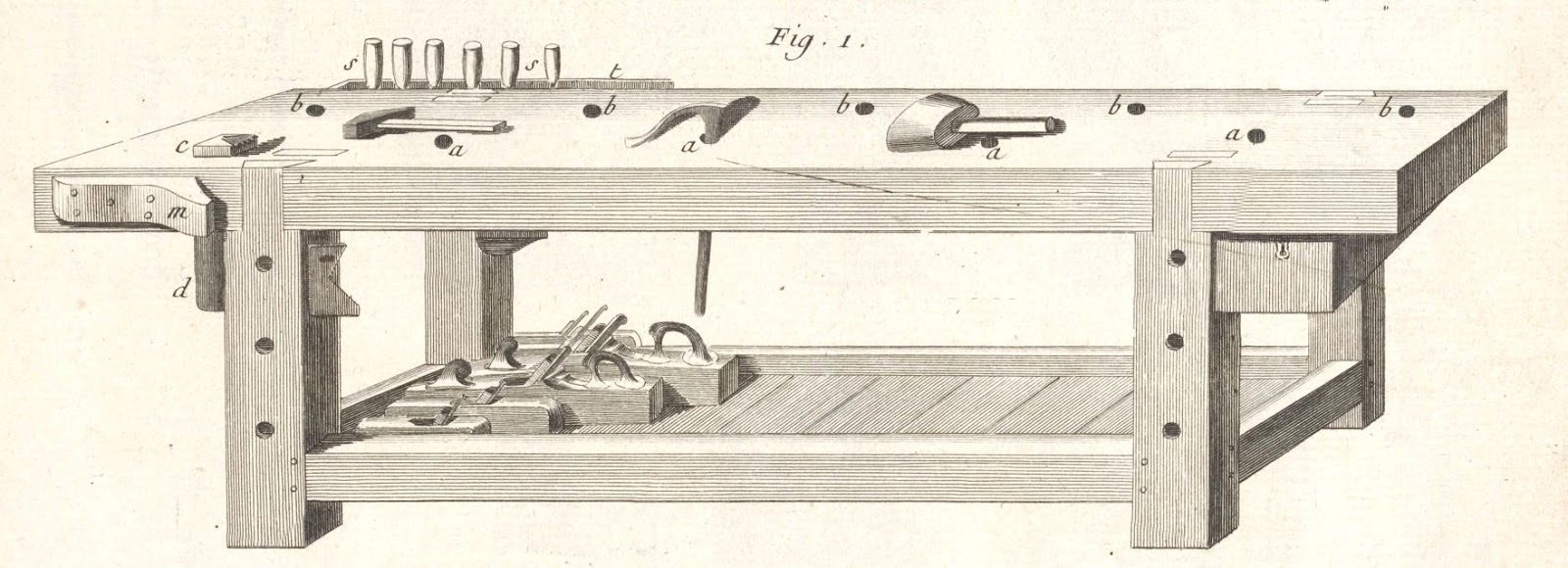
Another bench appliance that will do the job is a planing stop, as illustrated by Roubo in Plate 11, Item "C". These work like a huge dog, nominally 2" square, and extendable to 8 inches or so above the bench top, but also retractable, with a spring, so they can be set flush with the top when not in use. These are sometimes equipped with a metal toothed planing stop set in the top, but the planing stop is not necessary for this function. They are typically positioned a few inches behind the shoulder vise. While planing the front or back edge of a drawer, you can extend the stop to the height of the drawer and clamp it to the side of the drawer.


The Iron Hand

Re: Drawer fitting

#5

This. ^^^


Re: Drawer fitting

#6

Re: Drawer fitting

Roger

A Workmate?

Re: Drawer fitting

#7

Re: Drawer fitting

Don Stephan

Third vote for tail vise and bench dog.

Re: Drawer fitting

#8

Re: Drawer fitting

John Pappas

Put a bar clamp in your vise. Might put a short piece of wood in the vise to move the bar clamp away from the edge of the bench a bit.

Re: Drawer fitting

#9

Paul sellers video

John Pappas

https://www.youtube.com/watch?v=SozekTvPpJM

Re: Drawer fitting

#10

Re: Drawer fitting - some tips

Brian Holcombe

Bill,

Nice work. I've come across a few things that work well for me. Starting from the case:

I build the case now so that it is wider at the back by 1/32".

I then match both the back and front to the opening, then make the drawer.

The resulting drawer fits and does not get tight at any point so long as the sides are straight and remain that way.

No fitting, which is a recipe for a loose drawer.

Re: Drawer fitting

#11

A tip I will consider

Bill Tindall, E.Tn.

I find that stuff moves after I make it. I have taken to "storing" case goods in the damp garage for a few weeks before delivery and then drying it our inside. It is not uncommon that a drawer or two needs some refinement after this conditioning. Scale is another factor. This oversized chest of drawers I am building for son-in-law is going to move more than most. I'm pressing on to get an initial fit for the drawers so the assembly can "age" while I complete the rest.

Re: Drawer fitting

#12

Re: A tip I will consider

Brian Holcombe

When I build them as I've described, I have no problems with wood movement.

This approach eliminates issue with the side of the case and other factors which cause a tight drawer. The drawer also pulls out beautifully as the front exit is precisely fitted to the front and back of the drawer, so the drawer does not get loose as it is pulled out of the register.

Typically I plane the sides hollow as I'm preparing stock and if they have a slight bow to them I will put the bow toward the inside so that they will have a tendency to stay that way or to straighten, rather than bow outward.

I have made drawers by fitting and they're a headache. Once they're fitted they're too loose for my taste, and if they move and require more fitting then I need to travel to a place, work on the floor then refinish, no thanks.

👍 This page answered my questions

Your vote helps other woodworkers quickly find the answers and techniques that actually work in the shop.