WoodCentral Forums

Est. 1998 — 27 years of woodworking knowledge

A bandsaw as the only stationary saw

Posts

A bandsaw as the only stationary saw

#1

A bandsaw as the only stationary saw

Bill Houghton, Sebastopol, CA

That is, no tablesaw.

I have a small shop, 11x11 feet, crowded with all the house maintenance tools as well as woodworking tools.

I've seen people argue for a bandsaw as the only stationary saw in the shop, emphasizing its use for ripping. I'm curious as to other folks' experiences in this area.

Re: A bandsaw as the only stationary saw

#2

Re: A bandsaw as the only stationary saw

John C Lucas

When i was first single again ad had to find a place to live i was pretty sure i would have.an incredibly small.shop. i looked at my tools and decided that the bandsaw was the one tool i could not do without, not counting my lathe and all.of my hand tools.

Re: A bandsaw as the only stationary saw

#3

Re: A bandsaw as the only stationary saw

Joseph Piotrowski

i'm working my way there. so far i only need the table saw for sheet goods.

i have not set my bandsaw up yet but i am considering doing it for an end table that i just laid out all the cuts on a board. its a lot of cuts and i can see roughing them out on the bandsaw quickly and truing it all up with my hand tools.

Re: A bandsaw as the only stationary saw

#4

Adam of Oakland

Re: A bandsaw as the only stationary saw

Adam of Oakland

well i tell ya, if i only had one station[a/e]ry machine to choose from, it's a no-brainer: bandsaw. but that's just because of the kind of work that i like to do. the key question is what do you like to do?

bandsaws can rip OK, esp if i'm trying to save as much material as is possible from the wood since it's thinner than a table saw's kerf. also if the board is really long, i find it easier to control and i don't have the same issues with kickback that are present at a table saw (but if that's incorrect assumption, please let me know!).

the shortcoming of a bandsaw for ripping is that the blade teeth leave a rougher edge, so i typically have to use a jack-plane or a stationary planer to make something glue-line ready. you'd probably still have to do some of this finishing after a table saw, too.

there are so many things i would not want to do without my bandsaw. freehanding shallow curves. resawing to rough thickness. relatively quiet. i love my band saw. it was my first "big" machine. i won't stop woodworking if i didn't have one, but i would lament the grunt work it frees me from...

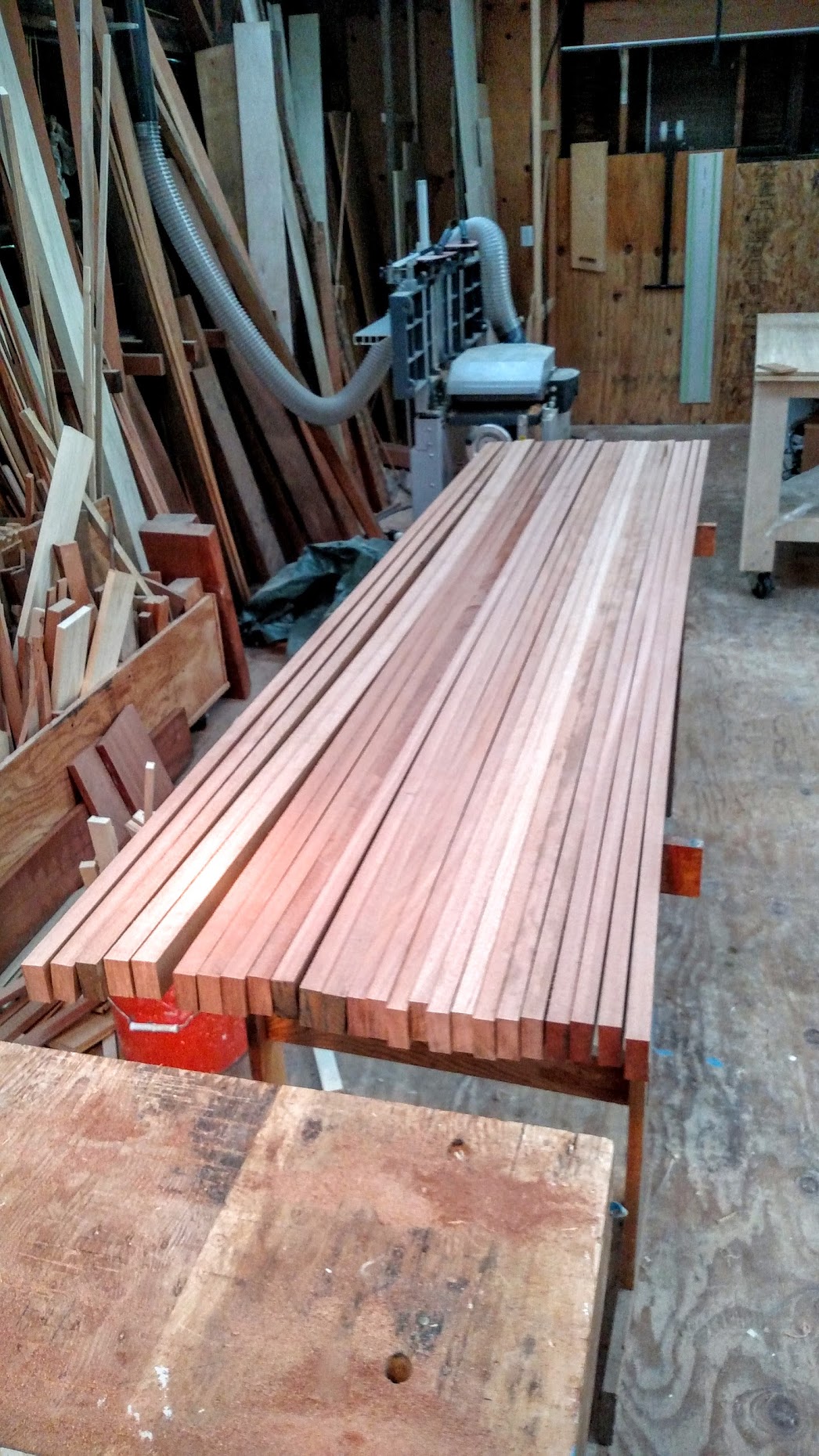
here's a lamination i did for a countertop of a bunch of 4/4 sapele that i wanted to make a 1,3/4" thick countertop from. i rip the boards to 1,7/8" on the BS, and sequentially glue them up. i could do this on my table saw, but i would still need to surface finish the final product with handplanes or a thickness planer. it was just easier on the BS. plus I would loose a bit from the thicker TS saw kerf...


Re: A bandsaw as the only stationary saw

#5

Can't imagine it!

Dick Coers

Woodworking without a table saw? Impossible in my book. I just don't feel you can get the same kind of precision and surface quality required for furniture with a bandsaw.

Re: A bandsaw as the only stationary saw

#6

Re: A bandsaw as the only stationary saw

Larry Clinton At Frankfort, (Central) Indiana

I'm sure you can work with only a band saw. For that matter many homes and all the furniture inside were constructed in the 1800's without any power tools.

However with my current work methods I would find it very difficult to do much work quickly without my table saw. Obviously if you look on the hand tool side they will certainly have techniques to do everything I use my Unisaw for and end up with product just as good or better than I. However I would probably not do any major projects without my table saw.

I have a very good bandsaw, a MM-16, it is powerful, has 16" re-saw capacity and is more capable than I as far as ripping. But I would have a tough time cutting anywhere near as accurately when ripping, and crosscutting is both limited and fairly inaccurate (at least in my hands).

For many years I made projects without a bandsaw, then for several years worked with a 14" Crapsman that had limited capacity and accuracy. In my mind I would rather give up my band saw than my table saw!

The only task I can think of that the bandsaw can do that the cabinet saw can't is saw wide veneer. Granted there are other tasks I use the bandsaw for today, like straightening the first edge of rough sawn lumber prior to joining. But I have done that by attaching a second straight board to the material and running it against the fence of the table saw.

Re: A bandsaw as the only stationary saw

#7

Re: A bandsaw as the only stationary saw

Bruce, a MN Galoot

Lately it seems the only saw I've used is the bandsaw, although I also have a tablesaw and a SCMS. The SCMS gets the least use; I often think of selling it or giving it to my son. For angled cuts, my MF Langdon Acme is probably better.

I can't imagine doing without either one, though for sheet goods it would be just as easy to have a tracksaw or a Skilsaw and a straightedge, coupled with some sawhorses.

I think you could squeeze a bandsaw into your shop, Bill.

Re: A bandsaw as the only stationary saw

#8

Re: A bandsaw as the only stationary saw

Hank Knight

Bill, I feel your pain. My shop is not quite as small as yours, but it's pretty small - 17' X 23'. It is crammed with machinery. I have thought long and hard about what I can do without. Two weeks ago I moved my Excalibur scroll saw into a storage shed to free up some space. I'm thinking seriously about doing the same with my lathe and my Performax sander. My bandsaw has never been part of that equation. Neither has my table saw. If it ever comes to a decision between those two, the bandsaw goes.

I guess it's the way you learn to work. I use the bandsaw for lots of things, including ripping heavy timbers, "quick and dirty" cuts, a little resawing and curves, of course; but it is not my go-to machine. My tablesaw is. It rips and crosscuts with precision, something my bandsaw can't do. I rely on it for its precision. I can work around the things my bandsaw can do that my tasblesaw can't, but not the other way around. If push came to shove, the bandsaw would go.

Re: A bandsaw as the only stationary saw

#9

Re: Can't imagine it!

John C Lucas

Well dont get me wrong i love my table saw. I was talking about If you could only have one tool. I can hand plane a board flat or joint it. For years i did all my jointing and edge truing with my router after rough cutting with a handsaw. The biggest advantage of a bandsaw is resawing. Ive always hated 3/4" lumber. Thicker or thinner always looked better and its tedious by hand and hard or impossible on the table saw.

Re: A bandsaw as the only stationary saw

#10

Re: A bandsaw as the only stationary saw

John C Lucas

A properly tuned bandsaw with a high quality blade will.do a remarkably clean cut. Part of the problem is the feed rate. There was an article in American Woodturner a cew years ago on cutting glue joint ready staves on the badsaw. They used a weight on a ramp to.pull the work through the cut. I have.yet to try it but one of my friends did and the cut quality was fantastic. Ive also.seen paper thin veneers cut to.show off the high quality blades.

Re: A bandsaw as the only stationary saw

#11

What do you do with your shop?

John K Jordan

I think the bottom line is what you do in your shop and the kinds of things you like to make. One person may HAVE to have a table saw; another can function without.

For me personally, I would pick the bandsaw over a big table saw if it came down to one or another. I don't cut up panels often and I can do it another way if needed. I know some people use a vertical panel saw where space is tight. For years I used a portable table saw for my tiny shop - when not in use the legs collapsed and it fit on a shelf. For ripping I carried it out in the driveway. Same with a planer.

A few years ago I built a much larger shop (which is getting crowded!) and have a large cabinet saw although I don't use it often. If it came down to keeping just one, I'd choose the bandsaw. For the way I work!

JKJ

Re: A bandsaw as the only stationary saw

#12

I could manage it...

John in NM

But it would take some adjustment to how I approach work. A friend of mine really likes carbide blades on his bandsaw (and he owns and runs a production shop).

I expect with a good stiff saw (like a General 490 or PM 141), a really good blade, and the willingness to experiment and clean up cuts with hand planes when necessary, I could do with just the bandsaw.

Re: A bandsaw as the only stationary saw

#13

Re: A bandsaw as the only stationary saw

joe mohnike

At one time the "Table Saw" was called a variety saw due to the different attachments and add-ons you could get with it. I have 2 band saws and seldom use them, and for the type of work I do I could probably live with out them as I have hand tools that will do the job in most cases. As far as re-sawing there is not much difference in the amount of material saved, true I am limited on the table saw to the height of the blade and it takes a wider cut, but the clean up is much less and faster than with my band saws. In the end I feel that it comes down to a matter of personal choice. Just my 2 cents.

Re: A bandsaw as the only stationary saw

#14

Hand tool vs Power tools

Derek Cohen (in Perth, Australia)

Hi Bill

I imagine it depends on whom you speak to. A woodworker who is comfortable with hand planes will have a different perspective from one who does not use them.

When one rips or cross cuts with a handsaw, it is expected that the surface finish will be rough and uneven. As a result, it is more usual to saw just off the line and complete the dimensioning with a hand plane. Sawing with a bandsaw is similar in that the quality of the line cut demands that further work is done.

In my expectation, a predominantly power tool user will seek to make a finish cut off the table saw, which is capable of doing so. Then it is important that the machine cuts precisely, and the finish is the best possible. The search goes on for a saw blade that produces a "glue line" finish. All this is less important to a hand tool orientated woodworker.

Ironically, I have just upgraded my table saw from a contractor, which I have had for 20 years, to a Hammer K3 Winner (slider). The importance for me is that the slider makes ripping intuitive (set the board on the slider at the angle desired, and rip it off). This is a different approach to a traditional table saw (where one rips using the fence). The bandsaw is similar in that one can either rip along a drawn line or against a fence. The bandsaw is more free hand (like a hand saw), but the slider is closer to the bandsaw than a traditional table saw might be.

Given the choice between a bandsaw and a table saw, I'd have to go for the bandsaw since it is capable of re-sawing boards, which the table saw cannot do. One of the reasons for choosing the K3, however, was that it has a small footprint - about half that of a Sawstop, which I did consider (I only have half of a double garage for machines. My shop is a little longer, and the hand tool area is at one end). Perhaps that may influence you ...


Regards from Perth

Derek

Re: A bandsaw as the only stationary saw

#15

not how I work with a table saw

Bill Tindall, E.Tn.

"Then it is important that the machine cuts precisely, and the finish is the best possible".

Rarely am I concerned with the finish from the table saw. The ends of cross cuts are usually hidden in a joint. It is a rare occasion that I don't joint a rip cut on the power jointer. It would not matter a bit if the rip cut was done with band saw or table saw. With a carbide bandsaw blade the rip cuts would be equivalent from either saw.

Hence, it is not rip cuts that would decide table saw vs band saw, it is cross cuts. A band saw is disadvantaged in every way for cross cuts and cross cuts are only inconveniently refined with a shooting board.

The bottom line of the decision is what will be the predominant use of the saw. You can cut curves with a saber saw and indeed that was my "band saw" for years. And you can cross cut with a chop saw if you have room to set one up conveniently. The fact that there are many times more table saws in the world than band saws suggests that most find the table saw more convenient. They are abundantly available used.

Re: A bandsaw as the only stationary saw

#16

Actually, it is ..

Derek Cohen (in Perth, Australia)

It is a rare occasion that I don't joint a rip cut on the power jointer. It would not matter a bit if the rip cut was done with band saw or table saw.

Bill, you are actually supporting what I said - if the edge does not need to be glue ready, then a bandsaw will do as well as a table saw for rips.

Let's see how many here want a 'glue-ready' rip and, therefore, would plump for a table saw over a bandsaw.

Regards from Perth

Derek

Re: A bandsaw as the only stationary saw

#17

Work-Flow

Mark Mandell - Gone Round In New Jersey

With a well tuned jointer sitting in its niche, I'm less concerned about rip cut quality. I use both the band saw and the table saw for rip cuts, but every rip goes to the jointer as part of my preparation of the part. The jointer goes me a cutface with a precisely controlled angle to the adjoining faces of the board.

The band saw I use for "safety rips" where I can anticipate that the board harbors compression wood and swirling grain that increases the risk of kickback. I also use a sled to crosscut and control very small pieces on the band saw.

The table saw's big advantage is speed and repeatability in multi-part rip runs. I use a Systematic glue-line rip blade in the table and the cut quality is such that a single pass on the jointer taking the barest of bites is enough to produce a hairline join.

Both machines have their place. If I had to be without one, the band saw would remain because of its applicability to the much wider range of cuts.

Re: A bandsaw as the only stationary saw

#18

Not really...

John in NM

It may well have been what you meant, but it is not what you actually said -- no fault there, I do that myself a lot.

"In my expectation, a predominantly power tool user will seek to make a finish cut off the table saw, which is capable of doing so. Then it is important that the machine cuts precisely, and the finish is the best possible. The search goes on for a saw blade that produces a "glue line" finish. All this is less important to a hand tool orientated woodworker. "

I too joint after ripping on the table saw. I usually aim for 1/32" over and take that off with the jointer. Its a habit I developed in a power tool shop where the sanding department would make a mess of my edges (the exposed ones) if I left them any opportunity to attack them with a sander and some 80 grit paper. Turns out a sharp, well tuned jointer and some 220 paper works so well that I do it all the time still, though it was 20 years ago I worked in that shop.

I sometimes do the same with a #5 plane if there is some reason to use it instead - like I don't have that 1/32" to spare (I know that sounds kinda crazy, but sometimes it happens). With the hand plane I can often skip the paper too, but usually I'm sanding everything and do the edges anyway.

Re: A bandsaw as the only stationary saw

#19

hammer saw

Joseph Piotrowski

although i want to sell my table saw(jet contractor), if i ever need a table saw i the future, i want one of these types.

also last night i just cross cut a 24"wide board last night with a handsaw. i think i could have done that with a saw like yours but not my jet contractor saw.

what i fond funny about the table saw is that it is expected to build numerous jigs and buy lots of after market add ons to gain the precision to make it worth the effort to setup.

there are numerous articles on how to setup a tablesaw to do xyz operation. so you need to spend 8 hrs building a jig so you can make 10 mins of cuts and use it twice a year.

i will see in a year or two. but so far 2 projects down and i used a table saw for 1 and hand tools for the other. the table saw was a lifeless un-enjoyable task. sure it was fast to make a small 5 drawer cabinet. no skill was involved but it was fast.

it took me much longer to make a simple open cabinet with hand tools but i enjoyed the heck out of it.

at the end of the day it's personal, almost religious in the tools you use. the table saw strength is high volume cuts and sheet goods. if i'm doing a run of kitchen cabinets, i want speed. if i'm doing an end table. it not worth the cost and real estate it takes up.

to me its luxury and nothing wrong with having it but like you asked, one tool would be the bandsaw for me.

Re: A bandsaw as the only stationary saw

#20

I prefer the tablesaw for ripping

Bruce, a MN Galoot

And bought a glue line rip blade from Bill Tindall to do just that. After that I haven't had to joint every rip as I once did.

Re: A bandsaw as the only stationary saw

#21

The band saw shortcoming......

Bill Tindall, E.Tn.

......Dinky tables and fences. Lets take the typical 14" saw most buy, or even the larger capacity Italian saws. The tables are so small that large boards teeter on them and the short fence provides scant support for rip cuts. After I bought an old Delta 20" I use it a lot more than I ever did the 14", largely because of the larger table and longer fence.

Re: A bandsaw as the only stationary saw

#22

butttt....

Joseph Piotrowski

most people build an outfeed table for there TS. easy enough ot add some support for bandsaw. i see that as a wash.

Re: A bandsaw as the only stationary saw

#23

Re: Hand tool vs Power tools

TM Stock

And probably more so, the nature of the work. Boatbuilder or luthier, def a band saw; cabinetmaker would be tablesaw.

Re: A bandsaw as the only stationary saw

#24

Turner:

Mark Mandell - Gone Round In New Jersey

band saw.

Segmented turner: table saw

Re: A bandsaw as the only stationary saw

#25

I use a bandsaw only

Brian Holcombe

Works fine for me, I use it as my only stationary saw.

👍 This page answered my questions

Your vote helps other woodworkers quickly find the answers and techniques that actually work in the shop.