Home Articles Forums Gallery Marketplace Videos

WoodCentral Forums

Knowledge You Can Build On — Est. 1998

Reach the woodworkers who ACTUALLY BUY

Sofa Table - part III

Posts

Sofa Table - part III

#1

Sofa Table - part III

Derek Cohen (in Perth, Australia)

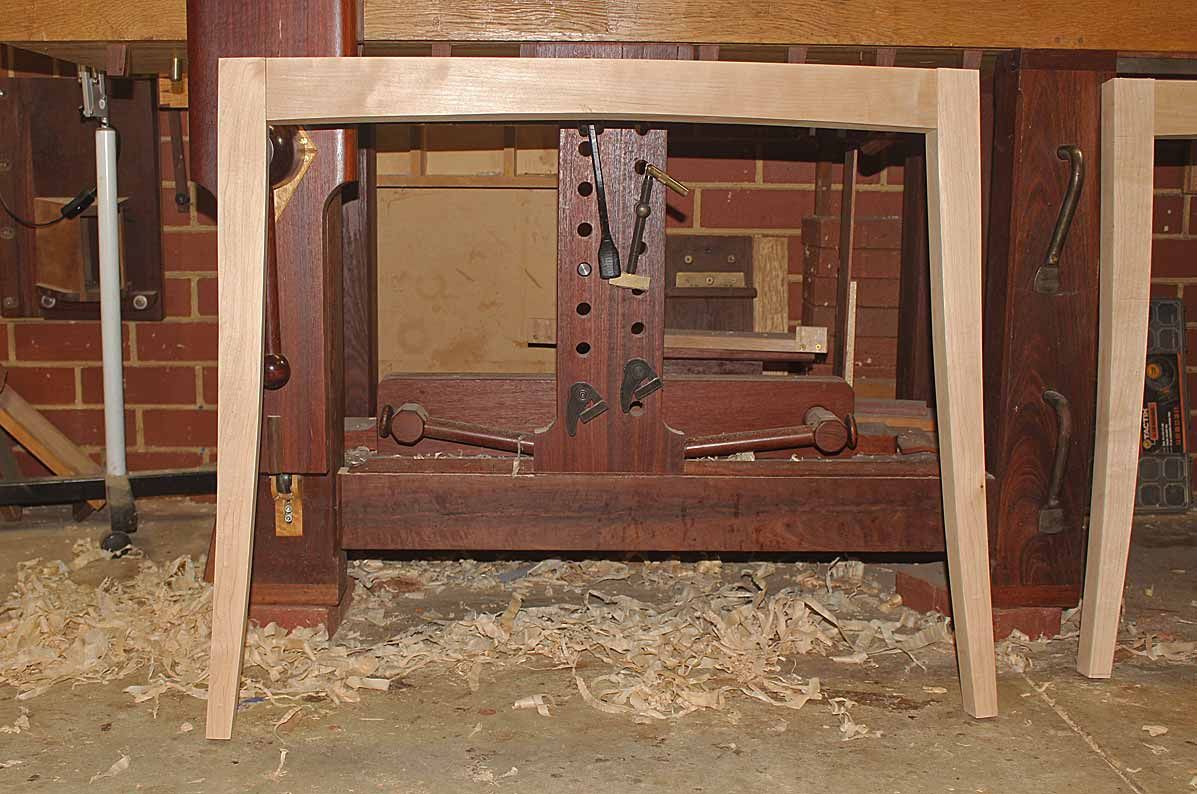
This is where we finished last time - the fitting of legs to the apron ...

I had a day in the workshop, and the following is a summary of the work completed today.

The aim was to make and fit the end rails for the table. I decided to use sliding dovetails rather than mortice-and-tenons: There was little room to add a tenon as much of the space in the legs was taken up with large tenons from the aprons (although working with the 1/3 Rule). A sliding dovetail would provide a compact joint.

A few hours were first spent aligning the aprons and legs. The legs had been cut from the centre of a board, to obtain the best grain arrangement. As a result, there were no registration sides. A degree here-or-there difference in the legs threw off their alignment. Tweaking them into parallel took some time.

The ends of the table are different. On one side is a solid stretcher. At the other end are top- and lower rails for a drawer. These are below along with the drawer face, which will resemble a stretcher once completed (it is to be a hidden drawer, disguised as a stretcher) ...
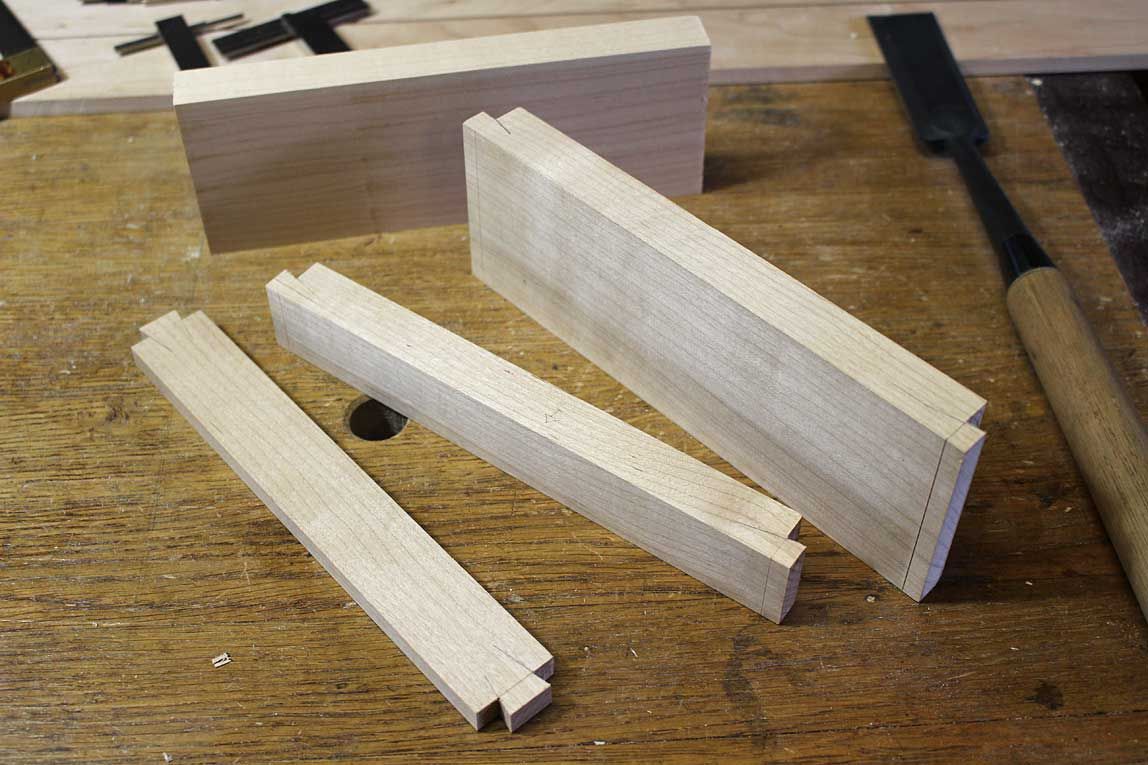

The rails went in this end ...
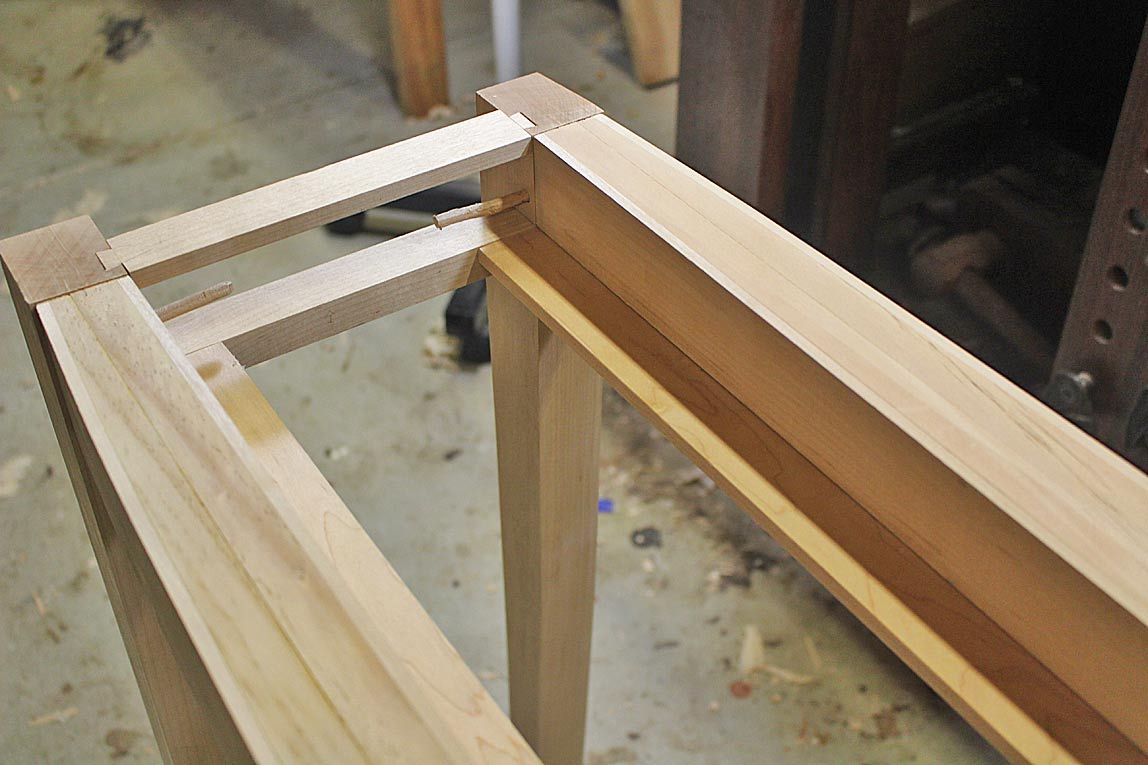

All is loosely fitted for these photos. Drawbore pegs lock the legs to the apron. The lower rail is actually locked by the apron ...
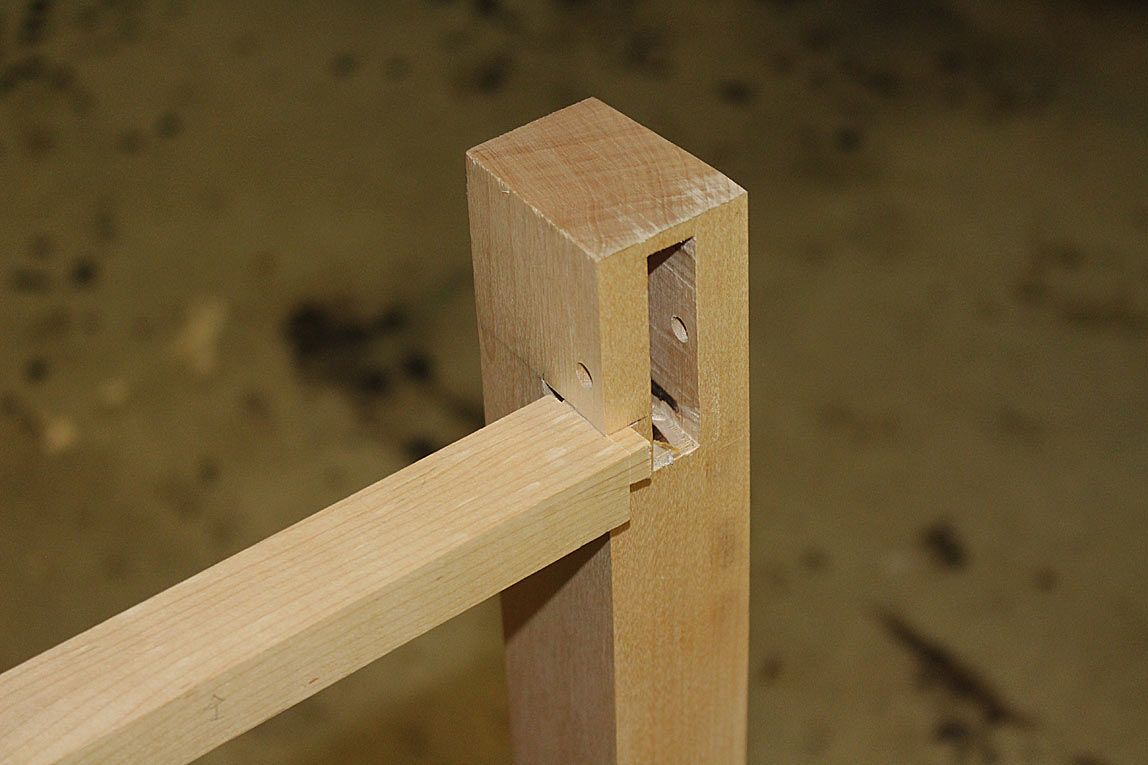

There is nothing special about the sliding dovetail on the lower rails. They are short and, therefore, were left parallel ..
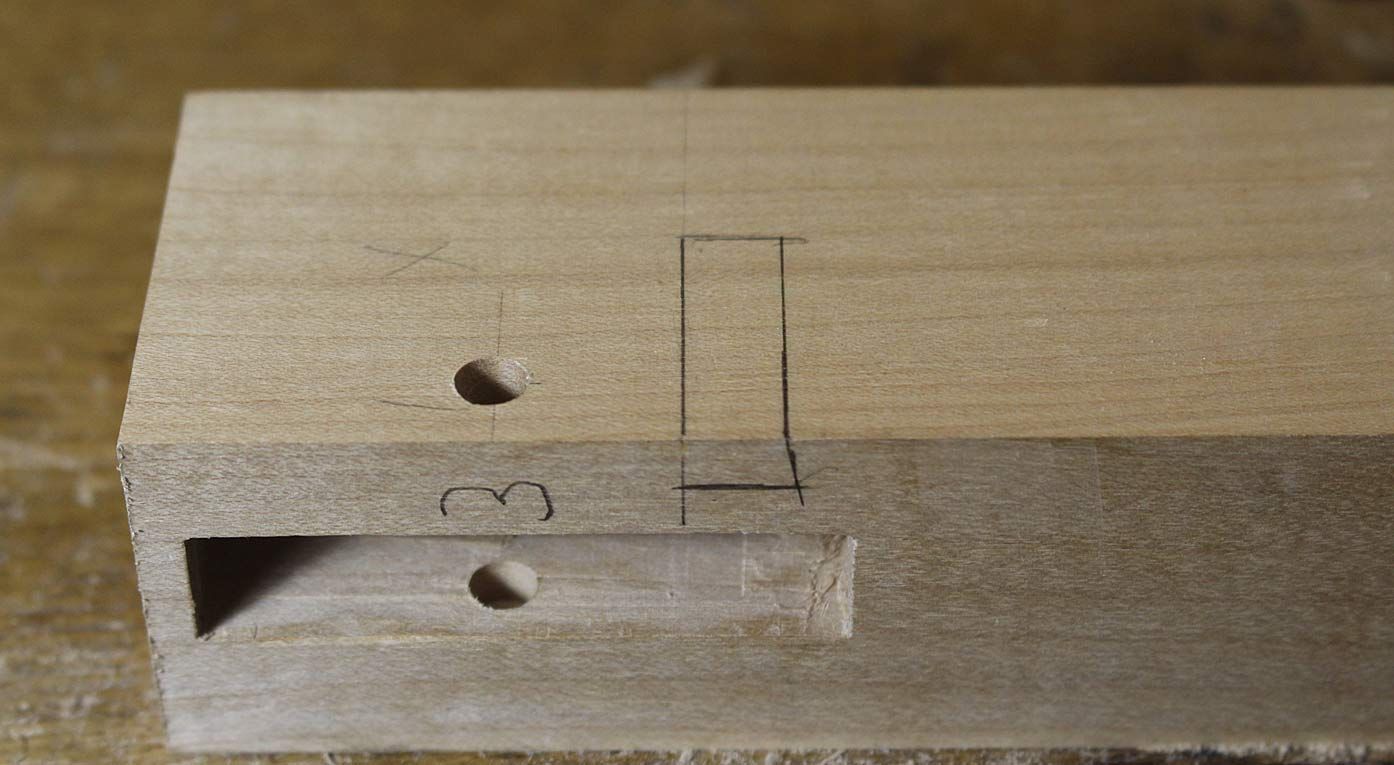

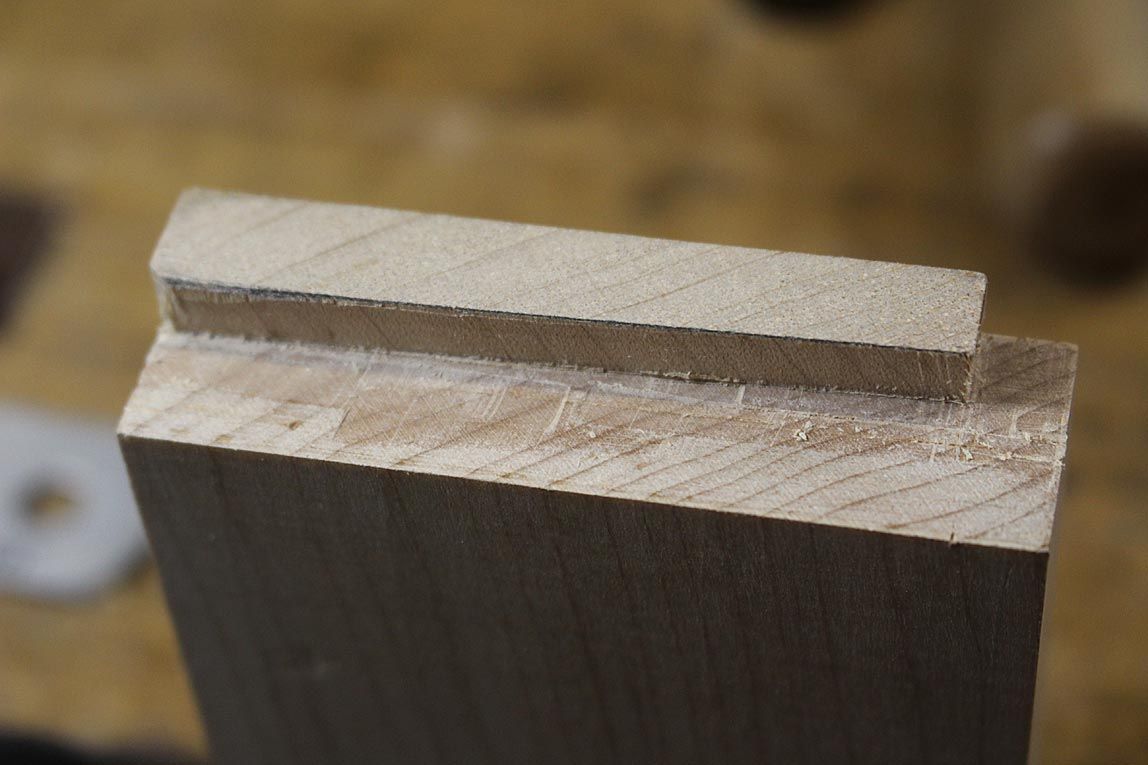
The top rail is simply dovetailed in ...
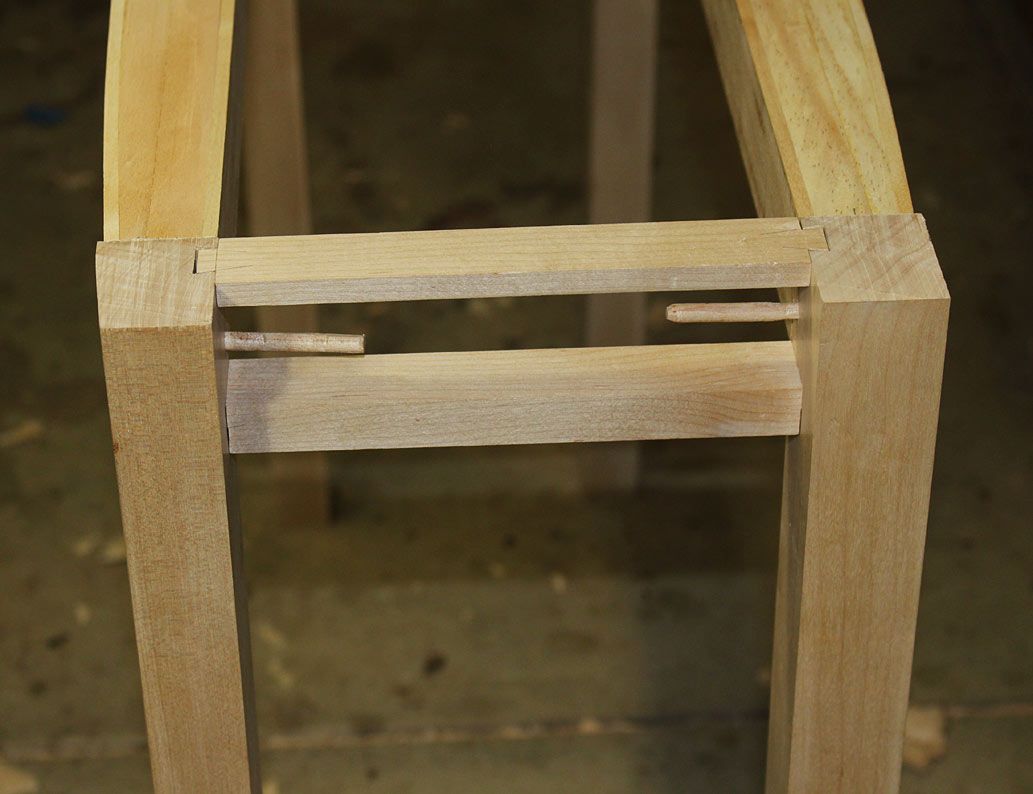

The top rail is 10mm high and the lower rail is 20mm high. This leaves 39mm for a drawer. No, it is not going to be high! Still, it is part of the fun, and no doubt will be a interesting talking point and find a use.

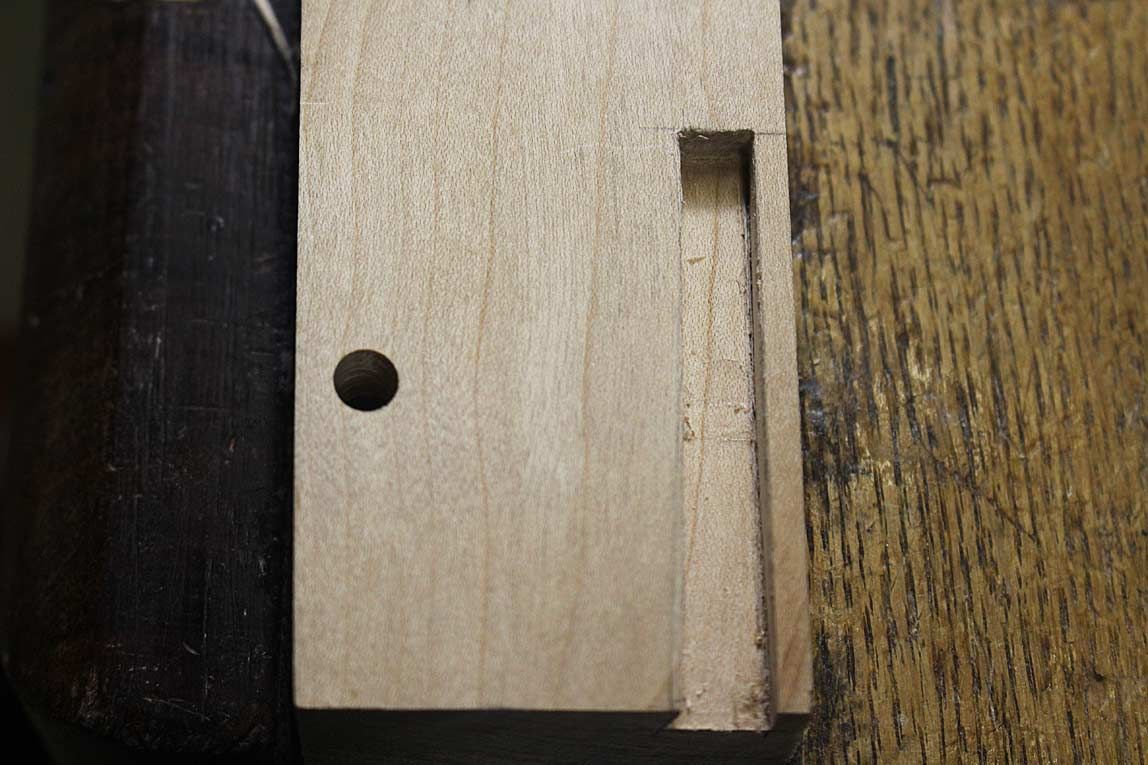
At the other end of the table is a solid stretcher. If you look at the left side leg, you will notice that the top of the mortice has broken out. This was caused by attempts to unstick a peg - which I thought was tapped in lightly, but broke off when I tried to twist it out (damn!). After this, I kept it all loose.
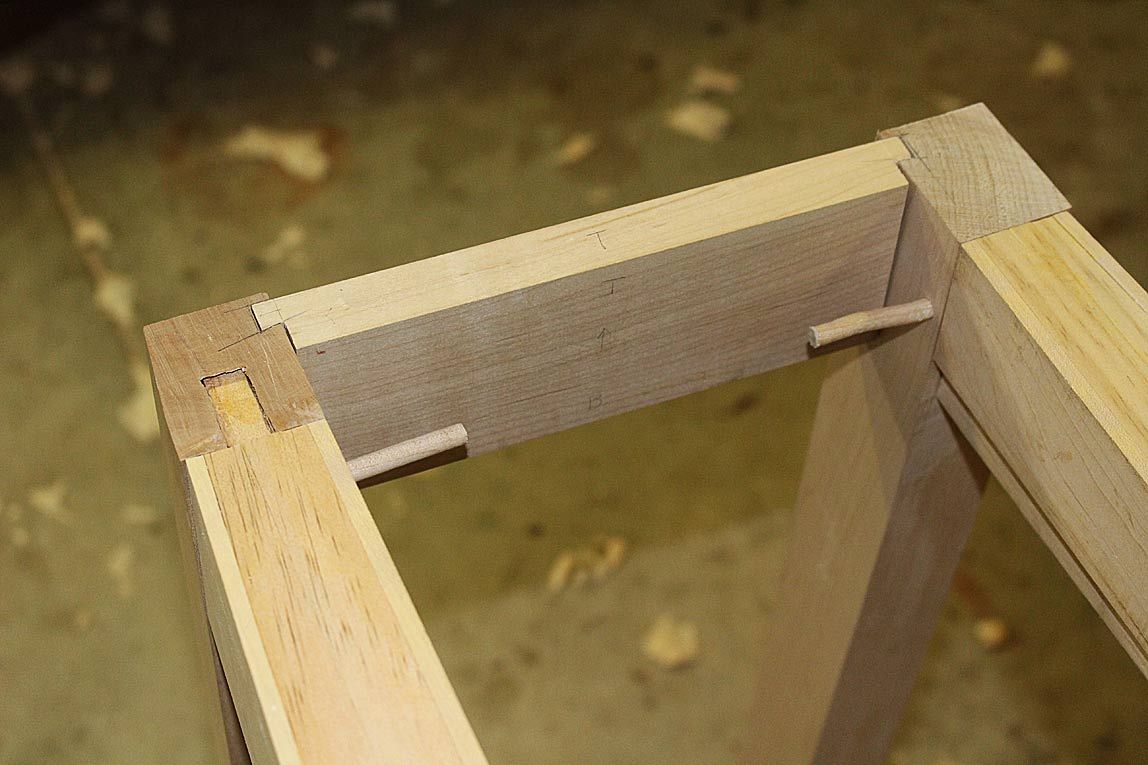

This stretcher has a tapered sliding dovetail at each side ...
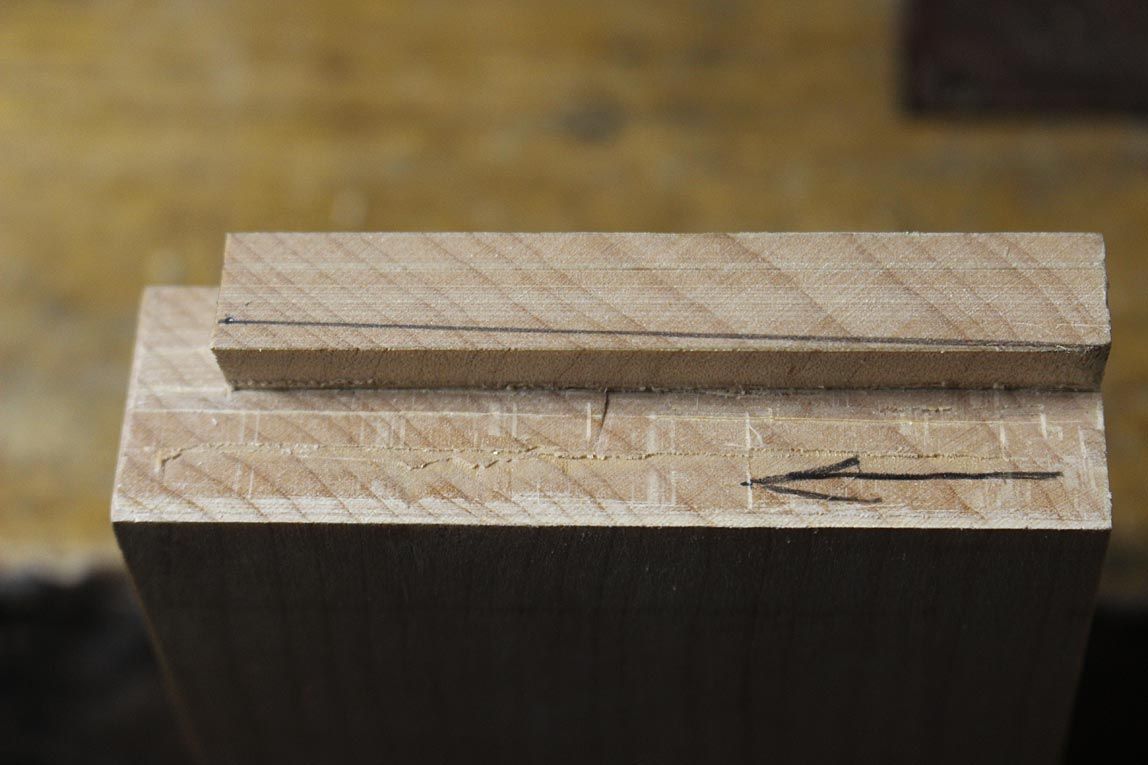


All of the sockets were marked, sawn and chiselled.

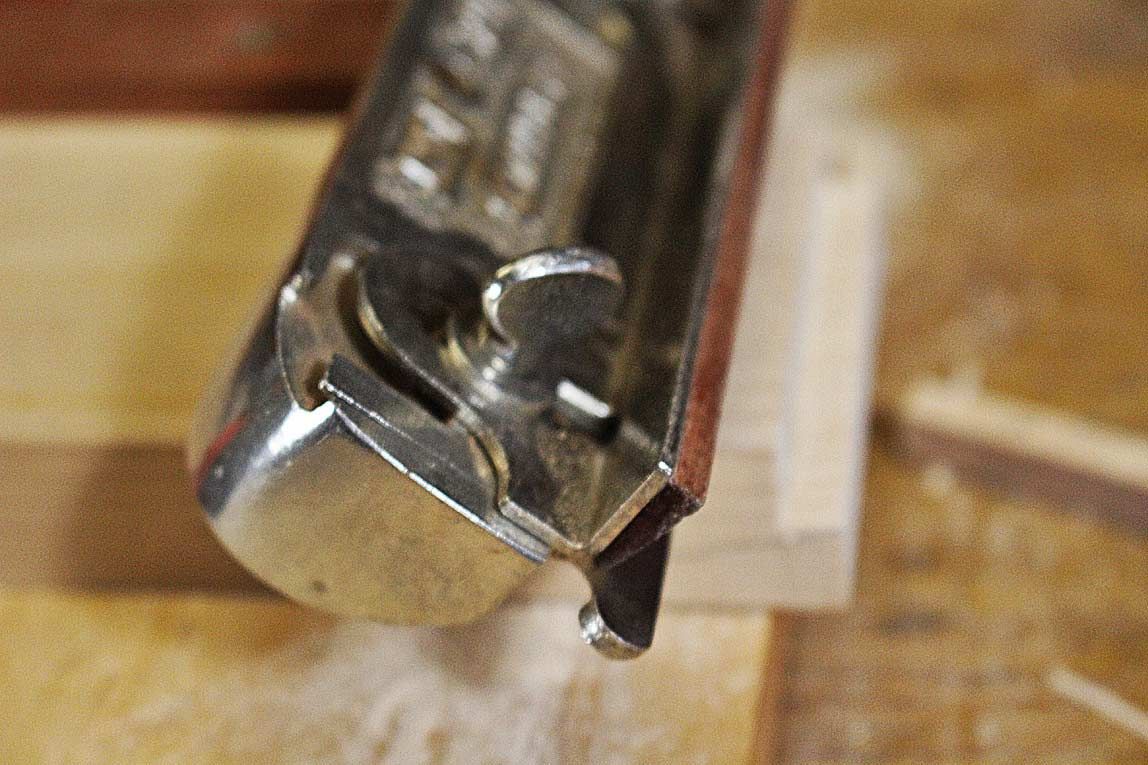
The dovetails were planed with a modified Stanley #79 side rabbet plane. The modification involved an angled fence ...
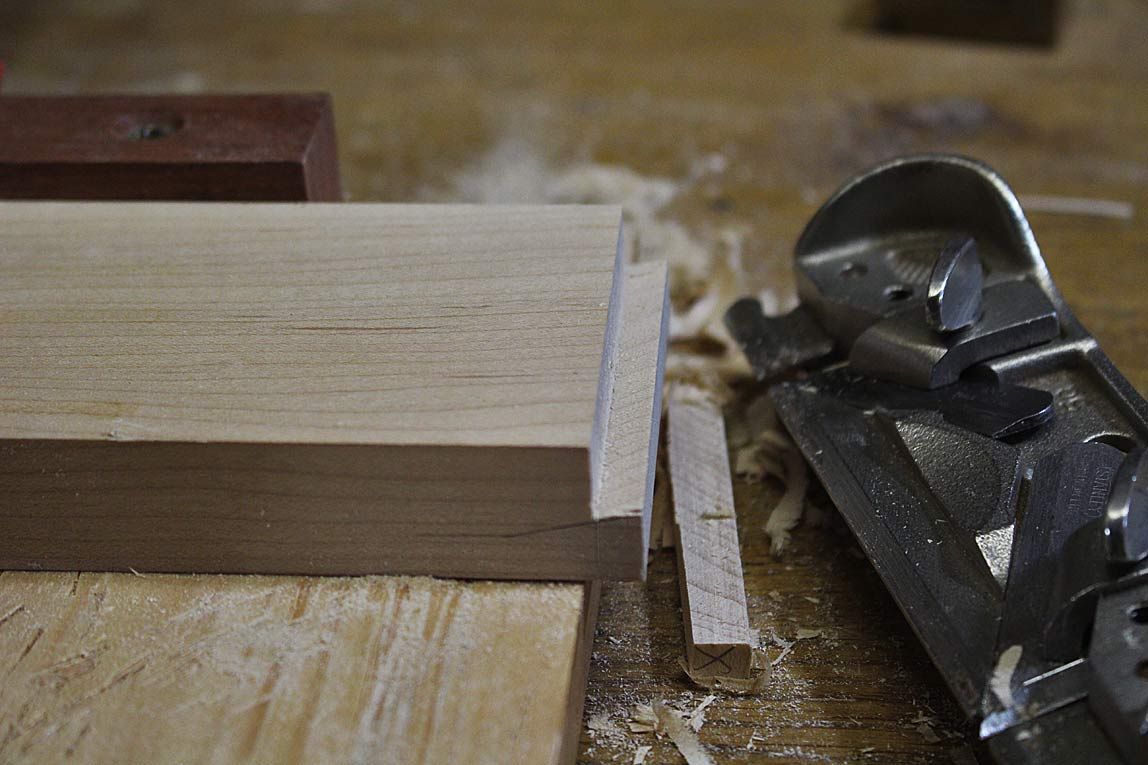
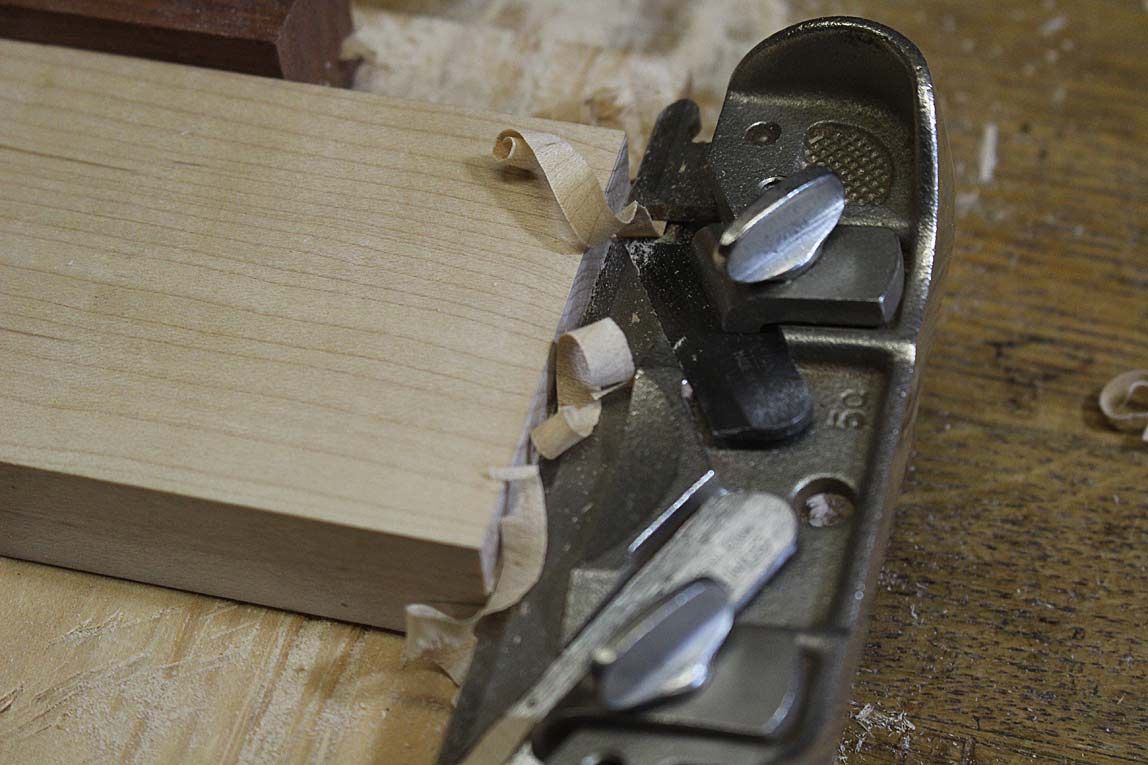

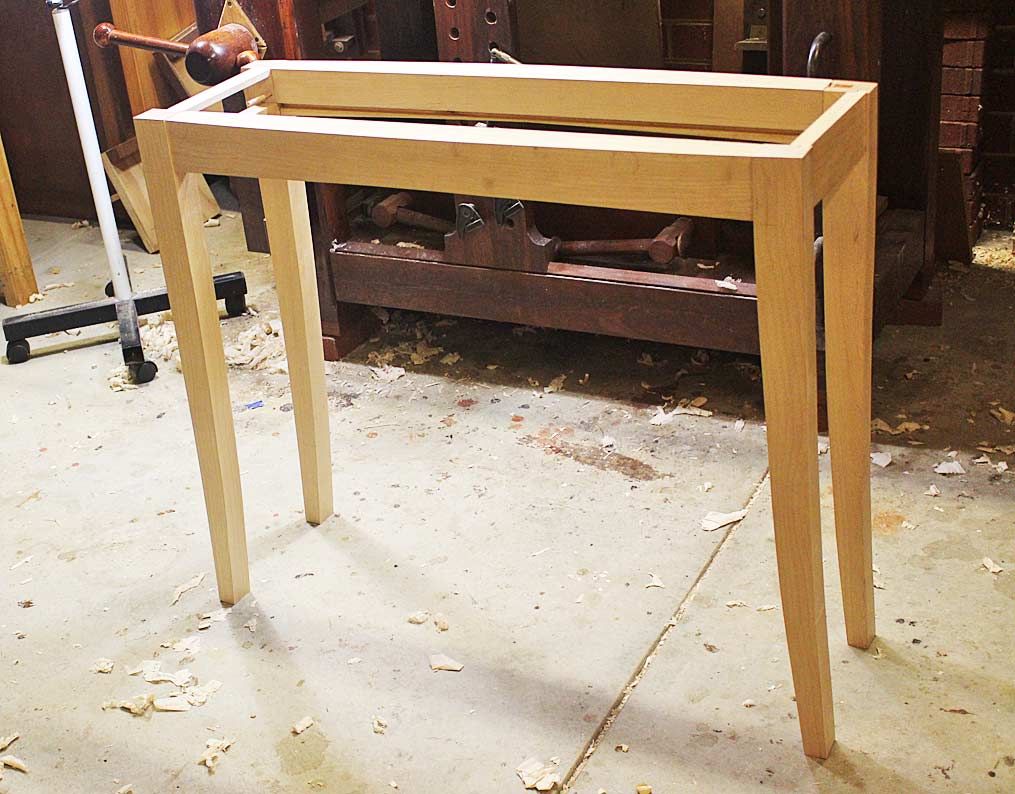
Finally, this is where I am up to with the sofa table. The front legs need to be rounded, and all the legs are yet to be tapered on the insides. There is clean up to do, a drawer to build, and the tabletop to resaw and shape.

Regards from Perth

Derek
Re: Sofa Table - part III

#2

Kneale Brownson

Re: Sofa Table - part III

Kneale Brownson

Is a "sofa table" intended to go at the end of a sofa, which I know as a side or end table, as opposed to a coffee table that goes in front of the table?

Re: Sofa Table - part III

#3

I like the legs even better

Bill Tindall, E.Tn.

Must remember the dovetail solution for the ends.

Re: Sofa Table - part III

#4

Outstanding - and a question about sofa tables

Tim Greif - West of Chicago

You really do outstanding stuff with your joinery. I've always had a fear that sofa tables (tables sitting behind a sofa in the middle of a room) were subject to getting knocked over, especially with small children around, due to the narrow nature of the table. I've seen some that had a horizontal piece that ran under the sofa to prevent tipover. I wouldn't want a table or lamp on said table to fall over on some kid as they grabbed or bumped the table. How does everyone else address this? Am I just being paranoid?

Re: Sofa Table - part III

#5

Re: Outstanding - and a question about sofa tables

Bill Tindall, E.Tn.

1. Such tables go against something, the sofa or a wall in the case of a wall/hall table.

2. When children are young the house is organized to accommodate their age, which includes more than just narrow tables and glass vases!

It's like running a table saw. If it looks unsafe don't do it. :)

I my case we are unpacking the cut glass and china to go into the display cabinet. Grandchildren are old enough now and daughter no longer has one of the few dogs I ever disliked, a stupid neurotic animal.

Re: Sofa Table - part III

#6

legs with a flair...question

Bill Tindall, E.Tn.

Regarding the outside edge....where does the flair begin along its length. The picture looks like it may flair all the way to the top?

How much does the leg stick past a perpendicular dropped from the top edge. (outside flair amount)

How did you draw the leg flair.....freehand, with a bent stick, the LV asymmetric flair maker....?

Re: Sofa Table - part III

#7

Usually

Mark Mandell - Gone Round In New Jersey

It stood behind the sofa and would hold one or two lamps that provided reading light over an occupant's shoulder. Other bric-a-brac may be placed but it was common for a floral arrangement to be centered.

Modern decorators often put the sofa against a wall and use end and coffee tables instead. The sofa table form has often been relegated to that of a small sideboy against a different wall.

It very much depends on the chosen traffic patterns in a particular room.

Re: Sofa Table - part III

#8

The problem with sofa tables and lamps

Gary Smyth

is that you need a floor box for the lamp cord. Artwork and large ceramics present fewer problems which is why sculpture and large chargers on stands are often present. Floor boxes for the electrical are expensive and require special consideration against moisture and many times are in the wrong place for modern sofa placement.

Re: Sofa Table - part III

#9

Re: legs with a flair...question

Derek Cohen (in Perth, Australia)

Regarding the outside edge....where does the flair begin along its length. The picture looks like it may flair all the way to the top?

How much does the leg stick past a perpendicular dropped from the top edge. (outside flair amount)

How did you draw the leg flair.....freehand, with a bent stick, the LV asymmetric flair maker....?

Thanks Bill.

The legs begin with a straight section that is 75mm long - that is 5mm longer (or under) the apron and stiles. The curved/flared section develops from that point, but faired into the straight, so that they blend together.

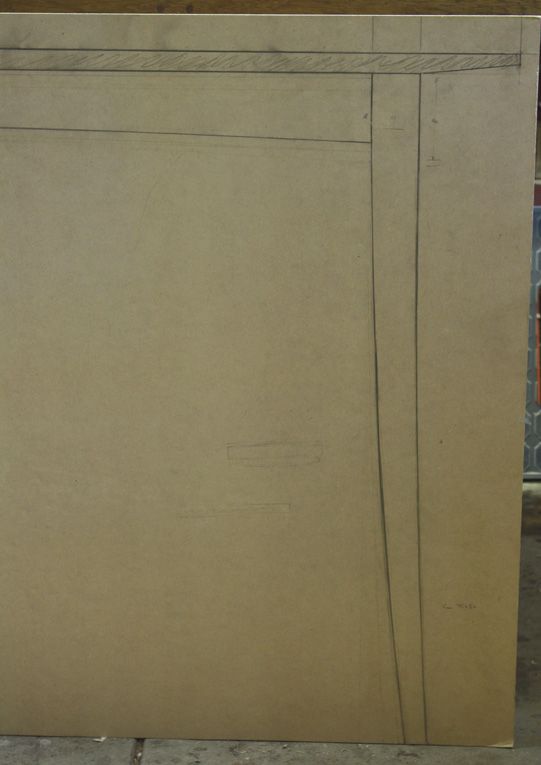
All the curves and details begin with an idea and crystalise in my imagination. Then they need to be plotted on paper to see if they work. I prefer to drawer them lifesize on 3mm thick MDF sheets, which I can stand up and look at from different angles.

The drawing of these curves is initially done freehand, and then I go over them with curved edges. I make these with long sticks, old fibreglass windsurf battens, steel rules, or French Curves. In this case I use a bow made from a 1m long steel rule. While a rule like this bends symmetrically, different sections off asymmetry (which I prefer).

The outside of the legs curve coplanar to the apron (and the table top). The inside of the legs will taper in a straight line from 5mm below the apron. The foot of the leg will end up 25mm square (from 40mm).

Regards fro Perth

Derek

Re: Sofa Table - part III

#10

for the matematically inclinated....

Bill Tindall, E.Tn.

"While a rule like this bends symmetrically, different sections off asymmetry (which I prefer). "

The curve created by a bent rule intrigued me for some time. Instead of creating it with something bent, that might or not be uniform enough to yield a smooth curve, I wondered if this kind of curve could be calculate and then just plotted on graph paper to design a leg or table top. I could not find any simple geometry that replicated this curve. I found that it is not a parabola, hyperbola or catenary. None of these curves quite fits the shape. I challenged the mechanical engineer neighbor to enlighten me, in trade for the shop time he requests from time to time.

The shape can be calculated using the mathematics developed to describe beams bending under load. In this case it is a beam supported at each end and a load centered in the beam length. Google bending beams.

Turns out the shape is straightforward to calculate in lieu of finding a stick to bend. In the case of Derek's leg only half the curve needs to be created with the bending stick. But for a table end one would like each half of the curve to be the same. My sticks rarely bend to make each half equivalent/symmetrical. In these cases I just calculate the result and plot the curve, smoothing the calculated points with a French Curve. (or if one had access to a large plotter.....)

Re: Sofa Table - part III

#11

confirming?

Bill Tindall, E.Tn.

If I understood your replies the outside corner of the bottom of the leg falls directly below the corner of the rectangle defined by the top of the table frame? In other words if one were to trace the rectangle defined by the outside edges of the bottom of the legs it would match in size the rectangle defined by the top of the table's leg and apron assembly (legs plus aprons). There is no outward flair of the legs in any plane?....(not what it looks like in the PIC)

Re: Sofa Table - part III

#12

Looking at photo it appears that the leg bottoms

Gary Smyth

extend past the apron of the table. I wonder though if the rectangle you describe might include the table top which is not yet installed? Just guessing but the top will extend past the apron and therefore form a rectangle and not be a tripping hazard that might occur with a outwardly extended leg as apparently shown in the photos.

Re: Sofa Table - part III

#13

Re: confirming?

Derek Cohen (in Perth, Australia)

Hi Bill

The leg is, in effect, vertical with an outward sweep (the curve of the leg). An earlier photo - leg is the same as now, but its position was moved inward ...


The outer face of the leg is shaped with the same bow as the apron (i.e. is coplanar with it).

The inner face of the leg will taper in a straight line from the top (5mm below the stretcher), where it is 40mm wide, to a 25mm square foot. The inside taper will create the illusion that that legs flair - but they are in fact vertical.

The reason for not flaring the legs outward - such as by turning the legs at an angle (say, 45 degrees) - is that this alters the way the curve is seen in the legs. The curve is reduced.

The benefit of a flare is that it increases the footprint and stability of a table. In this instance, this is unnecessary since the legs are wide enough (tested by an existing sofa table which it will replace), and it is placed against a sofa rather than in an open space.

Regards from Perth

Derek

Re: Sofa Table - part III

#14

Re: The problem with sofa tables and lamps

Brian Holcombe

I agree Gary, that is the best way to do it. If I could plan a house from the ground up I would always put in floor outlets for lamps.

The problem exists pretty much regardless of wether or not you have a sofa table, IMO. If you do not, such as myself, then you're still in need of a place to plug in floor lamps.

I dislike, greatly, overhead lighting in living rooms and so I use floor lamps and table lamps.

I have a 2 year old, he's getting accustomed to the rules of the house currently but still does occasionally test the boundaries.