Osmo Oil? *LINK*
JL
Got the latest FWW magazine.
One of the articles was touting Osmo oil - which I had never heard about.
I guess it is the latest finish du jour. The specs look interesting.
Thoughts?
Osmo Oil
Knowledge You Can Build On — Est. 1998

Osmo Oil? *LINK*
JL
Got the latest FWW magazine.
One of the articles was touting Osmo oil - which I had never heard about.
I guess it is the latest finish du jour. The specs look interesting.
Thoughts?
Osmo Oil
Re: Osmo Oil?
Bill Tindall, E.Tn.
If German, the most important attribute will be how "green" it is *perceived* to be, not how good a finish it provides.
The MSDS sheet says the solvent in essentially mineral spirits. It contains 2-butanonoxime, which binds the crosslinking catalyst, probably cobalt or manganese salt, to prevent curing in the can. So from that we know the resin is a drying oil. It might be "boiled linseed oil" in a nice container with an extra load of drying catalyst to yield a more rapid cure. Hard to imagine it provides a more durable finish than what is already readily available to us. But you can slather it on products and tell customers it is "safe", glossing over the fact that all our finishes are safe when used according to directions provided.
Re: Osmo Oil?
Joe Piotrowski
Richard McGuire, aka the English woodworker, likes it. If a multi generational woodworker, who puts food on the table with this craft, recommens it,then it's worth a try.

Maybe he is compensated for "liking"?
Re: Osmo Oil?
Don Stephan
Or perhaps, if he markets his work, the product is a marketing distinction from competition. Someone should ask him.
Re: Maybe he is compensated for "liking"?
Joe piotrowski
Not according to him.
What is missing from conversation
Bill Tindall, E.Tn.
For most of us the important attributes of a finish are cost, appearance, ease of application and durability. If someone advocates a new finish they need to address these factors, comparing to alternative finishes commonly used.
Only making claims of how "green" a finishing product is preys on ignorance. All finishes are safe when used according to directions. It will hard to justifiably claim something is greener than shellac or the drying oils which are based on seed oils. But it will be hard finding these products in a container that proclaims their greenness. From what I could gather from the MSDS sheet the Osmo stuff is little to no different than the drying oil products we already have available.
The only finishes that are entirely made from synthetic chemicals are the waterborne finishes. All the varnishes are based on vegie oils. Lacquer is derived from cellulose from trees, nitrated with nitrogen from the atmosphere. Can't get greener than that!
Re: What is missing from conversation
Barry Irby
I second everything Bill said.
While I try to be "green" I find it hard to believe that the use of finishes at the level I use them has ANY impact on the planet.
I also suspect that some green products are green when we use them, but the manufacturing and sourcing of them may not be.
I also suspect that using a product such as this and having it fail prematurely will be far less green once you consider the strippers and new finish it takes to replace it.
Re: Osmo Oil?
Fetcham
Some years ago I conducted an experiment looking at two things - the effect of various finishes on lustre and the ability of those same finishes to prevent or reduce the tendency of strong light to change the colour of the underlying wood. This involved the finishing of samples of a number of different wood species with with each of the finishes alongside unfinished samples of the same species as a control. These samples were then exposed to summer sunlight outdoors (so as to avoid the UV filtering effect of glass) over a period of three months. So far as lustre was concerned, although all samples showed significant colour change, exposure to sunlight made no difference to lustre. However, there were significant initial differences between different finishes which was maintained throughout the experiment. Broadly speaking these can be expressed by reference to the appearance of the finished in the can; the greater the opacity of the liquid finish, the greater the adverse effect on lustre. Unsurprisinly the worst was Osmo Polyx oil, followed by a water borne finish which had the characteristic milkiness in liquid form. The best were blonde shellac closely followed by pre-catalysed melamine lacquer.
I wouldn't hesitate to use Osmo on things like floors and doors (although there are certainly better options for the latter) but I certainly wouldn't use it on furniture where the natural beauty of the wood is an important part of the overall effect. It somehow takes a little of its "life" away.
Jim
Thanks
JL
I read up a bit on the ingredients. The oils present in the Osmo appear to consist of oils that are not really "drying" oils like linseed or tung oil. Osmo also has a bit of wax in it. That may be why it might appear "muddy".
question
Bill Tindall, E.Tn.
"The oils present in the Osmo appear to consist of oils that are not really "drying" oils like linseed or tung oil."
What are they then? This stuff obviously has an oxidative cross linking catalyst so something in there has double bonds.
from their web site
Bill Tindall, E.Tn.
"Based on natural and renewable vegetable oils, with a very low-VOC content, the products are environmentally friendly!"
From one of their vendors...
JL
"Key ingredients in Hardwax Oil include sunflower, soybean and thistle oil, plus two hard, natural waxes—carnauba and candelilla."
Are sunflower, soybean and thistle oil really drying oils? Seem to be mostly mono unsaturated and di unsaturated fatty acids - by the iodine values they are classified as semi-drying oils. Thistle is 66% linoleic acid, sunflower is about 59% linoleic acid and soybean about 50% linoleic acid. Soybean does have about 7% linolenic acid.
Interesting
Bill Tindall, E.Tn.
This "Green Game" can get interesting for a chemist. I stop by Whole Food occasionally to check on what is being perpetrated to the believers. The "mineral-free" water buffered with phosphate was an amusing example. I searched another green claim for a detergent where feel good green claims were made. The up front claims had a green feel but upon digging deeper other key components that made the stuff work were the same synthetic chemicals used by everyone to make a detergent effective.
This stuff must have a metal, curing catalyst because the MSDS sheet lists another chemical used to stabilize these catalysts in drying oils.
One has to wonder if this stuff is linseed oil with a whiff of cooking oil to make it sound as comfy as the oil your chicken is fried in (whoops, frying is bad, need another example). These vegie oils will eventually oxidatively cure to a thick goo. Maybe mixed with linseed oil and a boat load of catalyst the mix will yield a not very durable green film that can be scraped from the table and eaten if starving. I would not be surprised to see a "gluten-free" claim somewhere on the can.
If someone feels good using it instead of finishes with proven history I shouldn't object.
Here Is Sample on Curly Cherry
Phil
A pic of a table top I was working on recently: PolyX Gloss. Its very nice to work with and provides a finish somewhere in the satin/semi-gloss range. I was trying to capture the chatoyance but my photo skills are limited: trust me, it looks pretty nice.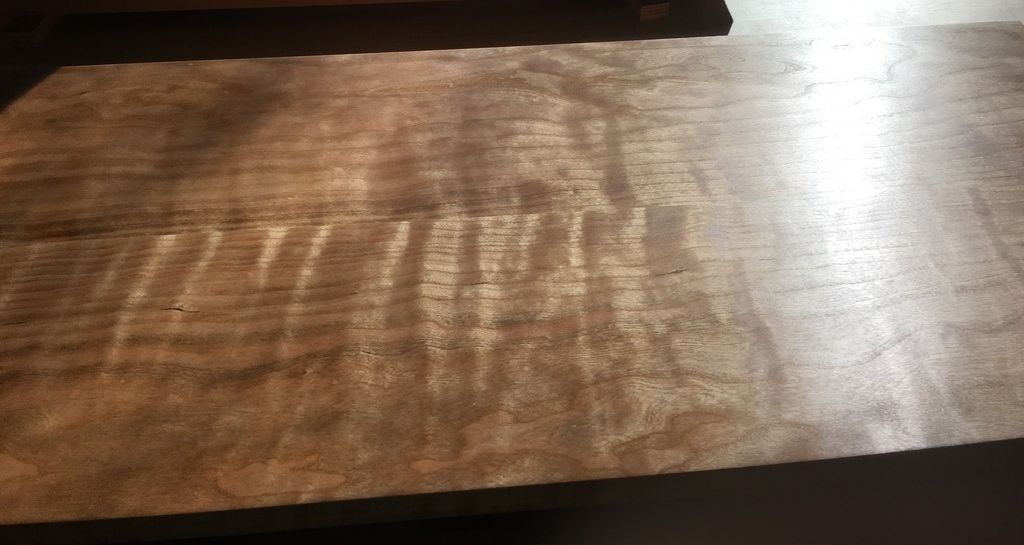
questions
Bill Tindall, E.Tn.
How did you apply it? How may coats? How quick does it cure at whatever temperature it was at? What does it cost a quart? How hard is the film that is formed, if it forms a film...can it be easily dented with a finger nail or not?
Re: questions
Phil
Well thats a lot of questions Bill: I will answer the ones I can remember and get back to you on some of the fine details.
Cost: It's expensive. But I learned a long time ago that its false economy to try to save a few dollars on the final step of a project that may have taken weeks or months to complete. For a .75 liter can it runs around $40: but it does go a long way.
Application Temp: Nothing special, I keep my shop in the high 60's for finishing.
Application Tools: I use a white non-woven pad.
Number of coats: I think that top had 5 or 6 coats when that pic was taken.
Film finish: no, not what I would call a film. It is an oil/wax finish and I have one other piece that is around 2 years old now and still looks good. I am not sure I would use it for a kitchen table (I'd use an oil poly there), but for end tables and such, it seems to be fine.
Finish schedule: I will try to find the link (it was provided in one of Chris Schwartz's blog posts some time ago).
Hope that addresses your questions: let me know if I can provide any more input.
Re: questions
Bill Tindall, E.Tn.
"Application Tools: I use a white non-woven pad." Don't know what this applicator is.
do you wipe it on and then wipe off the excess?
Re: questions *LINK*
Phil
Here is link to Chris's finish schedule for OSMO PolyX:
https://lostartpress.files.wordpress.com/2014/04/osmo-polyx-oil-finishing-schedule.pdf
Re: Here Is Sample on Curly Cherry
William Duffield
N.B. It is not possible to illustrate chatoyance with a single image. You need binocular vision and a relative movement between the chatoyant object and the eye or video camera.
Re: Here Is Sample on Curly Cherry
Phil
So you will have to take my word for it: molto chatoyance 


