A smoother resaw
Derek Cohen (in Perth, Australia)
The current bandsaw thread is drifting a little low on the page, so I thought I would start a fresh one.
I mentioned there that there are two features we seek when resawing: the first is to saw straight, that is, that the blade does not wander. It is then possible to create veneers of even thickness, or minimise the waste when sawing away boards.
The second feature, which is the topic here, is to create a smooth surface, that is, one that requires the minimum planing or sanding. My question is what can one do to reach this goal (assuming the obvious, which is the bandsaw is set up optimally). I have one suggestion, and then will open the thread to the ideas of others ...
In my search for a smooth finish, I did try the blades sold by Highlands. They do produce a beautiful finish, one which requires little finish work. The one used in the picture below was a 1/2" ..
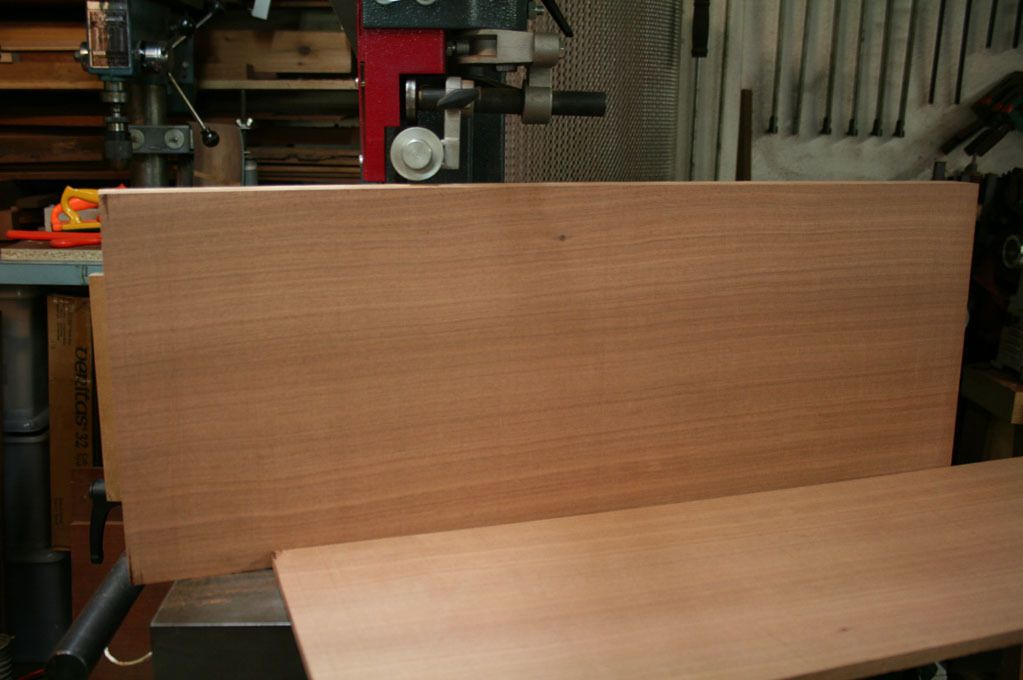
The problem with this blade was that it lasted only a short time. The wood I work with is very abrasive (contains high levels of similar), so your experience may differ. But, for this reason, I stick to bimetal (HSS) blades. The second reason for using bimetal is that I can resharpen these myself. I am doubtful I can do the same to carbide.
My bandsaw is a Hammer 4400 (17 1/2"), and the current resaw blade is a 1" wide Lenox Woodmaster, which has 1 1/2 tpi. When first used, the bandsaw/blade combination produced a dead-straight cut, however there were more saw marks than I considered desirable. My thought was that there was either an errant (or more) tooth with excess set, or that the blade had too much set altogether.
Unless something is really faulty, I do not send it back. I fix it myself.
The method I used to remove the excess set was to run a coarse diamond plate along the bandsaw blade.
Place the diamond plate against the fence and move thie fence/plate combination up against the blade so that it is just touching the outermost edge of the teeth. Ensure that the diamond plate is vertical, and clamp it in place.
Now run the blade past the plate by hand (spin the wheels). Do the same on the other side of the blade. Test the blade by resawing. Do this in very fine increments until you get the cut you want. Just be aware that some set is needed to avoid binding.
Other ideas, suggestions, or just comments?
Regards from Perth
Derek
 , but I'm sure carbide will be an advantage there.


