Home Articles Forums Gallery Marketplace Videos

WoodCentral Forums

Knowledge You Can Build On — Est. 1998

Combination Press Plough Plane

finishing after cabinet scraping

Posts

finishing after cabinet scraping

#1

finishing after cabinet scraping

Matt

I was thinking of learning how to use a cabinet scraper. Everyone says you'll never use sandpaper again. My question is this -- normally, you sand between coats of most types of finishes. So what do you do if you scraped the wood? You don't scrape the finish do you?

Thanks,

Matt

Re: finishing after cabinet scraping

#2

Re: finishing after cabinet scraping

Derek Cohen (in Perth, Australia)

Hi Matt

After scraping there is nothing to do but finish.

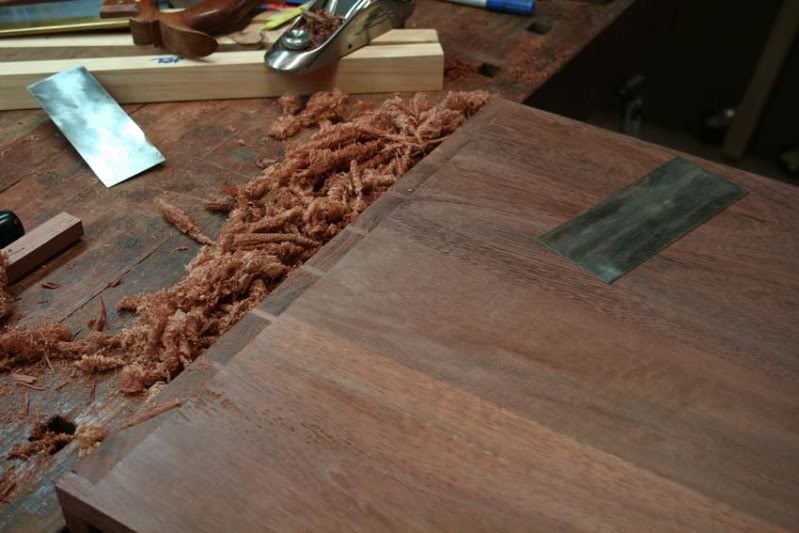
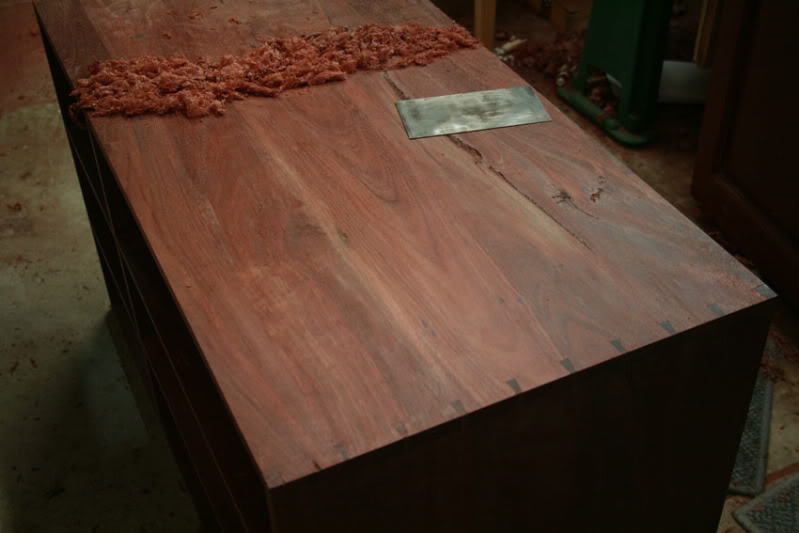
Here is a Jarrah chest (one of a pair based on campaign chests) that was scraped rather than planed.

The reason for scraping was that I wanted to avoid any spelching at the dovetails. The surface changes from planing (best) to scraping to sanding (worst), and it is not a good idea to mix the methods. On these chests, the hard Jarrah scraped to a surface nearly as good as one planed.


I finished this cabinet in danish oil and wax.


Regards from Perth

Derek

Re: finishing after cabinet scraping

#3

Re: finishing after cabinet scraping

don stephan

Matt

To save time I frequently use planes and a scraper, but your finishing options will be limited without having sandpaper.

Some finishes need a mechanical "bite" onto the wood and the previous coat. Some finishes applied with a brush never level perfectly, and need sanding to remove brush marks. The first coat of finish may "raise the grain" and leave whiskers of wood that need to be lightly sanded.

Hand planning and/or scraping can be used instead of level sanding of raw wood, but you might not completely eliminate sanding.

Re: finishing after cabinet scraping

#4

you have been misinformed

Bill Tindall, E.Tn.

"Everyone says you'll never use sandpaper again" Not correct.

I use a cabinet scraper in cases where I need to remove defects that would be slow to remove by hand sanding. A scraper is between a hand plane and sandpaper in my shop in terms of rate of material removal and I use it accordingly. Sanding precedes everything I finish.

It has been proven in many studies that there is no difference in appearance whether a surface has been properly sanded, scraped or planed once a finish is applied that builds a coating of finish. Hence, it is a personal choice as to what you want to do.

In my case I can not get the effect from staining I desire unless I sand. Scraping and planing leaves the surface too open and it drinks up too much stain.

Picture is a walnut sanded and stained surface.


Re: finishing after cabinet scraping

#5

Re: you have been misinformed

Derek Cohen (in Perth, Australia)

Hi Bill

I have little experience with staining, so defer to you in this regard. However, a planed or scraped surface does not finish worse than a sanded surface with oil or shellac, in my experience. If anything, the planed surface enhances these finishes, where the sanded surface is less clear. I actually scraped the sanded areas in the chest I recently built.

Below you can see the difference between a 400 grit sanded surface and a finely scraped one ...


Regards from Perth

Derek

Re: finishing after cabinet scraping

#6

Reply

Bill Tindall, E.Tn.

Everyone will agree that an expertly scraped surface looks different from a sanded surface as you illustrate....before finish is applied. However, most agree that this difference vanishes when a finish is applied that builds some surface layer of finish (shellac for example in the picture I provided).

It may well be that scraped appears different from sanded for what I call a minimalist finish such as wax or a thin coat of shellac. I don't know because I don't use these finishes. They are not sufficiently protective for my needs.

In response to the original question I think it correct that to say that "few woodworkers eschew sanding".

Re: finishing after cabinet scraping

#7

Re: finishing after cabinet scraping

Alexander Grigoriev

You'll still need to sand before coats. Especially after the first coat.

Re: finishing after cabinet scraping

#8

*need to sand between coats


Re: finishing after cabinet scraping

#10

Re: finishing after cabinet scraping

William Duffield

Frank Klausz advises: You plane; then you scrape; then you sand. I've found it to be futile to argue against his advise.

Regarding sanding between coats, I've found it to be more practical to raise the grain with distilled water and then sand once more with the finest pre-finish abrasive. This removes most of the nibs. The abrasive to use between coats of finish is completely different than the pre-finish abrasive for raw wood. It is necessary to abrade between coats because raising the grain doesn't remove all the nibs, and more dust falls out of the air and sticks to the finish while it is drying. You can use synthetic steel wool, real steel wool, stearated paper or a lubricated paper.

Re: finishing after cabinet scraping

#11

Re: finishing after cabinet scraping

Bill Tindall, E.Tn.

When my planer is performing well I go from thickness planed to 120 grit sand paper with no need for scraper in between. However, if I have torn grain to remove the scraper is the quickest, safest way to remove it.

Re: finishing after cabinet scraping

#12

Small Warning

Mark Mandell - Gone Round In New Jersey

Never m(ever) use steel wool if the finishing routine will include waterborne finishes. Wool will leave tiny bits of steel in the wood pores which will then rust and create spot in the finish. In addition, steel wool has an oil treatment to keep it from rusting. That oil can create adhesion issues with water based finishes. Synthetic wool is fine.

Re: finishing after cabinet scraping

#13

Re: Small Warning

William Duffield

Why would you use water-based finishes unless you were forced to by the State of Kalifornia? :D You can use the steel wool to make red oak look like pecan. :D

What I take away from Frank's recommendation is that you should be prepared to plane and scrape and sand, to make sure you get the best finish possible. If your personal experience and the job and the tuning of the tools at hand allow you to skip one or more of these steps, you're ahead of the game.

Re: finishing after cabinet scraping

#14

Why?

Mark Mandell - Gone Round In New Jersey

Because they're fast, easy, go down like glass with a good gun, have 100% burn-in when done right, flexible, very tough . . .

and Memsahib doesn't get on my case about solvent smell!

What's not to like? ;)

Re: finishing after cabinet scraping

#15

Jim DeLaney, Austintown, Ohio

Re: Why?

Jim DeLaney, Austintown, Ohio

Amen to all that, plus gun cleanup is easy, too.

They're what I use about 90% of the time. Mostly Target EM-6000, or EM-8000cv.

They take Transtint dyes well, too.

Re: finishing after cabinet scraping

#16

Re: you have been misinformed

Sgian Dubh

I rather agree with you Bill. I don't know a single woodworker, whether they be amateur, professional, and anything in between working at a high level that doesn't use at least some abrasive paper in their finish prepping routine.

I'm aware of quite a number of woodworkers that claim to routinely go straight from either planes alone and/or scrapers to applying a wood finish. I've mainly heard or read such claims (although a tiny number of people have made similar claims to my face) but I've never been able to witness anybody regularly and swiftly achieve polish ready wood with this prep routine - in the extremely limited number of cases I've witnessed where someone tried to demonstrate their ability in this wood prepping methodology they've always had to admit defeat in the end and reach for at least some abrasives papers to get the job polish ready.

It may of course be that I'm just not a very good wood prepper myself and need someone to show me how it's really done, ha, ha. Slainte.

Re: finishing after cabinet scraping

#17

Re: Why?

William Duffield

Don't they turn your project blue?

I was just playing "Devil's Advocate". I guess I'm just too much the traditionalist, and I happen to like the smell of linseed oil, tung oil and petroleum distillates in the morning :D