Home Articles Forums Gallery Marketplace Videos

WoodCentral Forums

Knowledge You Can Build On — Est. 1998

Fast and affordable laser cutting – so you can make the parts you can’t find anywhere else

Some dovetailing tips

Posts

Some dovetailing tips

#1

Some dovetailing tips

Bill Tindall, E.Tn.


I have the case close at hand, for this small case it's on the bench, to check fits . I also store parts in process where they go in the case.


This drawer part holder revealed to me by Roger Lance has been a great help in marking pins from tails. Before I made it I had alignment problems and problems with parts skidding during marking. Marking is now secure. I recommend it.


This Pilot pen makes highly visible thin marks on walnut. I use it for drawing the guide lines for dovetails on walnut.

Re: Some dovetailing tips

#2

Re: Some dovetailing tips

Brian Holcombe

Beautiful work Bill!

Re: Some dovetailing tips

#3

Re: Some dovetailing tips

Sgian Dubh

Your workmanship is always neat Bill. I have to admit I do find the size of your 'half' pins at either extremity of the joint visually a little heavy, and wonder if you've ever considered or experimented with making them smaller? It does seem to be that Americans generally tend towards stouter 'half' pins than British makers. For instance, typical guidelines for 'half' pin proportions generally suggested here in the UK are (or were) to make them roughly 2/3 the width of full pins, something similar to the example below.

The difference in aesthetic preference may partially be a cultural one: UK v USA tastes. It may also be related to a realistic concern about the relative inherent weakness of smaller 'half' pins. In the end I suspect it all comes down to individual preference, methods of work, and aesthetic test. Slainte.


img

Re: Some dovetailing tips

#4

A matter of philosophy

Bill Tindall, E.Tn.

I dovetail drawers because that is the best way to hold them together. I pay no attention to fashion that can't be seen, which includes anything inside a case. I have just completed a chest of drawers, these current pieces will make two more and son in law wants a large chest of drawers made soon. I am looking for ways to take labor and risk out of making drawers.

I would say that my goal is to make stuff similar to a 1800's shop making stuff to sell to middle class customers, with an occasional personal touch added such as careful wood selection. I spend a lot of time on wood selection and I have a lot to select from.

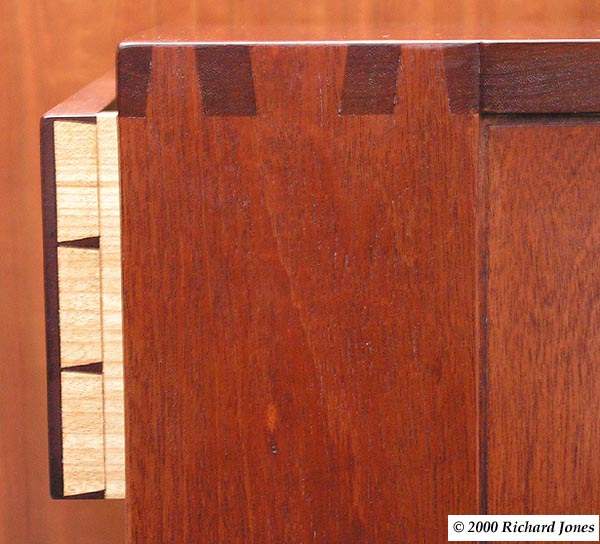
If one splits a half pin the drawer front is ruined. In my cases I have usually carefully selected drawer fronts and if I ruin one I might have to start over with a new set to get all of them to match. Hence, I make the half pins as wide as I can and still be able to hide the slot for the drawer bottom in the front in the tail of the side. The result is a half pin with the small end 5/16". I keep a marker set to this dimension.

I attempt to slightly overcut tails for it makes removing the corner waste more reliable, and easier. A crumb in the corner and the drawer side doesn't close up. I nail the two sides together and fit and dovetail them as a unit. Someone asked, "but what about the nail holes"? It's a drawer side. Who cares about a nail hole? Well, anyone striving to build as best they can would worry about a nail hole, but that is not my goal for a drawer.

Re: Some dovetailing tips

#5

By the way, I don't disagree

Bill Tindall, E.Tn.

I agree that the half pins are too fat. If I cared about pin proportions I would add the care, and risk, to make them smaller, but not dainty. I'm not a fan of dainty pins.

Re: Some dovetailing tips

#6

The origin of dainty English pins

Bill Tindall, E.Tn.

As told by Alan Batty who had a job in an English furniture factory cranking out a quota of drawers each day, as quickly as possible.

Drawers of that day had white oak sides and mahogany fronts. Pins were made first and tails marked from the pins. Mahogany is easy to chisel; white oak isn't. The waste to establish the pins was chiseled away in the soft mahogany. Then the tails were marked. Two saw kerfs and a paring thrust with the chisel established the pin hole in the oak drawer side. The soft mahogany pins were easily driven into the sturdy white oak sides to achieve a perfect fit.

If you accept this history, the currently fashionable dainty English pins had a practical origin rooted in productivity. The preference for white oak sides remains a mystery to me. Maybe they were easily riven?

In spite of the colonies being blessed with abundant white oak, for whatever reason we chose to make drawer sides from soft woods- pine and poplar. This choice made for more practical repair of drawer wear. The drawer side wears and not the drawer divider and runner which are hard to repair.

Re: Some dovetailing tips

#7

Re: Some dovetailing tips *LINK*

William Duffield

If anyone is interested in constructing this useful appliance, David Barron has more information on building one, and why you might want one, on a YouTube video:


Make a Dovetail Alignment Board

Re: Some dovetailing tips

#8

Re: The origin of dainty English pins

Sgian Dubh

I too am not sure of the reasons for oak being the preferred drawer side material in old and antique British furniture. You make valid points about wear characteristics of softer woods for drawer side material. Certainly, not all drawer sides in British furniture were oak. I've come across many that were made of softer material such as chestnut and various softwoods but, as you say, oak was frequently the preferred material, and it's still a popular choice. I tend to prefer a light coloured wood such as maple or sycamore for sides and drawer bottoms, primarily because they provide a light or bright drawer interior.

I understand your reasoning behind the relatively heavy half pins you produce. I suspect you could slim them down somewhat if you wanted to - I see no evidence that you lack the ability to do so, but I respect your preference and choice.

I don't recognise the drawer making methods of Alan Batty you relayed as being the norm, not for me anyway, because I've generally been a tails first and pins second worker. This has allowed me to cut up to three or four pairs of drawer sides ganged together in one go, much as you do with nailing two sides together. Still, I don't doubt the methodology he described to you as being the preferred method in the part of the industry he's experienced. I suspect it's simply an example of different work methods suiting different work environments. Slainte.

Re: Some dovetailing tips

#9

drawer side material

Bill Tindall, E.Tn.

There is a shop in Shelbyville, KY that specializes in antique English furniture and they have a lot of it in stock at any time. The owner makes two buying trips to England each year to purchase pieces. The owner says similar pieces would be times more expensive if made in US. I never miss a chance to stop by when visiting daughter and poke around in the pieces. From this limited experience I have observed that the older English drawers had softwood sides and larger dovetail pins. The wood is invariably mahogany except the very old pieces which are oak and relatively crude. But I am only seeing what the shop buys for the American market.