Home Articles Forums Gallery Marketplace Videos

WoodCentral Forums

Knowledge You Can Build On — Est. 1998

Want Better Milling & Firewood Knowledge?

Discussion-engineering the bottom of case goods

Posts

Discussion-engineering the bottom of case goods

#1

Discussion-engineering the bottom of case goods

Bill Tindall, E.Tn.

I hope this post results in some comments from others that build case pieces.


In a typical case piece like a chest of drawers there is a traditional way to construct the base and feet. As shown in the sketch, drawn by our XXXXX the case is assembled with a panel dovetailed into the top and bottom of the case sides to make a box. A frame is assembled that becomes the interface between this box and the feet, both of which are screwed to the frame.


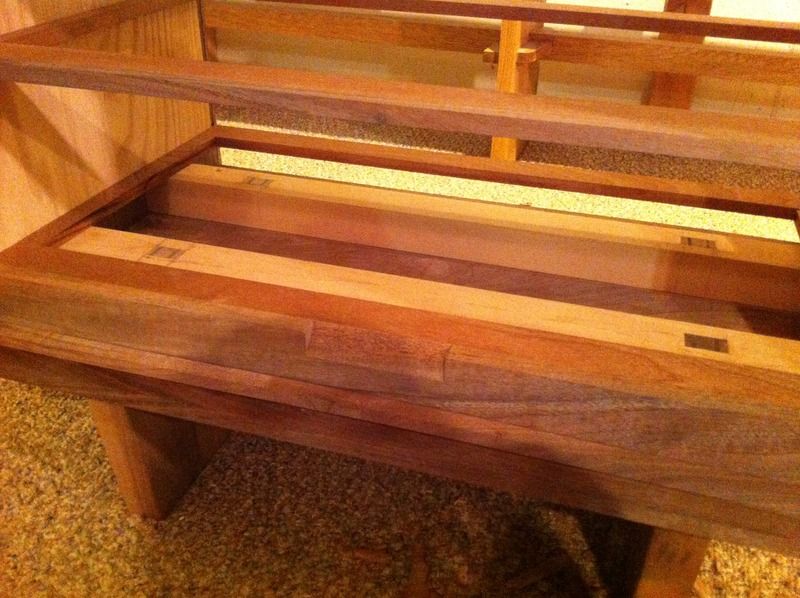
This construction is shown in real life in this cherry chest of drawers. The frame and bottom trim are in the foreground and the case with its dovetailed bottom panel is in the background. I can think of two advantages of this construction. The panel dovetailed into the case top and bottom restrains the case sides to keep them flat. The grain of the feet and trim molding runs parallel to the grain of the frame. The only cross grain issue to contend with is the joint between the case sides and frame. Are there other advantages for this construction?


A second approach is to extend the case sides to the floor and wrap the trim around this base. The advantage of this construction is that it is easier to accomplish and the integral feet are stronger. Gluing the side trim to the front of the case and nailing it to the back accommodates changes in the case side with humidity changes. A disadvantage is that nothing holds the bottom of the case sides flat.

I have made case pieces both ways and remain unsettled what to do with future pieces. Anybody have some experience to add to the discussion?

Re: Discussion-engineering the bottom of case goods

#2

Re: Discussion-engineering the bottom of case good

Brian Holcombe

Bill,

Here is another option. For case sides where the grain runs top to bottom I used this;


The base uprights protrude through the bottom panel, where they are housed, into stretchers located just above the base panel.


And here is my current project, which functions similarly to your setup but without screws (I may add a few along the back stretcher as a source of insurance).


The base panel in both cases is dovetailed in with half blind dovetails. You are aware of how the drawer supports are installed in the butler's desk, but in the tall upright case they are installed with sliding dovetails and pinned at the front.

Re: Discussion-engineering the bottom of case goods

#3

Ellis Walentine

If it solves the  problem, do it

Ellis Walentine

The essence of design is to solve the set of problems you've posed. Your alternate method, with the case sides extending to the floor, would seem to solve the problem of a less complicated construction. You can overcome the problem of keeping the sides flat by making the bottom drawer divider frame as a structural element. You could even join it to the sides with sliding dovetails. One possible disadvantage of this "unibody" construction might be that if the dresser ever gets its feet wet, any degrade -- rot, swelling, etc. -- would be affecting the entire case instead of just the base, which is by nature sacrificial.

Ellis

Re: Discussion-engineering the bottom of case goods

#4

For what it's worth

Gary Smyth

I generally build the cabinet and base separately. I used to move a lot and didn't have mover help. For my purposes it was often easier, for practical purposes to plan for strong brass or iron handles on the cabinet (like tansu or campaign furniture) and be able to carry and place a reinforced base, level it out with leg levelers and then set the cabinet within the base. Worked for me. I never fasten the base to the cabinet. I let gravity do its job. This method seems to collect more dust as there is a gap between the two pieces.

On the other hand, for the 1950's era medical cabinet rebuild I replaced the damaged base as built with a new face over a couple of water rotted internal legs of the base. In the latter case what was there was duplicated as built.

I use what seems to be the best alternative for me.


Re: Discussion-engineering the bottom of case goods

#5

Re: Discussion-engineering the bottom of case good

Barry Irby

I have seen a number of older pieces with ruined/broken feet on them because the grain is parallel to the floor and relatively short. My "answer" to that is to make a vertical piece hidden inside the foot that protrudes out the bottom about a 1/4" or a fat 1/8". I have had several of these in use for ten years or more with no complaints so far. Admittedly a small short term sample.

One of the broken ones was a case with "french" feet that were curved outward and broken. The drawers had very thin sides, maybe 5/16" out of oak with slips on the bottom of them. I wondered how old the chest of drawers was. It sold at auction for about $75. I was tempted, but it was beat to hell.

Re: Discussion-engineering the bottom of case goods

#6

Re: Discussion-engineering the bottom of case good

William Duffield

In the drawing, you show the grain of the bracket feet running vertically. It should run horizontally. The mitered front brackets should, at minimum, be splined. Much better would be full blind mitered dovetails. Your rear brackets are half missing. They need to wrap around the back of the case, even if they are not molded or shaped (because they are not seen if the case is kept against a wall) to provide side-to-side support. They should be half blind dovetailed (tails in the back, pins in the sides). The brackets themselves should not touch the floor. There should be a series of glue blocks inside each foot, with the grain of every other block running front to back and the grain of the other blocks running side to side. The lowermost blocks should extend below the brackets by about an eighth of an inch or so.

Re: Discussion-engineering the bottom of case goods

#7

Re: Discussion-engineering the bottom of case good

Bill Tindall, E.Tn.

I see that in my cut and paste I forgot to credit the drawing to Sgian Dubh, leaving XXX as the holder until I got the spelling correct, which turned out to be forgetting to do the edit.

Speaking and speculating for Sgain I think the drawing was to illustrate in its barest elements the frame and feet approach to holding up a case. In any case that was my intended use of the illustration. Seeing the concept illustrated was intended to make the example clearer to understand. As you pointed out, and what is illustrated in the example, there are details of this construction that were not included in the drawing.

My hope was to get some experienced comment on the two alternative ways of putting feet on a case. Are there advantages/disadvantages of one approach vs the other that people have found through experience implementing this or that construction?

Re: Discussion-engineering the bottom of case goods

#8

Re: Discussion-engineering the bottom of case good

William Duffield

OK, I reposted my comments to the Hand Tool Forum. I hadn't even noticed which forum I was replying on, or even that you had double posted your question.

Re: Discussion-engineering the bottom of case goods

#9

Kneale Brownson

Love your drawer pull application!


Re: Discussion-engineering the bottom of case goods

#10

Thank you!