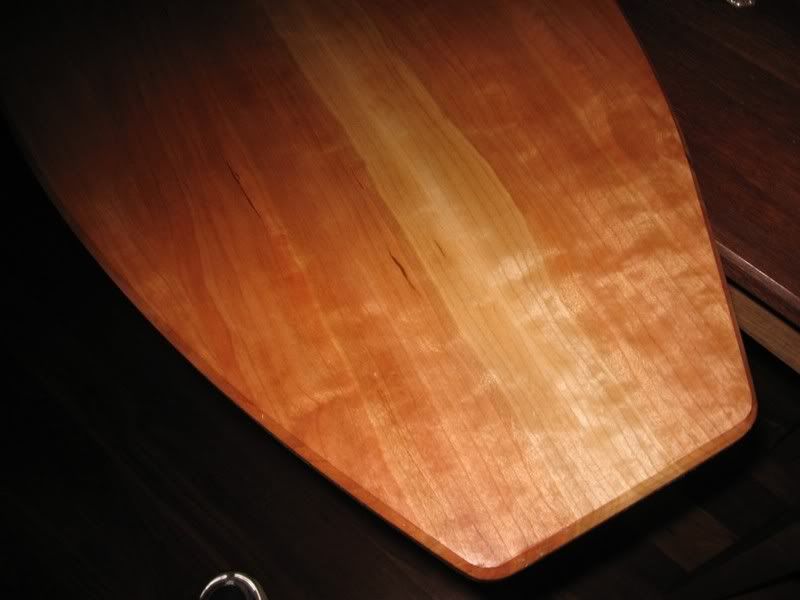
I am making simple Shaker Style moon beds for my grand daughters. The headboard has a convex curve and the foot board has a matching concave curve. The beds will be cherry cut off the family farm. The wood is tree run and not as good as I hoped. I'm having trouble cutting around the defects. I'm cutting out knots and cracks etc, but having trouble getting rid of the sap wood.
Do you incorporate sap wood into your projects? Is there a stain for it? Does it mellow out over time and blend in?
I think cherry sapwood looks fine on some casual or less formal pieces, but not on fine furniture - "fine" meaning formal or high style pieces. I consider Shaker style furniture to be less formal. I've seen sapwood incorporated in a lot of it, and looks good to me. By contrast, I think it would look out of place on a Pennsylvania highboy, for example. Sapwood in cherry will not age to blend and match the color of the red heartwood. It will soften to a creamy or slightly amber tone, but it won't ever turn red. If it were me, I'd use the cherry from your property as-is on your daughters' beds. I think the sapwood and the knots (depending on their size and how tight they are) will give the pieces some character. I wouldn't try to stain the sapwood to match the heartwood.
You could use the sap wood edge to "border" the top and bottom edges of a headboard and/or footboard, having the heartwood make up the center section(s). There the color change will tend to accentuate the heartwood. You can take it one step further and leave the top and bottom as "live" edges if that works for your design.
The sawyers and lumber dealers will always feed you the party line: "Cherry sapwood is not a defect." A lot of furniture makers will disagree with them, but trying to change their mind is an exercise in futility. So, to get a consistent heartwood color, you need to pick out your own boards (and expect to pay more), or you can buy extra boards (where trying to calculate how much extra you need is another "exercise…"), or you can stain the sapwood to match the hardwood. The color of the heartwood is of course a moving target, and you want to match the final, oxidized color, especially if you are planning to live with the furniture or the family long term. Since all heartwood is not the same color, you will want to leave the boards that are going to show out in the sun for a while to darken before attempting to mix pigments to match. You will also want to use earth pigments that change minimally over time. Dyes, and unknown stuff in a can are not the best choices.
You do not want to work with an "interior decorator." They understand the color of cherry heartwood about as well as the cardinals stealing ripe fruit off the cherry trees in your back yard, and they have about as much "taste" as Charley Tuna or a kid with a bowl of Fruit Loops. If you have to work with them, you will need to prepare samples of stained heartwood and deliver it to the "decorator" for their opinion before trying to match it. This will probably take several iterations, each one uglier than the last.
When the shop I worked in had done it, we always let the art major in the shop do the mixing and matching, because they have a much better chance of hitting the heartwood color than I do with the least number of experiments.
The stain consists of three parts: a pigment (really, a mixture of pigments), a binder and a carrier. The binder is easy: linseed oil, but pure tung oil could also be used. The carrier can be one of a number of volatile petroleum distillates, depending on how fast you want it to dry. Odorless mineral spirits is one of the healthier choices, or if you are impatient, use naphtha. Paint thinner is cheaper, but has more benzene in it. You need to use colorfast earth pigments. These can be bought in any art store in the form of pure powdered dry pigments, or as colors in oil (that used to be used by house painters for coloring oil paint and are still found at your local home center for adding to the paints they sell) or even as tubes of oil paints, which already have the binder and pigment mixed. Mixol universal tints also work. Grumbacher is probably the best choice in oil paints. For dry pigment, I use Sennelier.
Mix your colors into your carrier and apply it carefully as a wash with an artist's brush to the sapwood. You want to be careful to apply as little as possible to the heartwood. Use the brush to feather it out at the boundary. If you get it to dark, you can remove a lot, immediately with your carrier in a rag. Wait for it to dry and decide which colors to add (you can't take any away), and try again, until you get the color you want.
As far as choice of colors, you will want to start with burnt sienna, and a little burnt umber. To these you may add smidgens of other colors, which might include raw sienna, raw umber or yellow ochre, if your initial attempts are too red. You might also have cadmium red, cadmium yellow, van dyke brown, etc. on your palette.
After you think you have the color right, be sure you seal your experiments with shellac or whatever your film finish will be. Keep extensive notes. I like to record them on the back of the sample boards.
For more help, read George Frank's book, "Adventures in Wood Finishing."
I use a lot of cherry and this is a topic near and dear to me. Most sapwood gets cut and saved for other uses (runners, drawer sides, stops, web frames, etc.). Sometimes the sapwood is only on one face, so I just remember not to make that the show face. Ever now and then I find a piece of sapwood I like and manage to work it in. Couple of examples are shown.
I think trying to dye it to where the heartwood will eventually stabilize is a fool's errand - for me at least.
Last year I built a dining room table for my friends out of cherry cut on their farm. It was a PITA because there was no dimension lumber and had some through knots I couldn't avoid. They're convinced these are the things that make the table their own.