Home Articles Forums Gallery Marketplace Videos

WoodCentral Forums

Knowledge You Can Build On — Est. 1998

Build it. Rock it. Rockler has your woodworking tools.

Vdrum sander or thickness sander?

Posts

Vdrum sander or thickness sander?

#1

Vdrum sander or thickness sander?

brian-1 excite.com

A few years ago I built a sand flea type V drum sander. Works Well but I was wondering if I should have built a thickness sander instead. It does take a lot of passes over the top to get is smooth. It looks like it maybe easier and quicker to use the other style. Was wondering others opinion.

Thanks

Brian

Re: Vdrum sander or thickness sander?

#2

Re: Vdrum sander or thickness sander?

Dick Coers

Two different uses. The sand flea style of sander just sands a surface. You can get a nice finish because there is not a lot of pressure on the sandpaper. A drum sander has a set distance off the table, so thickness sands to a fixed dimension. They do put a pretty hard scratch pattern in the wood since there is pressure between the paper and the wood. That scratch pattern is only as deep as the abrasive grain size, so once you get to 180 they aren't too deep. But you definitely can tell the difference between 180 on a flea and 180 on a drum.

Re: Vdrum sander or thickness sander?

#3

Re: Vdrum sander or thickness sander?

TomD

I think the best option is the belt thickness sander. You can jig a standard belt sander to do a nice job, or you can spend multiple grand buying one of the factory built units. The advantage is the belts are much easier to change, and run a lot cooler. I found it a balancing act to get the right feed, grit, and speed, for a given wood species with my drum sander. If you blew it, you either ruined the wood, the wrap of expensive paper, or both.

Home made small drum, could be used for musical instruments, bows.


Same kind of idea but with a belt


Yowzer!


Re: Vdrum sander or thickness sander?

#4

Re: Vdrum sander or thickness sander?

TomD

You don't mention what you are trying to produce, but there are 5 other options just for starters:

1)The John Gilbert sanding disc. It is an al disc, very solid with the edges relieves, so you can shove something under it, and it will reduce the thickness and plane it. Gilbert was a great guitar builder, and tool maker.


2) The safety planer. It uses a similar approach to the Gilbert, but it more aggressively cuts away material with curly chips. Can work in concert with the above. At one time you could get versions for both the drill press and the radial arm.


3) CNC machine. I won't say much about it, but ultimately we buy all these tools and spend all this money and still can't do that much compared to CNC. Prices for smaller machines, say up to guitar size and possibly well beyond are in free fall, due to stuff like chilli pepper, free autocad/sketchup, and TinyG

4) Hand planes are an obvious thing, many time they will save a shop time and money, though in lutherie application we need something that will never, ever, blow up a piece of wood that cost 1 grand.

5) The Frid sled, which as we all know was recently invented by Nick Osterman, and many others. There are lots of creative ways of holding stuff in there if it is too fine to clamp.


Re: Vdrum sander or thickness sander?

#5

Ellis Walentine

Thanks for the great shots, Tom

Ellis Walentine

That curved router jig is sweet. I have never seen one like that. Good one.

Ellis

Re: Vdrum sander or thickness sander?

#6

Re: Vdrum sander or thickness sander?

Howard Pollack

Thanks for the pictures, Tom. Do you know if there is anywhere to purchase the Gilbert sanding disk? I couldn't find it on-line. Thanks.

-Howard

Re: Vdrum sander or thickness sander?

#7

Re: Vdrum sander or thickness sander?

brian-1 excite.com

Thanks,

But... would you rip apart your existing V drum and build a thickness sander? It seems so slow on the V drum, but do not want to do it if the difference is minimal. Any opinions from someone who has both?

Re: Vdrum sander or thickness sander?

#8

Planing with a drill press?

Dick Coers

Yup, drill presses are know for there fine adjustments and tight bearing tolerances. Man, almost the last method I would use. Especially with getting my hands as close to the head as that guy in the pic! I bought one of those for my Sears radial arm saw in the late 70s. Almost made a radial arm saw less safe!

Re: Vdrum sander or thickness sander?

#9

"Almost made a radial arm saw less safe"

Mark Mandell - Gone Round In New Jersey

I didn't think that was possible to do. :D

Re: Vdrum sander or thickness sander?

#10

Re: Vdrum sander or thickness sander?

Jerry Gibbs

I have a 30" v drum sander. Ideally I would have both. With the v drum, you can finesse a warped panel by hand to get one side flat, just like a jointer. If I have flattened one side of a warped panel, I then attach guide runners and sand the other side until even and the proper thickness. I assume you could do something similar with a thickness sander by placing the stock on a sled, like you would a planer.

I am not advocating one or the other, but a 30" v drum is relatively cheap. It is also practical to put two grits side by side for most projects. Jerry

Re: Vdrum sander or thickness sander?

#11

Re: Thanks for the great shots, Tom

TomD

Ellis, you probably have seen Tage Frid's project book? The last in his three part series. In it, he uses that jig to make his cat shaped clock, the side of which are in the same shape at the part in the pic. He may have used that jig for his chairs, though he doesn't in the book. But he also used the flat rail arangement for his bench, I think, though not in the book. He also liked a good hand held belt sander.

Re: Vdrum sander or thickness sander?

#12

Re: Vdrum sander or thickness sander?

TomD

They were for sale a few years back. I think his son now has the business, they might have one on the shelf. Don't let the prices for the tuners scare you too much, the tool was around 50 at one time.

http://gilberttuners.com/

This guy made his:


About which the gentleman from STguitarworks says: I don't have the floor space or the budget for a planer or thickness sander so the Saf-T-Planer gets a lot of use over here. What gets more use while I'm building is what I've got in the picture. 5" diameter chunk of 11/16" formica with an $8 arbor and 40 grit 3M adhesive sandpaper plus a 2' x 16" formica bolt-on table. It is very good for medium duty work, inexpensive to make and fairly reliable.

If you want to make one:


That does not include the edge relief I recall, maybe that was only on the later commercial ones?

Re: Vdrum sander or thickness sander?

#13

Re: Planing with a drill press?

TomD

I probably didn't buy one more for the cleanup issues which as stuffed as my shop is, are a huge problem for me. And safety seems an odd appellation, but people who have them love them, often.

It may come down to the difference between wanting to surface miles of boards, or turn out small items like guitars. Also in lutherie the vibe is really anti woodworking. If they can figure out a way that deskills a task that is the way most people will use. The safety planer can do things like plane off the meat in a headstock, when conventional planers couldn't get in there. But a woodworker would just saw and plane it with more control and less time, mess or specialty tooling.

As unsafe or inaccurate as it may seem, in the past 5 star orgs like Lee Valley have sold them (flip side, now they don't). But another 5 star enterprise Stew Mack sells them.

Frank Ford world famous repairman and website dude said on his Frets site:

"The Wagner Saf-T-Planer is a swell tool. I first encountered it about 40 years ago, and I wouldn't want to be without mine. Even if you have thickness sanders, planes and all manner of other woodworking gear, you'll be likely to find at least an occasional use for the Wagner.

I've seen any number of other drill press fly cutters and "planing" attachments, NONE of which is anywhere close to the simplicity and safety of the Wagner.

It will do a fine job of thicknessing ukulele wood."

Re: Vdrum sander or thickness sander?

#14

Re: "Almost made a radial arm saw less safe"

John in NM

I once went over to a friends shop to use his RAS --- an older Craftsman or some such.

Since my friend was poor, and not overly particular about using the right blade on a saw, it had a framer's 7 1/4" blade on it with about a 20 degree hook. Absolutely terrifying. After one cut I went home and used a hand saw instead :D

Re: Vdrum sander or thickness sander?

#15

Yeah, I'm left wondering about a couple things

John in NM

First, maybe all those machinists telling me not to do that kind of thing with a 3 jaw chuck are wrong.

Second, maybe those tools work so poorly that people never use them a second time so the incidence of a chuck coming off the taper is actually quite low :D

I'm a bit curious to know which it would be, or if there is a third explanation I simply haven't thought of yet.

Great series of pics though, I too like that router jig.

Re: Vdrum sander or thickness sander?

#16

Re: Vdrum sander or thickness sander?

brian-1 excite.com

What if you needed to sand a house worth of base and casing? V drum or thickness sander?

Brian

Re: Vdrum sander or thickness sander?

#17

Re: Vdrum sander or thickness sander?

Jerry Gibbs

I assume the moldings and casings can be flat sanded. The power feed of the overhead drum sander will be a big help. I don't have power feed with my v drum mounted beneath the table, but I don't do enough to worry about it. Jerry

Re: Vdrum sander or thickness sander?

#18

I would go to someone with a wide belt! *LINK*

Grant in Iowa

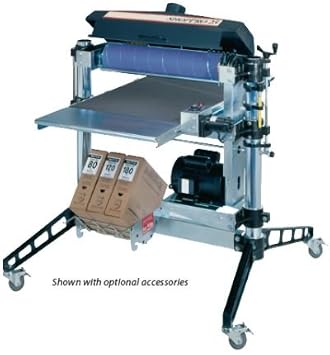
If I had to sand a house full of base and case (and I have done it), I would absolutely load it all up and go to a shop with a widebelt sander.

And that is coming from someone with a Supermax 25" sander that works great.

Here's why I take that position. Firstly, any drum sander only contacts the work piece in one area. Better production wide belts route the belt around a platen, which makes for a larger contact patch with the work piece. This results in an easier path to a flat surface free from uneven waves. These waves can creep in to work run through a drum sander without proper support, skill, paper, and a good bit of patience. Sure, you can do it, but it is tedious and time consuming.

Secondly, even if one has a very nice drum sander (and I think I have one of the best available), one probably doesn't have the in-feed and out-feed support setup to allow long stock to feed through smoothly, let alone the space needed for 14' stock. Keep in mind that most drum sanders, the Delta notwithstanding, adjust the feed table, not the drum. So each pass can require changes to the in-feed and out-feed setup for best results.

Thirdly, an industrial duty wide-belt will hold the work piece more firmly using its in-feed and out-feed rollers. In contrast, heavy consumer grade drum sanders all seem to have underwhelming feed roller setups.

Fourth, and perhaps the most significant is TIME. If you are trimming out a home, you are either building your own, or you are trying to earn money on someone else's dream. Either way, you are probably needing to save time where possible for other more productive efforts. When we built our home, we sanded and finished all of the trim work for a 3200 square foot home with Craftsman influenced styling. I didn't have the drum sander at the time, and we ended up using high end hand sanders (Fein) for the majority of the finish sanding. One thing I was very short on during the build of our home was TIME. I lost lots of sleep for a week or more of sanding. I dreamed of a nice drum sander at the time. Now that I have one, I understand its limits and the fact that, while faster and better for parts it can support easily, it is hard to use with long stock such as trim components. It excels on work pieces shorter than about 7-8 feet in length, but the fiddly nature of adjusting support rollers constantly means it is not an ideal tool for long parts.

So, knowing what I know now, I would take the job to the right tool, which is a wide belt sander of the industrial variety.

I will go on by saying that I will not sell my drum sander, as it has allowed me to make incredible parts from figured woods that I would otherwise not be able to flatten in the home shop. It also saves loads of time flattening and smoothing panels when doing casework. Want to do a production run of cutting boards? There is no better way to flatten and sand them than a drum sander (except a $20,000 wide belt).

Regards,

Grant in Iowa


Supermax pro 25