Home Articles Forums Gallery Marketplace Videos

WoodCentral Forums

Knowledge You Can Build On — Est. 1998

Urban Salvaged Hardwood Slabs, Milled In-House from Rare Trees. Shop Unique Walnut Stock.

Using rare earth magnet as a door latch

Posts

Using rare earth magnet as a door latch

#1

Alan Young

Using rare earth magnet as a door latch

Alan Young

I want to use a rare earth magnet to keep a set of cabinet doors closed:


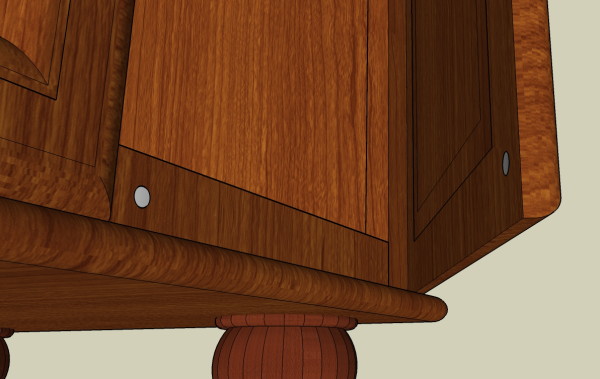
I assume I can epoxy the magnets into recessed holes-Should I use magnets in opposing positions i.e. keep the poles opposite so they attract each other and keep doors closed-or should I use a steel pin in one of the recessed holes? Should the magnets (and pins) sit below the surface of the surrounding wood and be covered with epoxy and overall finish of the cabinet? Or should these be installed post cabinet finish?

Re: Using rare earth magnet as a door latch

#3

Re: Using rare earth magnet as a door latch

Bruce, a MN Galoot

I use rare earth magnets to hold my tool cabinet doors closed, but with the magnet set in the steel cup recessed and screwed in place. It holds very securely, actually a bit too much for my liking. I really have to tug to get them open. I don't know the strength of the magnet. It's maybe a half inch across, 1/8" thick.

I'd recommend experimenting before deploying.

Re: Using rare earth magnet as a door latch

#4

What I have done...

Grant in Iowa

You will be surprised just how hard these magnets grip in a door latch situation.

Here are some tips:

1. Consider the cups available which allow you to drill a hole, install the cup with a screw, then install the rare earth magnet. This provides a permanent mounting. One can remove a magnet from a cup, but it requires epoxying a handle to the magnet first. Another benefit of the cups is they adapt the magnets to standard drill sizes. A magnet installed with glue could get yanked from its hole by the opposing magnet over time when the glue fails. Since the magnets are smooth, it could be difficult to get good adhesion.

2. If you plan ahead, you could install the bare magnet in a hole drilled from the back side of the surface. This would effectively create an invisible magnet, as well as negating the need for the cup.

3. Play with the distance of the magnets from one another to determine the amount of opening resistance you would like. Use a deck of cards between the two magnets and add or remove cards until you like the resistance amount. once you establish the right distance for your application, use that info to determine hole depth and arrangement.

4. As an alternative to #2 above, and with information from experimentation in #3 above, you can embed the magnets within the pieces of wood involved before it all gets assembled. Do this by ripping your part while it is still over sized, then drill a recess between the parts, install the magnet and glue it back together. Then finish size your part. Harder to picture than it is to actually implement.

5. As an aside, I built an entertainment center and was able to "float" the speaker panels in mid air by installing magnets on opposite edges of each panels. This prevented unwanted vibration, and is cool as all get out.

6. Consider a side swipe arrangement for your catch. By this I mean the magnet is installed in the edge of the door and its partner in the side of the jamb. The magnets would then approach one another in a non-linear way. This means no contact would need to be made, so no clunk in to a stop. Experiment on scrap first to establish distance for the best action.

To directly answer your question, "it depends". experiment as in #3 above, you will determine the best distance apart for your application. These magnets will not lose attraction over time, so no overkill required. It is that distance that will guide you in how best to mount them. I am fond of them being invisible, as in #4 above. You can accomplish the same effect by veneering over the part with the hole if your project is too far along to rip and embed.

I would suggest obtaining the magnets from Lee Valley, and obtain the correctly sized cups too. Order more than you need, as I would bet you will use them again after you see how many ways they can be used.

For some reason when I reduced the file size of this image, the console got shorter left to right, and so looks chunky. I assure you it is long and sleek in person. This is the project wherein the speaker grilles are floating in space. One removes them by simply pushing in on the grille frame until the magnets loose grip. This project was my first use of rare earth magnets, and I have refined my approach to generally hide them since then.


Regards,

Grant in Iowa

Re: Using rare earth magnet as a door latch

#5

Re: Using rare earth magnet as a door latch

Yonak

I have used 1/4"d. rare earth magnets for this purpose with good luck. I did not use epoxy, just a very snug fit. It was really a test. I figured if a magnet was pulled out I could then glue it but the magnets have never come out.

I used magnets on both surfaces and have done it both ways as far as whether the magnets touch or not. It's more noisy when the door closes when the magnets touch but not touching holds the door closed quite well. I'm thinking next time I might put a felt pad on one of the magnets to soften the close some.

Our plantation shutters are held in place with rare earth magnets on one side and a screw head on the other. It keeps them in place well. The only downside, if used for a cabinet door, is the exposed screw head which, of course, is hidden in shutters application.

Re: Using rare earth magnet as a door latch

#6

Alan Young

Thanks for all the info

Alan Young

I ordered a bunch from LV will test distance thickness etc...

Thanks my friends..

Alan

Re: Using rare earth magnet as a door latch

#7

+1 on what Grant said


Re: Using rare earth magnet as a door latch

#8

Re: Thanks for all the info

jcousins

have used magnets on many pieces - but never with the cups.

using a magnet on the case and another on the door - line them up - drill the hole just a bit deeper than the thickness of the magnet - epoxy them in and then use a matching piece of wood (color & grain) over each one - again securing with epoxy - this is done pre-finishing - the plugs are virtually invisible but you can certainly feel a nice gentle pull as the door closes.

jerry

Re: Using rare earth magnet as a door latch

#9

Re: Using rare earth magnet as a door latch

William Duffield

Similar to Yonak's experience, I've drilled holes for 3/8" Lee Valley magnets in hardwood with a forstner bit, and found that I didn't need glue to hold them in place. My project was some kitchen knife sheathes, not cabinet doors, and I put the magnets on an inside surface before I glued them up. I experimented with some scrap first, because once you push the magnets into the holes, they don't come out unless you can push them out from the back or leave a channel on the side of the hole to pry them out from the front.

If you are going to use the two magnet technique, polarity is very important. Lee Valley puts a little red spot on one face of each of their magnets. Two faces marked the same repel, so make sure you install the magnets with the spot showing on one of them and the spot hidden on the other. If you get it wrong, the doors won't stay closed.

I did the math and worked through the installation procedure in my head, and decided that 4 Lee Valley magnets in four holes the same size and depth is less complicated and less expensive than one Lee Valley magnet, one cup, one plate and two screws in two holes of different depth, and provides a stronger grip. Two magnets in two holes does not appear to be quite as strong, but it may be enough for your application.

I'm not so sure about Grant's proposal to drill the holes from the back. If you use a Forstner bit or a brad point bit, there is a real risk that the spurs and the center point will go through to the front surface while you are trying to get the magnets close enough together to grip effectively. That's not a problem if you use a bottom cleaning spiral upcut router bit instead. Also, sometimes the back surface you are starting from is even more visible than the mating surface. :D As Grant says, plan ahead.

Re: Using rare earth magnet as a door latch

#10

Ellis Walentine

Quick and dirty way

Ellis Walentine

I have made quite a few simple magnetic catches by epoxying the magnet into a little stop block mounted inside the cabinet, and installing a little flat head screw into the corresponding spot on the back of the door. This has the additional advantage of being adjustable by running the screw in or out.

Ellis

Re: Using rare earth magnet as a door latch

#11

Re: Using rare earth magnet as a door latch

John McGaw

I've used the 3/8" Lee Valley magnets in metal cups along with their washers on two different cabinets and find that they are more than strong enough for the job even with a six-foot door. Over the years I've noticed that plating on the magnets has worn away, probably because I didn't seat the screws in the washers sufficiently, but this hasn't hindered their holding force a bit, just making them look a bit shabby.

Re: Using rare earth magnet as a door latch

#12

Re: Using rare earth magnet as a door latch

William Duffield

The shiny, protective coating (often Nickel) on the actual magnetic material is itself pretty brittle, but not nearly as fragile as the rare earth alloy itself, which is also easily corroded, rendering it useless. It shatters and falls off if it is repeatedly hit with the cup. Even if it cracks in use, the alloy inside starts to corrode. So, you need to install it with a small air space between the magnet and the cup. Very close, but not touching, even as the door is slamming shut.

The Wikipedia article explains all this better than I can:

https://en.wikipedia.org/wiki/Rare-earth_magnet