Home Articles Forums Gallery Marketplace Videos

WoodCentral Forums

Knowledge You Can Build On — Est. 1998

Premium Domestic, Figured & Live Edge Hardwoods in Stock. Best Prices for Serious Woodworkers.

Demilune-Importance of grain orientation

Posts

Demilune-Importance of grain orientation

#1

Demilune-Importance of grain orientation

Bill Tindall, E.Tn.

Grain Orientation

When sawing an arc where the surface of the arc will show it is critical to select a board with proper grain orientation. The drawer for this piece will be highly figured so the “framing” around the drawer must be plain. Hence, I need the edge of the board to present a quarter grain as shown in the picture. In this case the growth rings will appear as darker lines more of less parallel to the length of the drawer.

PIC 1


PIC 2


If this board was flat grain on this edge the result would appear as a series of near vertical stripes where the growth rings were cut across by the arc, as seen in Picture 2. This result would be a distraction for this situation, though in other cases it could be a design element.

Re: Demilune-Importance of grain orientation

#2

I'm confused......

Barry Irby

What I see does not match up with what you say. The bottom rail appears to be perfectly quartered on the face but with curving grain. The top rail appears to be more rift grain. I'm trying to visualize how the curve affects this.

I would want the rails to appear perfectly quartered with very straight parallel lines. I would take what you have, (assuming I am skillful enough to make it) and veneer it with a piece of quarter sawn walnut. It would not appear correct to a really experienced wood worker with the ability to visualize what it should really look like. I would carry that straight grained wood on around the poplar sides. I would cut out the drawer opening and then veneer the drawer front with something spectacular and apply subdued cock bead.

And, I all ready have the pack rat gene. You have raised saving off cuts to a new high. Now I will never be comfortable throwing anything away. I don't even want to know what you save saw dust for. A pox on your house.

This is going to be a beautiful table. Thank you for posting the progress.

Re: Demilune-Importance of grain orientation

#3

answers...maybe

Bill Tindall, E.Tn.

Your questions and confusion may be difficult to answer. But stay tuned. As it comes together the strategy may become more apparent. There are a lot of ways to skin this cat. I picked what was easiest for me to implement.

"What I see does not match up with what you say." You are defining quarter and rift based on the lines you see on the edge (I think), not the reference I used.

pic

When I refer to the grain orientation it is with regard to the surface of the walnut board shown in this picture.

PIC 1


Ideally it would be grand if the face showing in the picture was perfectly flat grain with the growth rings being in a plane perfectly parallel to the face showing. What you don't want is for the face shown in the picture to be anything close to quarter or rift with the growth rings more or less perpendicular to the surface shown. My result was very close to ideal for the bottom rail and near so for the top, and neither close to the bad situation illustrated in PIC 2 of the original post.

"I would want the rails to appear perfectly quartered with very straight parallel lines".....That would be nice if you could achieve it, but I got close enough. The top rail will be shadowed by the overhanging top and nobody is going to notice its small departure from perfect. I had hoped for perfect, but when cutting an arc across a surface with growth rings the result is never predictable.

"I would take what you have, and veneer it with a piece of quarter sawn walnut." .... This approach would leave a veneer edge exposed on the drawer opening. Unless this edge was cockbeaded it would be subject to chipping over time. I will cock bead the veneered drawer to protect its edge.

"I would carry that straight grained wood on around the poplar sides." .....Keep in mind that a leg with a bridle joint separates the drawer opening from the rest of the skirt. I intend to veneer the rest of the skirt with crotch walnut, which I would be doing as we speak were It not for your complicated questions that need clarification.

" I would cut out the drawer opening" ...Oh, boy. Probably not if you had ever tried it once. It is difficult to do precisely, and I don't know that I could do it at all on a curved skirt.

The advantage of my approach is that the drawer opening is easily and accurately defined as part of bricking, which in turn is easy. When I was done bricking the drawer framing was done, except for a detail to be shown in a post later this week. I just didn't see any easier way to get to this point with assured success of the arc and drawer opening.

.

Re: Demilune-Importance of grain orientation

#4

Alan Young

Pardon the Interuption

Alan Young

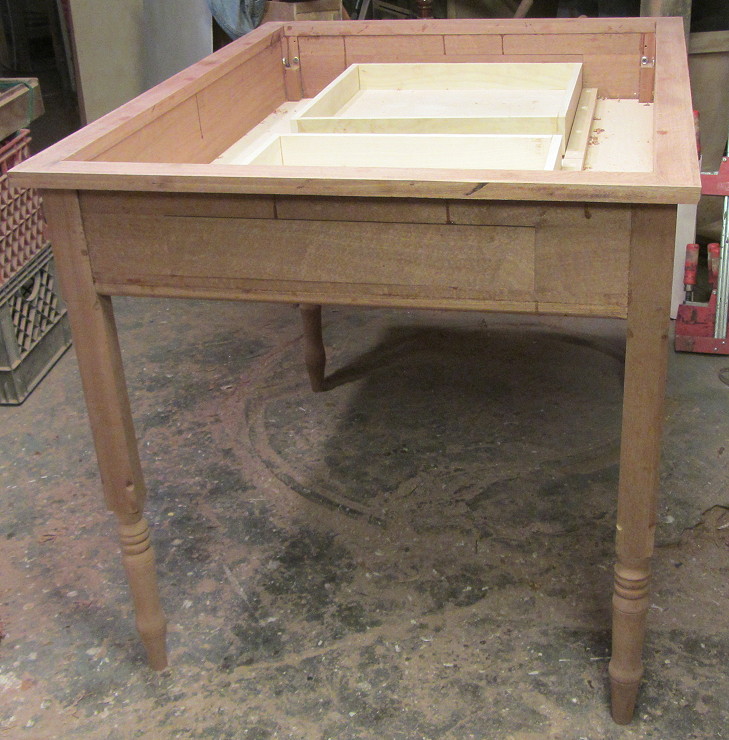
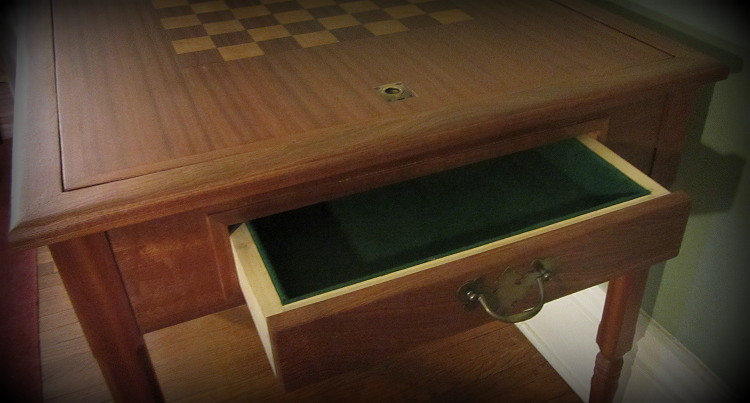
Hi Bill-I am very much enjoying the build documentation-especially after having just built that game table with two drawer openings---

My question has to do with the vertical sections of walnut on either side of the drawer opening-


The grain orientation of these pieces is horizontal--So were the pieces in my table when I made the aprons/ drawer openings- I ripped the top and bottoms then re glued them together using the middle as the drawer front attempting to maintain a consistent grain pattern. I think this picture shows the glue lines--


I proceeded to make the drawers- without mechanical slides- so they would have a tight but smooth fit-I was pleased with those results-sort of- I found that when I pulled out the drawers the drawer caught the edge of one horizontal apron and it caused some chip-out--My solution was to add a thin 1/16th or so frame around the drawer openings.


This turned to be a satisfactory solution but I think Cock beading might have been a bit more subtle and elegant-still if the beading is applied to the drawer front The opening would have shown the chip out---Do you think you might run the risk of this occurring?

-Alan

Re: Demilune-Importance of grain orientation

#5

Re: answers...maybe

Barry Irby

I have been thinking about your construction all morning, while building a deck rail. (the opposite end of the wood working spectrum)

My confusion was with the 3-D nature of the thinking required to visualize what you were doing. Trying to visualize it in some sort of imaginary perfect wood that would yield perfect results and then trying to do it again with ordinary wood. I appreciate your work and the time and effort you take to post the progress. I and I'm sure many others have learned a lot from you and your efforts. Thank you.

I build my table rails with drawer openings the way Alan did. I pick a nice straight grained board and dissect it and delete the drawer opening.

What I meant by " I would cut out the drawer opening" Was I would veneer over what you have now with a pieces of quarter sawn veneer big enough to cover the assembly you have now and then cut out the part covering the opening. You are right, in spades, about trying to cut the opening out for a drawer in a solid board. Been there Done that When I was a kid. Boy was that crude.

I am lucky enough to have almost 5000 BF of air dried walnut. Unfortunately it in a barn about 40 miles away and that one perfect piece is on the bottom of the pile. Pretty sure it is anyway.

The only thing I have applied cock beading to lately, I back beveled it about three degrees. Really made it slide into the opening nicely.

Wonder if the deck rail suffered from my being distracted?

Re: Demilune-Importance of grain orientation

#6

Re: Pardon the Interuption

Bruce, a MN Galoot

I typically use the same construction as you on hall tables, bedside tables, etc. I avoid the problem by adding internal guides that prevent the drawer from hitting the front frame.

Re: Demilune-Importance of grain orientation

#7

WoodCentral at its best........

Bill Tindall, E.Tn.

Interruptions are good. WoodCentral posts sometimes teach, inspire others to try, "interruptions" can reveal potential problems, and occasionally a reply offers encouragement to reward the effort of posting.

I have not experienced the problem you found. In my post above I describe using a thick insert to avoid the known problem of chipping applied veneer. I am doing some research into the problem you revealed and will report later.