pencil edge
chandler
Hi folks... does anybody know of a good way to make a pencil edge on three- or four-quarter stock? I can't seem to find any woodworking router bits for the purpose (just diamond bits for countertops)...
Appreciate it!
Chandler
Knowledge You Can Build On — Est. 1998
pencil edge
chandler
Hi folks... does anybody know of a good way to make a pencil edge on three- or four-quarter stock? I can't seem to find any woodworking router bits for the purpose (just diamond bits for countertops)...
Appreciate it!
Chandler
I never heard of a pencil edge

Cutters
Ellis Walentine
I'm assuming you're looking for a radiused edge that isn't round. I used to have router bits made to create exactly the profile I wanted. There are some bits out there that might do what you want, but you might have to commission some jobber to make up a bit for you.
Custom bits aren't cheap (think $100 and up), but if you can write them off to a job and use them forevermore, they're a bargain.
One of my perennial pet peeves with router bits is that you're generally restricted to round-overs, chamfers and various beads, ogees and other profiles, which may or may not be interesting, beautiful or wanted. When we were doing custom interiors, I routinely designed special profiles for specific jobs. A custom profile can really add a unique quality to a job.
There are plenty of tooling manufacturers who can work from your simple drawing to create router bits and shaper cutters in any shape and dimension. You might want to talk to a local cabinet shop to see if they are willing to share their sources for such cutters. Most markets have companies that make and service specialty cutters.
Ellis Walentine, Host

Re: pencil edge
Leo Cuellar
Hi Chandler,
I'm not sure if you want 2 30 degree bevels or a pencil ledge, but this bit from Tools Today may be what you are looking for.
Leo
Re: pencil edge
chandler
As Ellis correctly surmised, I'm wanting to make a round edge profile where the radius is much larger than 1/2 the width of the board. It's like a gentle roundover with defined top and bottom edges. It's uncommon apparently. Why it's called a pencil edge I don't know but that's how I've seen it described.
I can approximate it by hand with plane/file/sandpaper, but a) I'd like it more regular and defined and b) my design incorporates many curving feet of this edge.
Thanks for the replies... I'll keep looking. Or commission a router bit. Or use a different edge!
Chandler
P.S. Now i think about it some more it would be a difficult bit to make. Because I would need it to have a bearing guide so I could use a template, but then the curve profile would be fixed at a certain stock width to get the center of the curve right. Or, I could use a spacer between stock and template to put the middle of the stock in the center of the curve..... Hmmmmmmmmmm,.,.,,,,
Re: pencil edge
TomD
You can use different sized bearings to modify offset.
Just look at a lot of bits, often there is a segment you can use from one of the more complex shapes.

There are planes of course, and you can make those yourself with relative ease.
Another thing you can do is get a shaper blade. These exist in forms that allow the use of ground blades whereby it is relatively easy to grind any shape you want, or take it to a tool shop for grinding.
Re: pencil edge
Leo Cuellar
Something more like this thumbnail edge?
Is Bull nose what you want
Bill Tindall, E.Tn.
Have you studied router bit selections, for example from Eagle American and Lee Valley?
I often profile edges rounded with a radius greater than 1/2 the thickness or even a curve that is not a section of a circle. For large radii circle sections use bull nose bits of large diameter
For curves that are not sections of a circle see Eagle American "Furniture bits" #162-205 or any of a number of molding bits. While it may not be obvious the furniture bit can be run on one edge and then the depth adjusted and then on the other with the bearing riding the first profile. see example in picture
The Lee Valley Stanley 55 bits are made to match the profile of the Stanely 55 plane cutters. The Stanley 55 cut elliptical profiles in some cases as do these bits.
Re: pencil edge
Steve jenkins
If you have a shaper you might be able to use a large diameter bullnose bit or if it's something you do a lot have a pencil edge cutter made with a matching bearing for curved template work.
I was thinking more like this one.... *LINK*
John in NM
But I sure don't know why its a pencil edge  I got the same mental picture you did the first time around - probably because my shop is littered with Dixon Ticonderogas.
Tough to do if not a straight line, as the bit has no bearing. If it's a straight line like a table edge, then no problem aside from forking out for the bit
http://www.toolstoday.com/p-4968-convex-edging-router-bits-bullnose-half-radius.aspx
another nonround example on chest edge
Bill Tindall, E.Tn.
cut with Eagle bit

Re: pencil edge
chandler
No, like this... http://cedgetops.com/files/32525900.jpg
Re: pencil edge
chandler
No, like this...
I did a quick google search...
Leo Cuellar
a lot of different profiles seem to be called a "pencil" edge now, mostly by granite countertop manufacturers. I under stand the confusion. My first thought on a pencil edge was a slight hump on top of the piece to keep the pencil from rolling off.
Found it!
chandler
I think this will do what I need. Thanks Bill Tindall for pointing me in the right direction, and thanks to all for your replies.
Chandler
Re: Found it!
Barry Irby
That bit will do it, but it may take some fiddling. The first half will be easy because you have the remaining square edge to run the bearing on, but the other side will may be a little harder. If the bearing drops into the cut for the other side you will get a step in the middle of the edge. At the equator as it were. When I did this I had to change to a larger bearing for the second cut. Might want to buy a set of bearings in different diameters. Or, if the bearing is very close to the bottom of the cutter, you might be able to leave a very small flat at the equator and run the bearing on that and then sand the edge to eliminate any remnant of the flat.
As always, try it out on some scraps first.
Re: Found it!
chandler
Thanks Barry. That problem had begun to occur to me too as I contemplated the picture of the bit.
Chandler
It is not a problem
Bill Tindall, E.Tn.
I have used this bit on numerous tops and the problem you anticipate doesn't happen, note examples provided......I found it straightforward to adjust the depth to get the profile I was after. Do, of course, make test cuts on scrap.
The only thing to be careful of .....do not jam the bearing into the edge for the second cut or it will leave a mark on the finished profile. Other than that it makes gentle curved edges effortlessly. It comes in more than one size for tops thin to thick.
not a problem
Bill Tindall, E.Tn.
"If the bearing drops into the cut for the other side you will get a step in the middle of the edge." I have cut "miles" of profiled tops with this bit and not had to contend with making a step.
To get the profiles illustrated in the pictres I posted above the bit bearing was most certainly riding on the profile of the first cut. There is no step discontinuity as seen in the pictures.
It is true that a gross maladjustment of the depth will lead to a step but Chandler is a careful fellow and will not have this problem.
Re: not a problem
Barry Irby
I am sure that Bill is correct as usual. I was just trying to provide an abundance of caution. I think the problem comes when you try to use a bit that is too big/tall for the thickness of the top and try to lower it too far to get the sweet part of the curve. Also if you are working with softer wood and apply too much lateral pressure you can leave either a step or a line from the edge of the bearing.
Just did not want Chandler to try it with out the benefit of my mistakes/experience. Some of my experience comes from being too cheap to buy a custom bit and trying to finesse a profile out of what I have. It is a joy though to buy a special bit and then have it later when you find another occasion to use it.
I have seen a rounded edge on glass shelves called a pencil edge, but I would not have called this profile a pencil edge.
Darn those granit guys!
John in NM
Don't get me started.... lets just say I'm not surprised given how everything is either granite, marble, or travertine to them.....
Probably due to the gentle curve...
John in NM
I've had the step problem with roundover bits, but it is to be expected with a full quarter circle cut.
I would expect to be careful with that bit, but that the problem would be less pronounced if not fully avoidable. From what you say it's the latter.
Re: This...
TomD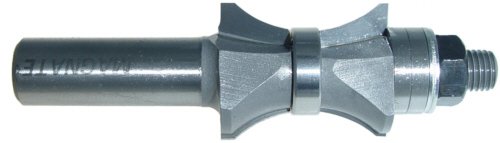
Three cats skinned so far....
John in NM
I remember seeing that one too now....
Magnate's a good company. Bits are imported from somewhere but they are good quality, never had one out of balance or any other problem... I have several of their bits because they make some of the weird sizes I use.
Ship fast too, same business day if you order before lunch.
Re: This...
Barry Irby
That bit would make it easy. It would do in a single pass what you would have to do two passes for with the other bit . It would leave a flat in the center, but so would the other bit if you set the bearing height the same.
I think it would be easier with easier to run this edge with either bit if you add a large offset base on your router to help you keep it perfectly up right at ninety degrees to the edge. At least it helped me, but I am something of a klutz.


