I bought some 5/4 by 6 deck boards from Home Depot. No. 2 common. I think the little tags on the ends said Top Choice. In crayon on the boards there were what I assume were grade marks. It appeared to be an S and either an under score or two under scores. I guessing the S was meant to be a 2. Some of the boards had red marks and some had orange.
Out of curiosity, anybody know the significance of the marks. Red Vs orange? S or 2? One slash or two? I can't remember ever seeing these marks left on the deck boards.
Beyond that, don't get me started on Borg lumber. Who told them "center Cut" was a good idea. Every 4x4 had the pith of the tree in it. So did almost every 2x8. What a pile of crap. Mostly Juvenile Wood. No wonder it all warps.
The color of the marks are just whatever color crayon the grader had that day.
I've never found a great deal of rhyme or reason to those markings, always assumed they were either a shorthand that could vary somewhat with the grader or that the markings don't necessarily correspond to what gets stamped on the board. I once got a bunch of really good 2x6's some of which were stamped select or #1. I gathered from those that the crayon marks were more a counting of flaws than something like a grade. If you really want to know, there is probably a youtube vid for this, as there seems to be for everything else.
I think the prevalence of juvenile lumber is just a question of the rate at which the trees grow and the rate at which we use the lumber. In most cases the crappy lumber is just annoying and more difficult to work with, but the houses don't collapse as a result. When we were building, I used to go to Lowes for 2x4's, at the time and place, they had the best quality ones, and the pro yard I used had the worst. 2x10's it was exactly reversed - go figure.
Hey Barry, I can't help you any with the grader's marks, but I will say that I think getting the better grade of deck boards is the best deal over the long run. I have managed to build some decks without a single knot showing, and almost all of the board faces will show the treated wood, which would be the sapwood before the log was cut into lumber.
When it goes through the treatment, the sapwood, which would normally be very quick to rot untreated, really soaks in the up the chemicals. The natural extractives of the heartwood in pine has pretty good decay resistance, but not as good as the chemically treated, and will prevent it from really soaking into the cells, so the heartwood will be the first to decay eventually.
The last deck I built was about 16' x 16', and the best grade cost about $100 more. If the deck last 20 years, this would be only $5 per year prorated, but the higher grade may actually last longer. I know that you probably don't care if this is one of your flip houses, but you might use that as a selling point, and a shoot higher asking price. For my own deck, or friends or family, $5 per year difference is nothing for having the nicer finished deck.
As for the pith in all the 4x4s, that is all I see here too. If I can't find anything better in the longer lengths, I will usually find some better material in the 4x6s, especially in longer lengths. I just refuse to spend the time / money to build a deck on legs that are sure to be the first thing to rot.
Barry, I know you like to pinch pennies, so you may want to try this. Except for the ends, instead of using two screws on each joist, I only use one, switching back and forth from one side to the other as I go down the board, keeping it the same as I go out each joist. The main reason I've started doing this, is because I've seen the framing underneath decaying faster due to to so many fasteners causing the upper edge to split open, then filling up with dirt and pollen, and whatever settles out of the air.
"Barry, I know you like to pinch pennies"...... I don't know whether to Ouch or you got me...
This is a flip house and may be the only one I lose money on. It is a horrible blunder. It was assessed at $195K and I bought it for $123. I figured I could fix it and make a profit no mater what was wrong. Then I realized I had bought it in a neighborhood that will only support about $165K tops. Thirty Thousand Dollars just went POOF.
The roof was leaking. Replaced that with some new rafters and new plywood. Repaired the ceiling below.
Windows were shot. Replaced those and had them wrapped.
Those two items were mostly Point and Pay...but I did replace the rafters and plywood myself.
(You don't get to go in these before you buy.) It was on top of a hill, so I figured the crawl space would be dry. NOPE!!! Turns out the water heater had leaked in one end of the house for a long time, rotting out floor joists and part of the main beam. while under there replacing parts I notice the bathtub drain in the other end of the house had flopped over. I crawled over and looked at it. It had been wrapped in duct tape, a wad about the size of a football. Another half roll and his gloves were laying there. Every bath they took was dumping into the crawlspace. More rotted joists and beam.
And, there was the dog pee smell. Second time I have had to deal with that. This time I found some chemicals that tackled that.
The interior doors were worn out. Replace those myself.
Stripped the goofy 1/8" Masonite out of the bath rooms and repaired the damage.
Replaced the worn out blue bathtubs. changed one into a shower. (fixed the duct taped drain at that time.)
Repaired the dog chewed front door.
Removed the baseboard heat and repaired the base boards.
Replaced the disappearing stairs.
Replaced the foyer ceiling where the AC had leaked onto it.
All of the ceilings had been stomped. Repaired the texture under the roof leaks.
The kitchen cabinets were dated and worn. And huge. Decided not to replace them. (Pinched a few pennies there.) Remade the drawers and upgraded the runners. Built the doors and drawer fronts. Flat panel shaker of mission style. Five pieces in each and there are fifty of them. Just took them to a friend to paint them with white lacquer.
Loaded 30 yard of crap into a dumpster and have hauled about five additional truck loads to the dump.
Tore the floor and rail off the deck and tore down the weird triangular appendages the previous madman had built. Cut two feet off the length to make it 24' by 12'. Installed some new joists, steps, and flooring and railing. So yes, I cheaped out on the deck boards. The standard grade were about $260 and the higher grade woudl have been about $500. I also bought prefab rail sections that had been discontinued and got them for half price. (MUCH faster that building your own.)
So I have been trying to turn this into a nice house at a reduced cost to limit the loss. Some of it is hard to explain. Like the kitchen and den paneled in T 1-11. Dark brown. Would have pulled it out, but there was crown molding and the (curse) stomped ceiling. This house is the gift that keeps on giving. (Or is it Taking?)
Odd that you mention your pattern of alternating the screws. I have been doing that for years. It makes sense to me. Less chance of splitting the joist below. Less splitting of the deck boards. Part of my theory is that if the boards are going to warp, the screws won't hold them anyway. And you can go back and replace a board or screw one down if necessary. (I did have a client that could not stand it and went back and added the "other" screws after I left.)
You are right about the better appearance and longevity of the premium boards, but this deck has already had one set of boards. I figure these will wear out about the same time the joists fail.
PS, I have one of the SpinRite screw guns that uses collated strips of screws. A fabulous tool if you don't have one.
I did not mention the detached garage. Barn roof, shot. Garage doors, shot. T1-11, past it's prime. Double doors, shot. Sheetrock, failing.
It's detached and hopefully on an adjacent lot. The smart move woudl be to bootleg an apartment into the top of it and rent it out. Need to hire a surveyor to be sure it can be sold separately. It's 24 by 32'.
I have worked in a Canadian retail lumber yard for 14 years and have a few observations and no answers.
1) most lumber yards buy from wholesalers and not directly from mills, we will order lumber at a specific grade, but there is a wide variety in what we receive.
2) even if we have a favorite lumber mill this year, with near perfect lumber, that may not be the case next year. Lumber comes from trees, and the stand of timber that they are harvesting can have a major effect on what the end product is.
3) when you say deck boards, do you mean pressure treated? Our yard buys supposedly premium pt lumber, but that is purely an aesthetic term. The grade stamped on the lumber may be anything from stud grade to 2300 MSR, the treating plant buys and sells their product according to appearance.
4) as far as being critical of a particular retailer goes, I have learned to ignore the comments. I love to hear customers rave about how much they love our lumber, knowing full well that at the same time past customers are somewhere else bad mouthing us. It all comes from the same wholesalers or mills, and it is all supposedly fairly graded.
5) this is a low margin business, and we have to sell as much as possible of what we bring in. If you are at a retailer that does not let you pick through the lumber, that is a good thing. If you come to a lumber pile where the previous two or three customers were allowed to pick through the piles, you know what will be left for you. I admit that this is the hardest rule to enforce.
I don't "KNOW" any of this. Its not statements of facts based on quality research, most of it is impression and casual observation.
There is a Lowe's and Home depot about a mile from my house in opposite directions. Very convenient. They give easy credit terms. Very convenient. I know my way around both. There is also a local lumber yard about five miles away. They use the gated yard system. You go in, tell them what you want, they print a ticket and you drive out into the yard to get it. Wait for a loader, hand him a ticket and either he loads it or more likely watches you load it. Sometimes you have to drive around to get the stuff. Then you drive out where they check the load again and take another copy. This process seems like a PITA after the other two. Probably some form of 'conditioning'.
I have seen bundles of studs at the borgs that appear to be very small trees cut into 4x4's, split into 2x4s and stacked back together as if they were book matched. These are sometimes the center of larger logs, but sometimes they were very small trees because there are bark edges on both pieces of the "pair". They advertise "center cut" lumber. A Term I have never heard from a lumber grader. Center cut may be desirable for a pork chop, but not so much for lumber. Years ago I wrote and article on juvenile wood used in trusses. The truss industry picked it up and republished it, at least the first half, the more positive half, but ignored the second more negative half. Length wise it can shrink thirty time as much as more stable parts of the tree, causing what known as truss lift or uplift. Another whole topic.
I am reasonably sure the Borgs have had dealings with the big mills that indicate they are willing to take very marginal lumber for a lower price. Instead of the mills DUMPING the marginal stuff on the little guys, they are selecting it and selling it to the big boys. I have not spent enough time looking at the lumber at other outlets to be sure they really do have better lumber. It could be that everybody is selling marginal lumber.
I went to a Honda dealer about a year ago looking at cars. I asked when the new one they were introducing was coming. The salesman said "I don't know, they don't tell us anything, They want us to sell what's here, not what's coming." Might be the most honest thing a car salesman ever said to me.
I am sure you are right, they mills sell what they have when the order comes in. If they are in an excellent stand, you get that, if they are milling crap, that's what you get.
I have mixed feelings about truss wood. On one hand our guys are very good at checking their lumber. I see rejected boards that to me have no visible defects, and I know they figure in a fairly high rejection rate into their pricing. On the other hand our highest grade ( 2400 MSR) is almost all plantation grown S.Y.P. when I measure growth rings that are 1/4" to 3/8" wide it does cause me to wonder. The wood is enormously strong and well dried, but it is anything but old growth lumber.
That will always be the case with construction grade lumber. 1" boards are ripped parallel to the center of the log. After cutting 1" boards the mill will be left with boards that contain the pith which are then sold as 4x4 or 4x6 posts.
If you don't want the pith, go to a real lumber yard that carries furniture grade lumber. But, be prepared to pay quite a bit more. The yield when a log is cut without the pith is a lot less so the seller gets less money for the yield of the tree.
The commercial yard I used to buy from for our house building was like that. If you were buying around $1k or up, it was a very different experience - better price than the home centers by a few cents or a few dimes per piece, polite salesmen, etc. If you wanted a couple 2x12's they would charge you double to make you never come back and go to HD instead. Definitely conditioning.
Also helped a lot that I showed up with a 3 ton flatbed. Fork lift drivers make you load if you show up with a trailer or pickup. Flatbed and they'll do it all for you, even if it isn't complete units or a pre-made package.
I was thinking about all this yesterday while fixing a porch. Had a 12' 2x6 stamped #2 that could easily have been #1 or even structural select at a stretch. One tiny knot in a straight grained, perfect piece of Douglas fir. Wasn't center cut, and came from HD. Right now all the HD lumber I've seen around the state seems to be really nice stuff coming from Idaho.
I don't know SYP because we don't get it up here. But some wood is stronger fast grown, while others are stronger old growth. Old growth pine was hard enough for flooring because of all the rings. Old growth oak was brash because of the pores being over-represented. Structural lumber is either taking a post load, or a beam, load, once you sellect it for other purposes it gets to be more complicated.
You can make a very simple jig to rate wood modulus by using a pump jack on a bathroom scale, with a fixture that holds a sample over the jack. As you pump up the Jack the scale registers a load, and you can either measure deflection at a given load, or load at a given deflection, or load at fracture. This makes it very easy to do your own testing, and to work with real results rather than guesswork. Obviously you have to use the same section of wood for each sample.
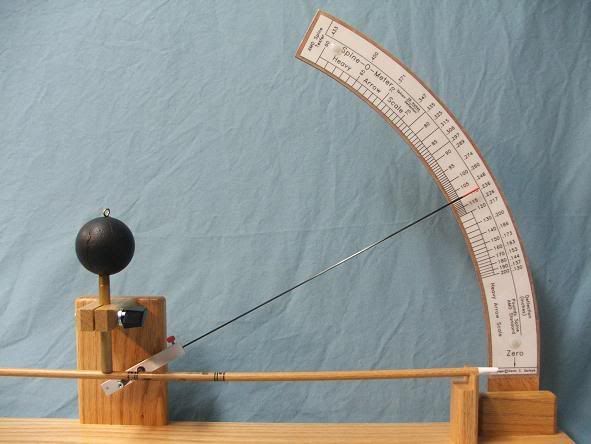
This gizmo is for doing similar measurements on arrow shafting. If a wooden shaft breaks in the bow, it can be driven through your hand, so it is prudent to check arrows carefully, and it is also necessary to check them so that they can be assigned to a bow of a given weight which is critical for safety and accuracy. These jigs normally measure deflection for a 2 pound weight on a span of 26 inches.
Picking through wood is basic, and I wouldn't go to a place where I couldn't do it. I don't know why it works out, but some places manage it while other places are destroyed by it. A place selling exotic woods has to allow it, it is like selling marble counter tops, it sells on the look. But Home Depot allows it and it works out fine.
My feeling is the problem is worst when someone doing a generic stud frame comes in and tosses the pile so that they can cream the stock in a situation where if the material was sold in order, it would all be perfectly usable in the form it was banded in. But if I go in and pick out a few choice pieces for a boat, it doesn't really mater. To the average guy doing the frame, he probably isn't picking through it, because if he can only use the 1% best he is out of luck. But I can cream that out and it doesn't hurt anyone. The drill is to look at a pile every time you go in and take only the very best. Put all the wood back, and don't look to far down the pile, you can't replace it under the pressure it was banded to which is the only thing that keeps some of this crap straight.
Also, a lot of piles I see have good wood only on the top, after than it is all crap. If I am there at that point, I will take the best couple of pieces. But the seller can't really blame me, their supplier is marketing a deception.
The commercial lumber yard I generally use allows picking through stacks. They will even help, which is nice when picking through a stack of 16' 6x6 PT posts. I always restack even though they say don't bother. Culling the rejects is the primary reason I go pick it up myself rather than ordering and having a load delivered, although they will accept any returns without question. They sell warped and rejects and goods with even slight damage at a discount. This is my favorite lumber yard.
When building my shop I bought an entire "unit" of SYP 2x6-10s for wall studs, wrapped and banded. This was great (although it put my skid steer to the test getting the bundle off the trailer!)
I think the that it was not opened and loosened and picked through gave me more straight boards which were quickly restrained from twisting by being installed. (Very little crooking on 2x6 compared to 2x4. Bowing, cupping doesn't much matter for studs.)
Working from the bundle also gave be an added benefit - I set aside the best clear, straight-grained, and accidentally quartersawn boards for framing doors and for milling and building other things later.
I also bought 1/2" ply for paneling and ceiling as well as OSB for sheathing by the bundle as well. The lumber yard loves to sell and load it like that! They even offer a pretty good discount on full units. Fortunately my shop was the size that almost none was left over.
First - decking has no real grading system like, say dimensional lumber [2 x 4, 2 x 6, etc.]. Dimensional grades deal with amount of wane, knot size, location and frequency, etc - structural things.
Decking is just an appearance deal - there is no structural value assigned.
The "S" means Standard. There is also Premium. I doubt you would ever see Premium at a big box - the cost difference is too great - it is basically clear, and that comes at a price for 6" x 16' boards. You would need to go to a contractor yard to get the Premium.
The other marks - the color doesn't mean anything probably, but the lines, etc. certainly do - within that specific lumber mill - they have a marking system they use internally - could even be read by an optical scanner down-stream.
The 4 x 4 will always have the pith in them - there is no other way to get them at any kind of reasonable price. Same for the "wides" [greater than 2 x 6].
The warping - well.... since you are talking decking and 4 x 4, I must assume you are talking pressure treated. The warping is primarily due to the moisture content of recently-treated wood, not the wood itself - it was all fine before the PT process.
As far as Juvenile wood.....well, the Old Growth SYP is long gone, in terms of availability for PT material. You are looking at farm-raised stuff, with advanced forestry methodology behind it - could be 3d generation after the old growth was cut down.
You have a trade-off bewtween the characteristics that annoy you, and a gigantic price increase to avoid them. Pick your poison.
Thank You. I did not know the deck boards had no grade as you say.
Your explanation matches perfectly with my observations.
As an aside, the borgs do have a premium grade that as you say is clear or nearly clear. Obviously a better grade and better appearance, but I am trying to limit my loss on this particular house so I bought about 20 percent extra boards and will return the rejects. The premium grade was literally twice as much money. I used it on my son's deck and it is nice.
There is another bit to this story, kind of an addendum:
There are 2 or 3 producers of pressure treated that also offer a product called KDAT: Kiln Dried After Treatment.
After the PT process is complete, they run it into a dry kiln, and take it back to the standard 19% MC that the lumber started with before PT. This obviously adds cost - handling, inventory, and heat, so the finished product is more $$ also - which is fair. Available on all sizes of decking and dimensional, but not on timbers [4x4, 6x6] - the loss from splitting in the kiln are too great to make those products viable as KDAT.
It does not have the same issues re: shrinking that regular PT has - stuff is stable. Any lumber can twist, etc., but the issues inherent in standard PT are off the table. And, since it is a higher-cost product, they only produce KDAT on the upper grades of material.
You won't find it at Big Box stores AFAIK. HD dabbled in it in some test markets, but I think that ended. Wrong price point for the inter-Box Sunday Supplement flame wars, and competes with the composite products. You need to go to regional lumber yards that focus on builders/contractors.
If I was going to drink a big can of stupid and build another deck [that first one was enough to prove I can do it] I would absolutely use KDAT - well worth the $$, IMO.
Look up Great Southern Wood along the Eastern seaboard - PA down to FL and over to Mobile, or Biewer Lumber in the upper Midwest. Look for their distributors near you.
There is a 3d KDAT producer, but I cannot remember their name off-hand. Ohio-PA area, IIRC.
And - yes - I have ridden a few rodeos at companies that produce PT lumber [as well as other things - I was never in the PT side of the business].
I built some decks with 2x6 PT rather than decking boards. They were very sturdy and are still in use ~30 years later. With double 2x12s below and 4x6 posts you could probably drive a car on one. The edges of the boards were not rounded but it was never a problem. The cost was about the same back then.
BTW, I once watched a guy grading boards at a big commercial sawmill down the road. Seems like he had 3 seconds to evaluate and mark each board, maybe 4.
I wish I had known about this KDAT stuff before. I built an addition to my house using some very wet PT 2 X 12's for cross beam under the joists. They shrank about 3/8" over the years, causing some small but noticeable cracks in the sheetock that now has to be replaced. Uffda!
There is a local yard that stocks KDAT or ADAT (Air Dried After Treatment) and it is not significantly more expensive, but is about a 60 mile round trip.
One place it has a real advantage if in replacing rotted or termite damaged floor joists. (As a Home Inspector, I strongly recommend treated lumber in either application.) There are two advantages. Its lighter in weight. This can be significant if you are the one crawling around under a floor doing the work. I just repaired a house and I know this from personal experience. The other advantage is the lumber shrinks back to its regular size. A sopping wet treated joist may be a 1/4" to 3/8" wider than a dry one. That's HUGE when you are trying to install them under the floor sistered against the old joist. Also, the drying of the lumber practically eliminates the chance it will warp after you install it. So I guess that's three real advantages.
We can argue all day about whether treated lumber is necessary in this application, but it only makes sense to me. You know it won't rot or get eaten is they don't do a perfect job of stopping the rot or bugs. To me its stupid to pay big bucks for the labor and try to skimp a few on the materials.
I have used both 2x6's and 2x8's for deck boards. I have 2x8's on my deck now. The first set lasted over 25 years. The beams are redwood and they are going for the second round. I covered the tops of them with Ice and Water Shield to help keep them dry. I think it was a good thing.
I also think you get better lumber by buying bigger sizes. It just seems logical that it MUST come out of bigger more mature trees.
He better be able to grade in 3 or 4 seconds, or he will be out of a job.
There is extensive training for the job of Grader - not at all a general labor job - much higher pay scale also. Must pass exam and be certified, and you are subject to regular, unannounced, on-site reviews - they take units of lumber you have graded, break them open, run them across a grading chain, and the expert grades them, to evaluate the performance of the grader.
Yeah...The trees are more mature of course - they are bigger. To get a 2 x 12 x 16', you gotta have a good tree.
But..... they are managed by the same forestry wizards, targeting certain stands for wides - they are bigger trees, but they don't grow any slower - the growth rings are spaced the same.
The first 15 years +/- of the SYP trees are all the same, regardless of ultimate board sizes cut from them. After that, it is just age and target product. Long story about how to run an SYP tree ranch, from planting to final cut - there are multiple cuttings in the life cycle.