Home Articles Forums Gallery Marketplace Videos

WoodCentral Forums

Knowledge You Can Build On — Est. 1998

This is the most versatile work station you will ever use

Foolproof sharpening of card (cabinet) scraper

Posts

Foolproof sharpening of card (cabinet) scraper

#1

Foolproof sharpening of card (cabinet) scraper

Derek Cohen (in Perth, Australia)

As promised, here is a foolproof method of sharpening a card (in USA) or cabinet (everywhere else) scraper.

Step1: flatten both sides of a the card. I use a well worn 600 grit Eze-lap diamond stone. This is 10 years old and now the equivalent of about 3000 grit.


Step 2: use a magic marker along one edge (texta to us Aussies) to ensure you get it all.


Step 3: Once both sides are done (I do all 4), it is time to square the edge on the diamond stone. Use the magic marker again.


Step 4: This is the point where many think that they have done enough. They run the card over the wood (here, softish quarter grain Tasmanian Oak). Nothing but dust ...


Step 5: Use a proper burnisher. Not a screwdriver shaft - too soft to do a damn. I use a carbide rod.


Step 6: Draw out the steel. This is one of the vital ingredients. You want to pull the steel outwards with the burnisher. You will not create a proper hook without doing so. About 5 strikes from the left and 5 from the right.


Step 7: Turn the hook at about 5 degrees. Do the 5 and 5 again ...


Step 8: This is another crucial omitted step - do it again but at closer to 10 degrees.


Step 9: Now take your shavings!


BONUS: I made the following out of the end of a 3/16" thick O1 plane blade. It must be flat (as above).

Take it to the grinder (mine uses a 180 grit CBN wheel) and create a hollow around the edge.


And you are done ...


This is the most amazing tool for shaping or rapid removal of waste. It does not provide as smooth a finish as the first scraper, but it works so much faster.

Regards from Perth

Derek
Re: Foolproof sharpening of card (cabinet) scraper

#2

The big difference I see.....

Bill Tindall, E.Tn.

I didn' t used to polish the sides and edge to a fine enough grit. I watched Curtis Buchannan scrape white pine successfully and concluded I needed to do what he did. He didn't do anything different except refine the polish to a finer grit than I did.

Amen to the carbide burnisher. I get mine from Misenheirmer saw shop as the blanks they use for making carbide CNC router bits. The Lee Valley burnisher is a handy alternative.

I do put a thin film of oil on the burnisher.

Re: Foolproof sharpening of card (cabinet) scraper

#3

Re: Foolproof sharpening of card (cabinet) scraper

William Duffield

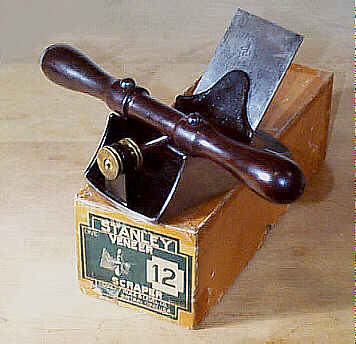
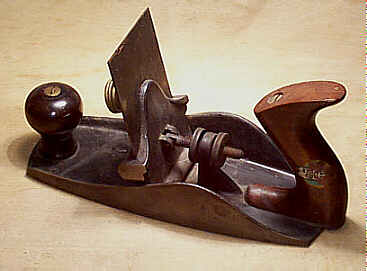
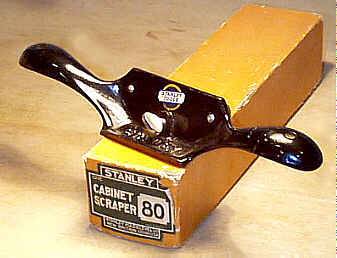
If you call a "card scraper" a "cabinet scraper", then what do you call these?


(Images property of Patrick Leach, www.supertool.com)

And some alternatives for your Bonus, for those who may not want to make their own:


Stewart-MacDonald Ultimate Scraper

Do you think a handle might help? :D I think probably not, but it might be useful to just throw the idea out there. For those who might not immediately recognize it, this scraper is a turning tool.


Woodcraft

Re: Foolproof sharpening of card (cabinet) scraper

#4

Re: Not Quite Foolproof

William Duffield

I'm definitely going to start using your idea of using the Sharpie, Marks-A-Lot or Magic Marker. I find it essential whenever I'm grinding a chisel, plane iron or turning gouge edge, but hadn't though of using it when polishing a scraper edge.

Yours is an excellent description of the process, and it usually works for me. There is one subtle point that others might miss, than can lead to less than desirable results:

At the step where you are holding the scraper on edge and pulling the burnisher to turn the hook, you should be aware of a subtle tactile feedback: The burnisher should move smoothly over the edge of the scraper, but if you apply a little too much force or at a little too high an angle, you will feel a bit of additional drag. This means that the steel is failing from being overworked, and the burr is starting to crumble. If this happens, it will probably continue to cut, but will start making dust a lot sooner and will not provide as smooth a surface. If you notice this, remember the amount of pressure and the angle you were holding the burnisher when you started getting the drag, and next time, stop burnishing just before you reach the point of failure, instead of when you feel the failure.

At this step, I find it sufficient, and simpler, to just clamp the scraper in my vise with about a half inch (or a centimeter or so) projecting above the vise jaws, and instead of pulling and burnishing the near edge, by tilting the burnisher away from me and pushing, I turn the hook on the far edge. That way, I don't need to find the block of scrap wood, and I think the actions to get from drawing the edge to turning the hook are a little less complicated. I use the same hand for holding the burnisher and operating the vise handle, so if you have a steel vise be careful that you don't strike the handle with the burnisher.

Re: Foolproof sharpening of card (cabinet) scraper

#5

In violin repair school...

Brian Roberts

we were taught to rub the burnisher (whatever it is) across the side of our nose to lubricate it...to prevent the galling that can happen from the metal to metal contact.

Nose???? Yup ...because it's handy....and it works!

Re: Foolproof sharpening of card (cabinet) scraper

#6

Re: Foolproof sharpening of card (cabinet) scraper

mdclor

Derek, thank you for posting this. I have been reading your web site and found more educational info than I can absorb right now, but I will keep trying to learn. :)

Re: Foolproof sharpening of card (cabinet) scraper

#7

Re: Foolproof power sharpening of scraper

TomD

Normally I just hold the scraper square to the belt sander, and push it home for a few seconds, then burnish more or less as Derek suggested. Probably shouldn't work as well as it does, but if it doesn't cut and last as well as more painstaking methods, the difference is slight, while the time spent sharpening is massively less than some methods that treat it like a hand sharpening a Japanese chisel.

If you use this method be sure the outfed part of the scraper touches the paper, a fraction before the infed portion, or it might catch, or get rounded.

Re: Foolproof sharpening of card (cabinet) scraper

#8

Re: Foolproof power sharpening of scraper

John K Jordan

For the cabinet (card?) scrapers I use for woodturning (mostly small, rounded) I grind 90-deg on the Tormek, then file and burnish. I've never thought to try the Sharpie or scrapers although I use it on all turning tools. (I like blue the best!)

Years ago there was a guy on WC who was a good source for carbide burnishing rods at a good price. I bought two (a two-lifetimes supply). I wonder if he is still around.

JKJ

Re: Foolproof sharpening of card (cabinet) scraper

#9

Re: In violin repair school...

William Duffield

I used to use my nose when lubricating fishing rod joints, but the salts on your skin can be corrosive if you aren't working with stainless steels. Mineral oil or vegetable oil, or whatever you use for protecting your steel tools from corrosion or for lubricating your oil stones, are better choices. Machinists use cutting oils when milling metals, and these will work, but they are usually toxic.


Galling is not really a problem with carbide burnishers, because the carbide is so much harder than the scraper. For that reason, I have used carbide burnishers exclusively for several years, despite the risk of shattering it if I drop one on the floor. I made the one I'm now using ten years ago.


If you are using a hardened steel burnisher, you can avoid galling it by following Derek's advise of drawing it towards you or pushing it away as you move it along the edge of the scraper. this distributes the wear along the length of the burnisher, instead of concentrating it in one place, where an immense amount of heat and wear can occur. A shaft several inches long is essential in a steel burnisher, while my first carbide burnisher's shaft, recycled from the shank of a broken solid carbide router bit, was less than an inch long. I made this one at least 15 years ago.


Re: Foolproof sharpening of card (cabinet) scraper

#10

Re: Foolproof power sharpening of scraper

William Duffield

Yes, Andy Lincoln is still around. He doesn't post very often, but he offered me another water jet nozzle a few months ago. I didn't need it because I have found another source at a woodworking show I attend every year. One of the dealers in piles of cheap stuff that resembles tools, sells carbide rotary files for about $6 each. These work well because the have 6 mm or 1/4" diameter shafts about three to 4 inches long, and their toothed cutting heads are easily and securely glued into a homemade turned handle. They're similar to this one, which you can buy directly from China by the intermodal container load. :D

If you shop around, you can find them for a lot less.


http://guide.alibaba.com/shop/6mm-x-16mm-double-cut-cylinder-tungsten-carbide-bur-rotary-file-cutter-bit-ax0616-free-shipping_5344723.html

Re: Foolproof sharpening of card (cabinet) scraper

#11

A little more info

Derek Cohen (in Perth, Australia)

Yours is an excellent description of the process, and it usually works for me. There is one subtle point that others might miss, than can lead to less than desirable results:

At the step where you are holding the scraper on edge and pulling the burnisher to turn the hook, you should be aware of a subtle tactile feedback: The burnisher should move smoothly over the edge of the scraper, but if you apply a little too much force or at a little too high an angle, you will feel a bit of additional drag. This means that the steel is failing from being overworked, and the burr is starting to crumble.

Hi William

It is interesting you write this since I had omitted to comment on this area.

In years past I used a hard carbon steel burnisher, such as the one sold by Crown. It did the job, but it could gall the edge ... unless the steel was first lubricated with a tad of oil (any type, even off the side of a nose!).

Two things changed all this for me. The first was the use of smooth carbide. It acts as if it is self-lubricating. The second is that I do not press down that hard. If it starts to resist, I back off the pressure - it is too much!

Over the years I would hear stories of work-hardening the steel. I cannot say that this has ever happened to me, or perhaps I am too thick to recognise the symptoms (probably the latter :).

Regards from Perth

Derek

Re: Foolproof sharpening of card (cabinet) scraper

#12

Re: In violin repair school...

Brian Roberts

Ummmm..... yeah.... wipe it off when finished.....

Really never had any problem with corrosion.

The main reasons for using the nose.....it's handy (most would not take the time to "go get" something else) and we did NOT want other chemicals introduced to the process and area.

Re: Foolproof sharpening of card (cabinet) scraper

#13

Re: In violin repair school...

Bill Tindall, E.Tn.

I would have thought First Cold Pressed Chianti olive oil would be the violin school lube of choice :)

Re: Foolproof sharpening of card (cabinet) scraper

#14

source of carbide rods

Bill Tindall, E.Tn.

1. Any tool room supplier-MSC, Travers, Enco et.

2. Stuff any sort of carbide router bit into a stick

3. Misenheimer, Morristown TN

For years I used a 1/4" solid carbide laminate trim bit stuck in a stick until I got a rod from Misenheimer.

Re: Foolproof sharpening of card (cabinet) scraper

#15

Re: source of carbide rods

John K Jordan

I've used various short burnishers and found them limiting. I like this size:


I can hold the handle in one hand and guide the end with my other hand for more control.

Re: Foolproof sharpening of card (cabinet) scraper

#16

Ellis Walentine

Burnisher profiles and scraper sharpening

Ellis Walentine

I think I bought my first burnisher from Woodcraft, back when they were still in Woburn, Massachusetts, we're talking 40 years ago. It was an "oval" burnisher, probably tool steel, and it had two different radii on the opposing faces, which concentrate different amounts of pressure on the edge being burnished. I found that the "slow" curve, the flatter of the two, was less likely to gall the edge at a given pressure. The take-away, if any, is that you need to strike a balance between the radius of your burnisher and the pressure you apply to the edge of the scraper. If you apply too much pressure for the tightness of your burnisher's radius, you will gall the edge. This effect is easy to detect when burnishing, because it translates as roughness or resistance to your burnishing stroke. The trick is to sneak up on the right amount of pressure so the edge keeps laying down smoothly. This is strictly a matter of awareness and the biofeedback loop of burnishing.

There is also another dimension to this, which is the surface quality of your burnisher. The higher the polish on the burnisher, the less of a roughing action the burnisher surface will have on your edges. I have a few of Andy's water jet burnishers and I find that they work fine out of the box for what I might call utilitarian scraper edges. By that I mean that the low luster of the burnisher surface will not condition a razor edge on a scraper. I have actually polished this type of burnisher to 14,000 grit in a lathe chuck, and the difference is considerable.

This, of course, begs yet another dimension to the scraper sharpening quandary, that of efficency. You need to decide what the objective of your scraping is, and sharpen and burnish accordingly. I view card scrapers -- and I suppose cabinet scrapers (#80 etc.) -- as incredibly versatile tools. But, you don't need a world-class (think fussy to create) edge for everyday leveling of hardwoods, assuming you will follow up with sandpaper. If you want a polished surface off the scraper itself, or if you're scraping delicate surfaces like veneers or lacquer, you need to have a really keen edge. In those cases, you'll need to a) sharpen your edges to a finer grit (think 5000+); and b) burnish them with a very smooth, gently lubricated burnisher, with just enough pressure to raise a razor-like burr.

A lot of woodworking is about feel. It's a good exercise to pay attention to these small details. It makes a real difference in performance and results.

Ellis

Re: Foolproof sharpening of card (cabinet) scraper

#17

Re: Foolproof sharpening of card (cabinet) scraper

Jerry Roberts

Derek, I have tried and tried to sharpen my card scraper with no luck. I cant get the burr but its probally the tools Im using. I use as a burnisher the smooth part of a 3/8 drill bit. That's the cheapness in me I guess. I doesn't work. After reading your method I guess Ill have to break down and buy a real burnisher tool it looks like. Thanks a bunch for the info.

Re: Foolproof sharpening of card (cabinet) scraper

#18

Re: source of carbide rods

William Duffield

I agree. That's the right way to obtain the raw materials if you are building just one for yourself.

The only reason I recommend buying the carbide is I usually build them in batches, and that allows me to prepare several handle blanks the same size, use one drill press set up and one lathe set up, gather a handful of compression nuts of one size, and mix up one batch of epoxy. After the first one, I usually don't even need to caliper the ferrule tenon. I used to sell them, but I now usually give them away.


I will note one potential problem. Some nozzles have been used with an abrasive suspended in the water. These usually end up with a matt surface on the carbide, and are useless as a burnisher unless you polish them using a sequence of diamond grits. I've done that, and have decided it's not worth my time, given the price of Chinese carbide files.