paddle design
paul woolson
Hi all,
I'm looking for some canoe paddle design help. Does anyone have any drawings of designs that they might want to share? Specifically, I'm looking for something with a bit wider blade. Thanks, Paul
Knowledge You Can Build On — Est. 1998
paddle design
paul woolson
Hi all,
I'm looking for some canoe paddle design help. Does anyone have any drawings of designs that they might want to share? Specifically, I'm looking for something with a bit wider blade. Thanks, Paul
Re: paddle design
Mike Johnson
If you can buy or borrow a copy of the book Building a Strip Canoe by Gil Gilpatrick, you will find plans for a canoe paddle in the back. I have built several using his plan, and have been very pleased with them.
I have made paddles.....
Bill Tindall, E.Tn.
....both straight and bent shaft.
Useful Book Canoe Paddles- Warren and Gicmark
The wider blade remark needs some clarification. Even the exceptionally strong marathon paddlers don't paddle with any wider blade than I do, or different paddle for that matter (well, actually theirs are carbon fiber and mine cedar the same basic shape, but they do paddle at twice the stroke rate.) What do you believe the wider paddle will do for you? Where/how are you going to be suing this paddle- touring, white water, racing, recreation........and with what kind of boat?
The top grip is most important. There are style options. Find a paddle you like and copy it.
Re: I have made paddles.....
TomD
I actually got into adult woodworking to build paddles back in the the 70s. I agree mostly with Bill. Wider paddles are generally used in the same circumstances on:
Need more gear inches to use a cycling metaphor. You want to pull harder and you don't care about the fact that it may be too much gear ( for instance because it is your spare paddle and unless the main paddle breaks you are using it only downwind). This also applies to white water where you may be mostly bracing on it, etc... but keep in mind those places where there is 25 miles of flat water between the rapids.
You need a lot of support (covered above)
Styles of paddling that use more muscle groups, like high kneeling.
Your boat is super skinny. If you are the rare person paddling an international marathon boat or other skinny design, knock yourself out.
(Solo Freestyle is a kind of all the above category at times.)
(Marathon boats despite the idea they are used over long distances are relative pigs, as the original percent waterline guidines were set with the idea they would be used with mom and the kids when not racing. They set the pattern for American canoe design for long afterwards, and that isn't a bad thing, but it probably did retard canoe design at the same time, as it is basically impossible to sell a boat narrower than a "race boat". The cycling equivalent would be only mom bikes because at some prior period in cycling development, the mom (or dad) bike was the basis of all racing bikes. The bent shaft is another innovation that has a dark past. As great as it is. it is rooted to some extent in the fat boats going fast cycle as trying to move a pig through the water fast, means a high stroke rate, small paddle, and over time all that lifting water out of the lake caused tendonitis.
Re: I have made paddles.....
TomD
2nd and 3rd adult woodworking projects, the paddle is a freestyle 5 degree bent shaft that had an ash carbon insert under the grip that bent like a bow limb, pretty fly for the 70s. The canoe was my own design based on the Tuttle designed marathon boat, like every other canoe in modern history, pretty much. I designed my boat partly out of ego, but also because back in the 70s I couldn't find any serious designs to copy. There were traditional designs, but not modern ones. The paddle broke during a courting ritual, and the canoe is still with us and will probably see the water this year, though as I have 100 linear feet of self built waterline on the property it may not make the cut.
I have a CAD file of my sugar island variant, and a very thin otter tail. I could send those on somehow, though I don't know how useful they are in a vacuum. Mostly I don't go with the books since they are always behind, if you want to copy at least find good sources, like commercial paddle makers. And size the boat to you, your boat, and your needs. And attempt at custom work is no more likely to end up wrong than a random copy, and you learn a lot more.
Re: Sugar Island is the classic modern...
TomD
http://www.cricketdesigns.com/honeyisland.htm
You will note that having decided on your paddle ratio of width to length you simply draw one parabolic line, that maintains a lot of fullness (overall feel is not triangular). You add arc to the end, and you add radius.
Blades should be made of softwood, and they should be glassed, the main thing when designing this is that if the blade seems nicely stiff when you have the first glass on one side, then you need to take off more material. If should feel fragile when you first glass the one side and have finish carved the other, so that it will have the right feel when the second side is glassed. Veneer is another option and can yield similar results with less freedom of shape.
Doing a bent shaft is easier because shaft aside, the back can be flat, or otherwise it's own thing. Then you glass it, and you can then carve the dihedral on the non-power face to have the right spring, and you can glass it. Double faced paddles have the problem of getting everything right and in addition centered, however it isn't all that hard in practice. Only my first paddle as a kid was not good enough to use. Once you glass one side, get on with the carving or some spectacular tacoing can occur if you suffer a weather change.
if you glass both sides then you can leave the glass long on trimming and lay in some glass and epoxy strand to thicken the edge and complete the envelope against moisture.
Almost all the details are wrong on modern paddles, so set yourself free and come up with some solutions that work for the kinds of paddling you enjoy.
you have that strip canoe on the rocky beach?!
Re: probably on a life jacket
TomD
I wonder, that was a long time ago. It still has virtually no scratches on it. Most likely it is resting on a life jacket or some such. I never place a boat like that on raw rocks, run it up aground on a sandy beach, etc... I pace the boat in the water and get in. I came up through competitive rowing, and you always keep the shells in perfect condition.
As it happens, I am working on a variation on the sitch and glue theme for canoes that will allow one to cheaply and relatively quickly build a canoe for white water use that one could contemplate trashing.
I went to a canoe testing evening they held on a beach a few hundred yards from where I live, and it always blows me away that the folks who are willing to contemplate spending 4 K on an exotic boat think nothing of paddling them onto the beach and walking off onto dry land.
Re: paddle design
paul woolson
Thank you all for the replies. When I said a "wider design" I should have clarified. The designs I've seen are of otter tail and beaver tail when I'm looking for a standard "north woods" type of design.
I'll check out the books recommended. Thanks again! Paul
more questions
Bill Tindall, E.Tn.
Bent or straight shaft?
The straight shafts I have made I patterned off Old Town paddles. I could send a tracing.
I don't remember where I got the pattern for the bent shafts but it is typical of the bent shafts I have from other sources.
Re: more questions
TomD
I wouldn't copy old towns... I would take inspiration from high end.

Sugar island in competent hands. For the history buff.
If you like pretty here are some fancy woodies, I prefer light and performing, I can see how people who don't know wood would like this kind of thing, I like the craftsmanship in service of people who like this kind of thing.

Bent shaft side, plain 15 degree at the blade is fine also:

Blade shape on typical bent shaft marathon/recreational paddle:

Blade shape that emphasizes the catch, the parts of the paddle that are actually going the same way you are and that makes working under the canoe easier:

Paddles that make you feel young again, and that make you forget you like wood:

Re: more questions
TomD
Here is a pic I like that shows three planforms: Sugar Island Solo/Freestyle paddle, great for anyone who wants a paddle to control and easily moved canoe. The middle is their S, but you can see planforms like that in touring and white water paddles, if a little dated. And the smallest is the basic bent shaft shape. Keep in mind that the bent shaft does certain things well and it doesn't pay to just tack on any old shape at the same time. You want high stroke rate, small planform paddles.

I also like paddles like these when matched with the right canoe, but I find them boring to make.
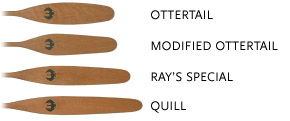
Re: paddle design
paul woolson
Thanks again,
As I've been doing some searching, I find the Bending Branches Espresso most pleasing to my eye. I think I'll go that route.
As it turns out, my daughter will use it on a Joe Seliga wood/canvas canoe in the arctic. If you don't know his boats, they are works of art in and of themselves.
Re: paddle design
TomD
If that is going to be a loaded canoe in a wilderness setting one might not want a large paddle surface area, but sounds like she probably has experience if she is contemplating that kind of trip.
Re: paddle design
TomD
8x20 isn't that big though...
Re: paddle design
paul woolson
Yes, lots of experience with loaded canoes. This will be her 7th summer (next summer) on a similar trip. ~30 days on trail totally self-supported. So the boats are sitting quite low in the water early on.
We're actually headed up there this afternoon, to pick up my older daughter who has been in the arctic for the last 7 weeks, so maybe I can get an idea of what paddle she's been using.
Re: paddle design
TomD
Seasoned folks who know what they are doing, sounds like a good time.


