Home Articles Forums Gallery Marketplace Videos

WoodCentral Forums

Knowledge You Can Build On — Est. 1998

Have a question? Ask Woody!

How to fare a convex Curve????

Posts

How to fare a convex Curve????

#1

How to fare a convex Curve????

Barry Irby

I am making a table with legs that have concave curves I sawed on a bandsaw. Try as I may, the curves are a bit lumpy. How to fare them? I don't have one of the planes with an adjustable curved shoe. The curves are not uniform anyway, just fudged them with a spline until I liked them.

The convex side, I sanded on my stationary belt sander.

I touched up the concave side a bit on the drum on the end of the belt sander.

Then I made a sanding block out of one of the off cuts and started hand sanding them. That worked well enough, but I am a tired puppy. There are eight concave sides.

Any suggestions? They are poplar.
Re: How to fare a convex Curve????

#2

OOPS! Conave curve, Said I am tired.....


Re: How to fare a convex Curve????

#3

JL

Re: How to fare a convex Curve????

JL

I have a Ridgid spindle/belt sander. That works well.

Another alternative is a spokeshave w/ a convex bottom. That's what I have used in the past.

I have also used rasps to some effect.

Many of my chair seats have concave areas in the "waist" of the chair. Those are the tools I use.

Re: How to fare a convex Curve????

#4

compass plane or pattern routing

Dick Coers

Compass plane works very well. Old ones can be had for a pretty good price. I always found it easier to sand and work templates compared to hardwood. Made a pattern in 1/2" mdf or plywood, then pattern routed off a bushing or top bearing pattern bit.

Re: How to fare a convex Curve????

#5

Re: compass plane or pattern routing

Barry Irby

Thanks. I made a pattern out of what passes for 1/4" plywood (5mm?) and traced it on two sides. Sawed to the line. Taped them back together for the second side.

No straight edges left, but if I made more of these I would figure out how to pattern route them.

I like hand craftsmanship, but I think I would rather burn electrons than calories in this case.

The forty grit compass sander worked fairly well.

Re: How to fare a convex Curve????

#6

Re: compass plane or pattern routing

Keith Newton

You didn't mention how long, or tight the bend, but I've found that I can saw an arc that fits under the metal platen on a portable belt sander, that gets up off the wheels, and is pretty easy to feel the bumps, or fairness.

Re: How to fare a convex Curve????

#7

Re: How to fare a convex Curve????

Alexandre Grigoriev

Attach sandpaper (with contact cement) on a flexible ruler. That's a poor man's equivalent of a compass plane.

Re: How to fare a convex Curve????

#8

Re: How to fare a convex Curve????

Richard McComas

Kind of hard to say with a picture to see what the concave look like.

Kerf bend a piece of stock and attach sandpaper.

Re: How to fare a convex Curve????

#9

Re: How to fare a convex Curve????

TomD

He already has a sanding method that works, but it is tiring him out.

Re: How to fare a convex Curve????

#10

Re: compass plane or pattern routing

TomD

Just to mention it, you can make a compass plane out of a normal, plane, just over-extend the bit. This will allow it to cut accurate curves, if the ends are supported. Rig a few planes for different areas of the compound curve, or throw some body english at them by skewing more or less and you should be able to clean some of this up. Assumes you can cut very much with the grain as you already cut a curve in it.

A little tool bowyers make to check for areas where the limb is weak, is like a marking gage but the beam is rested against the concave limb and supported at either end of the fence. This establishes a 3 point arc, and one can easily tell when unfair hollows or flats occur. Same principle with the plane.

Re: How to fare a convex Curve????

#11

Re: How to fare a convex Curve????

Sgian Dubh

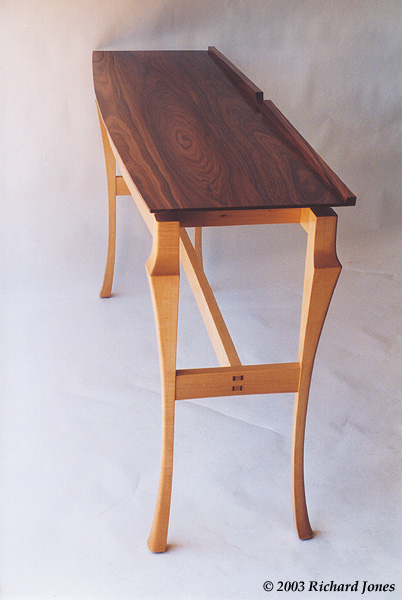
Barry, are you averse to using a router or spindle moulder? It may be too late now, but if you're not against routers and the like, I describe a method for doing that sort of job that you may be able to adapt for your needs, either now or in the future - see the link at the end. The advantage of making jigs and templates is that mistakes in the making of the jig aren't overly expensive, at least with regard to materials, i.e. if you do make an error you simply start again with another piece of cheap material, and once you've got the 'master' template to your satisfaction, then all the other parts should really come out right too.

If you go to the link, scroll about 2/3rds of the way down to the technical description, Slainte.

http://www.richardjonesfurniture.com/Tables-Chairs/equus-tabula/equus-table.html

Re: How to fare a convex Curve????

#12

Re: How to fare a convex Curve????

don stephan

My experience is the best way to take out bumps and dips is #50 Nicholson rasp or similar, angled to about 45 degrees. Once the curve is smooth, spokeshave works well for me. Also card scraper.

Re: How to fare a convex Curve????

#13

Now I know where I stole the design.....

Barry Irby

Sometime in the past I had seen this table and liked the legs. Mine are shaped like those except that I also put a curve on the inner face. The inner face has a convex curve and the outer one is concave. Obviously I did not remember all the details and thought I had dreamed this up on my own. All my best ideas were taken by those who went before me. (Actually, I made three different patterns and sawed out legs from some glued up construction 2x4's until I got one I like.

Your article on the making of this piece is fabulous. Wish I had seen if before I started. I should have chopped the mortises first. I got excited and went straight to working on the shaping of the legs. Makes much more sense to cut and dry fit all the frame parts first while they are still in the square. But that requires foresight, discipline and maturity. Someday, when I grow up, I will learn.

Thanks for the inspiration and posting the article.

Re: How to fare a convex Curve????

#14

Spoke shave

Bill Tindall, E.Tn.


A Lee Valley spoke shave with a curved sole works dandy for this task. Skewing it will be helpful. I was going to pattern route these legs but in developing the pattern I saw that spoke shaving them was so easy that I didn't make a pattern. I have made 8 similar legs, plus numerous practice patterns. I think I would need to be making many legs of the same size to bother with pattern routing. Note however. One needs to choose the wood wisely and not include some wild grain where the spoke shaving was to occur. I did do a curly leg and it was slow going.

For a convex curve, amazingly a hand plane works great. Use the band saw lines as guide lines and plane away.

Re: How to fare a convex Curve????

#15

Re: Now I know where I stole the design.....

Sgian Dubh

Actually Barry, there is a small curve on the legs in that piece, although the curve starts below the stretchers. In the image below there's a similar leg form, but in this case they're more slender and delicate. In both cases, forming the convex curve on the inside face is a piece of cake with hand tools after bandsawing off carefully to a line copied from a template. And in both cases the outer concave curves were formed using jigs and spindle moulder and/or router.

The table below, if jiggled, wobbled a bit but as it's basically just meant to stand around looking something like pretty, sturdiness wasn't much of a design imperative to me, not in the same way a dining table or workbench really ought to be sturdy. Slainte.


Re: How to fare a convex Curve????

#16

Jack Guzman from Maine

rasp and scraper

Jack Guzman from Maine

I have had good luck on these with a couple of rasps followed by a scraper.---Jack

Re: How to fare a convex Curve????

#17

Re: How to fare a convex Curve????

John McGaw

When I first started out I did it the way you are now a couple of times. Later on I realized that there was an easier way: cut a pattern in Masonite and fair that with a drum sander then use that along with a top-bearing pattern bit to router a near-perfect surface on the stock (roughed out with the bandsaw as required). If the stock is very thick it is possible to use a bottom-bearing router bit to follow the first cut and finish things up; I've only had to do this once but it did work despite the cheap bit I was using. At this point it is usually just a matter of light sanding to finish up.

Re: How to fare a convex Curve????

#18

Re: rasp and scraper

William Duffield

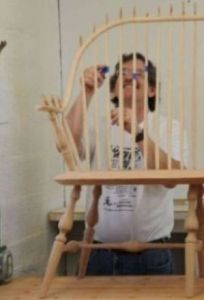
I also prefer patternmakers rasps, files and scrapers. Auriou makes excellent rasps in several sizes and grains. Google will find U.S. distributers for you. These chairs were done with U.S. made Nicholson #49 and #50.


If I'm doing work that is curved in more than two dimensions, I find them essential. (For two dimensional work, both concave and convex curves, I usually fall back to my oscillating spindle sander followed by a scraper.)

On this back splat, which was cut out with a scroll saw, I used a pair of half round Swiss pattern files, a size 00 and a size 2. The number 2 leaves a surface that can go directly to spraying a shellac finish.


For the back of the crest rail, I used the same tools as for the arms.

Re: How to fare a convex Curve????

#19

Ellis Walentine

Second Sgian's method

Ellis Walentine

I've made umpteen pieces of furniture with curved legs and other parts, and it is so much easier to just make a template and pattern rout or shape them than to try to fair them by hand. I always had a large industrial pin router in my shop, which was perfect for not only shaping outside curvatures of things, but also of internal details like mortises and grooves. Compass planes and spokeshaves are the way to go if you don't have a shaper or adequate routing equipment, but you'll need to have a lot of skill, patience and willingness to sweat out all those curves by hand.

Ellis