Home Articles Forums Gallery Marketplace Videos

WoodCentral Forums

Knowledge You Can Build On — Est. 1998

Support WoodCentral when buying things you need

Question on using loose tenons outdoors

Posts

Question on using loose tenons outdoors

#1

Question on using loose tenons outdoors

Barry Irby

Been watching This Old House. Twice they have used loose tenons outdoors. Norm used them in miter joints on some Ipe steps. Tom Silva use them in the Cedar Railing. They both appeared to use a Domino machine to cut the slots. Neither of them explained what the tenons were, but they appeared to be the standard ones. I don't own a Domino, but I was not aware of loose tenons suitable for exterior use. I would have thought the standard ones would swell and rot. So, are rot resistant tenons available?

Re: Question on using loose tenons outdoors

#2

Re: Question on using loose tenons outdoors

William Duffield

Festool makes rot resistant tenons from Sipo (an African mahogany). Last I checked, you could buy them in all sizes except the tiny 4 mm. The larger ones (8 mm, 10 mm, 12 mm and 14 mm) are also sold in long stock that you can cut to any desired length. I would also use epoxy as the adhesive.

Re: Question on using loose tenons outdoors

#3

Ha!  Same thought!

Tony - Memphis

We watched the latest episode Saturday night and noticed the same hign and I had the same question. I bought a bench made of cedar for the wifey years ago that was a nice bench and good value...I thought. The dowels were not meant for outdoor use and the whole thing fell apart after a few short years. Bummer.

Tony

Re: Question on using loose tenons outdoors

#4

Re: Ha!  Same thought!

Barry Irby

Looked like a perfect place for rot to occur. I was surprised they did not mention it.

Re: Question on using loose tenons outdoors

#5

Re: Hardware bonding

TomD

I don't have a Domino either, but say you had a post, and a beam on top of it (railing say), the tenon should be well protected, and the Domino allows a blind installation. In the old days they would have nailed from the top, and rot would start from there.

Hardware bonding is a better method, but it is more difficult/time consuming to install. The pic shows an old garden gate my dad made. Pretty much from day one the gate spread. Periodically I would nudge the concrete anchored posts back into place. You couldn't get through the gate because it needed a windlass to hold the posts together. I built the upper section out of stuff we had around, and it holds the posts rigid. The pediment top is a bit of a joke on my father - he gives the impression that he would trade Dixter, for all the redwoods in California. Anyway the problem was how to secure the top to the bottom, you may be able to see a line just above the level of the pickets. There was no attempt to align the two posts axially as they are not that precise. The solution was to drill large holes into the end of the posts and bond in rebar. Say 1/2" rebar in 3/4" holes that are filled with epoxy. This was done first in the inverted arch, and then the arch to the post. The bonding did not require clamping, merely alignment. The only special equipment was a speedbore bit. The result is enormously strong. The frost heave is very severe, it took a pick-up to nudge the posts back in place before the arch was installed. No way a Domino is as strong or as water proof. This is how I installed the winches and traveller on my sailboat. And it didn't cost 1-2K for the tool. One huge advantage (feels like cheating), is you can get highly precise results without precision workmanship.


Re: Question on using loose tenons outdoors

#6

Re: Hardware bonding

Barry Irby

I like your solution.

Water is unbelievably invasive and will find its way into almost anything. The Building Scientist I took some classes from said "The potential to dry should exceed the potential to wet." It should dry out faster than it got wet.

Re: Question on using loose tenons outdoors

#7

Re: Hardware bonding

TomD

If you look at this picture you can see all the bolts it takes to mount one of today's huge windmill blades, I do not know how they are attached...


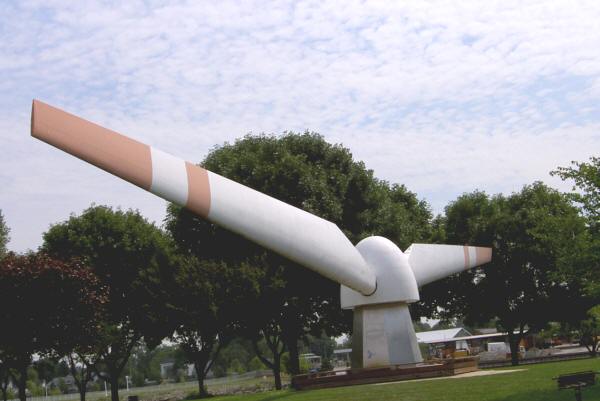
The next picture is of a giant wooden windmill blade made by the Gougeon brothers in Bay City, and on permanent display in the town park These blades are held on by something like 24 studs that are just bonded into pockets filled with epoxy. It is the best way to take a load off wood, onto metal. The blade is something like 140, or 160 feet OAL. Obviously displayed on it's side, it would be deployed in the usual mater we are all familiar with. They made hundreds of these blade sets. They had to be made very accurately, so they fabricated enormous strongbacks out of plywood box sections and hardware bonded in rebar to the tube corners. This has some interesting applications in the shop, like very strong bases for machinery, or beams to support shop cranes.


Re: Question on using loose tenons outdoors

#8

Re: Hardware bonding

TomD

Hardware bonding works because if you drill a substantial hole in wood, and fill it with epoxy it will take countless thousands of pounds to pull it out, and the unit will likely not weather badly if carefully detailed. At the same time, a bolt or stud that is bonded into a small lake of epoxy will be much harder to pull out because epoxy bonds to metal to some extent; it flows around the metal component perfectly; and it is a lot harder than most woods one would ever have access to, possibly all woods. So when a stud is put in a lake of epoxy in a piece of wood, you have a wonderful fastener. And the combination is one in which the precision of assembly comes after the glue is dried, allowing all kind of tricks to be used to achieve machine-like precision, without effort.

What hardware bonding is not, is just coating a screw with glue and inserting it into wood.