making a parquet tabletop
Rob Anderson
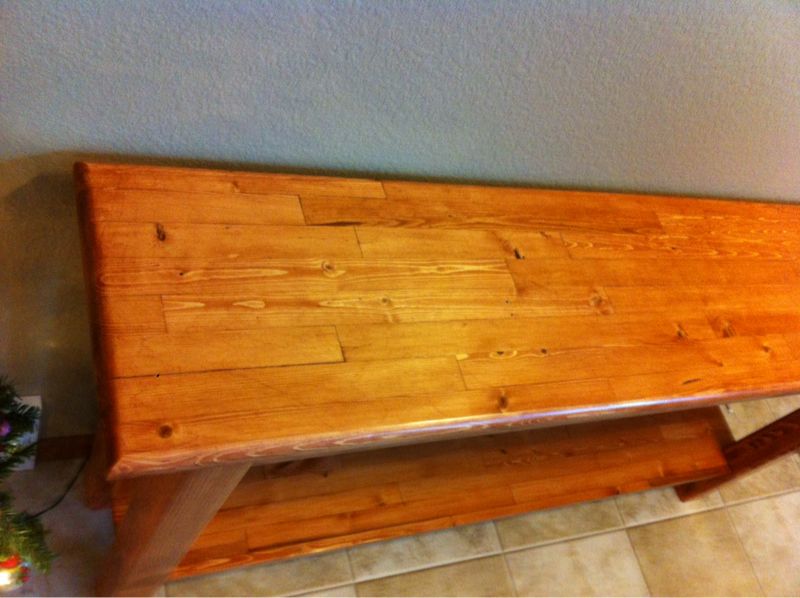
Looking to make a sofa table for the wife and was thinking of making a parquet top out of old scraps. Any suggestions, do's, don'ts or videos anyone can suggest. Never tried it before so anything may help.
Knowledge You Can Build On — Est. 1998
making a parquet tabletop
Rob Anderson
Looking to make a sofa table for the wife and was thinking of making a parquet top out of old scraps. Any suggestions, do's, don'ts or videos anyone can suggest. Never tried it before so anything may help.
Re: making a parquet tabletop
Mark Mandell - Gone Round In New Jersey
Hi Rob,
This piece in walnut was done using 1/4" walnut stock glued to 1/2" MDF and then "picture framed" with solid walnut. It has hung well (a wall piece attached with steel sink mounts) for 12+ years. Finish is oil poly.
Parquet tables are usually done with veneer, but I wanted the piece to have more durability. For that you need a solid base sheet and a limit on the parquet pieces to limit seasonal changes. Movement is not an issue, however, if you use regular veneer.
Re: making a parquet tabletop
Howard Acheson
Use pieces no thicker than 1/4" (less is better). Be sure the parquet pieces have their grain all running in the same direction. Use a 3/4 MDF substrate.
Opps
Mark Mandell - Gone Round In New Jersey
Here's the pix:

Maybe I don't understand the definition.
Keith Newton
But I thought the whole idea for parquet was to use a lot of small parts, not glued along the edges, but glued down to a good substrate, where the parts across the grain is normally so small, that seasonal changes are insignificant, allowing the grain to be oriented in any geometric pattern the maker chooses, at least for flooring.
Now, for a table top, if you want a perfectly pristine finish with no space between parts, which could cause problems from spilled liquids, I lean toward using veneers. If you want to use your own re-sawn scraps, I'd suggest staying thinner than 1/16", which makes it easier for the glue-down to the substrate to hold. As the wood gets thicker, the the integrity of the wood allows it to tear away.
If you want to just use one species of wood, especially one with a good level of chatoyancy, I like, uh, cant think of the name for the pattern, but it consist of diamonds with 60º & 120º corners. You group three of them together with the grain running different in each, forming a hexagonal block. These are then assembled, which gives the illusion of blocks, which seem to have a physical dimension. When you stare at it a moment, what appeared as an outside corner, will suddenly seem to be an inside corner. Being on a horizontal surface even reveals other hidden patterns as you walk around it in the changing light, that don't reveal themselves when presented on a vertical surface.
Re: Maybe I don't understand the definition.
John McGaw
It is commonly called the "tumbling block" pattern. That is what I chose for my class project when I tried to learn leaded glass work. It looked simple. In theory...
Re: Maybe I don't understand the definition.
Yonak
Here's a neat "weave" pattern I ran across when I looked for "herringbone" :

(Although I would not consider this design herringbone.)
Re: making a parquet tabletop
don stephan
The recommendation I've always seen is that the wood "veneer" should be no thicker than 1/16" or it may be able to generate enough force during seasonal movement to cause problems.
Re: wood movement
Mark Mandell - Gone Round In New Jersey
This is another piece I did in walnut and cherry. The top is a sandwich over an MDF core. Top was glued up using 1/2" stock, then thinned to 1/4" from the center out to about 1-1/2" from the edges. before the MDF was then glued in. The center point does show slight seasonal changes as the cherry moves more than the walnut. 
Here you go.
basil
Top of the page on the left is a kitchen table my Buddy Tommy did many years ago. One of his sons is using it now. Pieces were about 7/8" wide and 1/2" thick glued to 3/4" thick cabinet grade plywood. Cut on a 45 degree angle on each end and the length such that two 45 degree sides were the same length as the long side between the 45 degree ends.
http://www.woodcentral.com/shots/shot139.shtml
He did a large dining room floor using about the same method, same sizes and 28 different kinds of wood. "If" I remember correctly he cut 7 miles of strips into many thousands of pieces for the floor.
Here's the simplest way to do that. Plane all boards to exactly same thickness. This determines the width of pieces....and the thickness is determined by how far from the table saw blade that you set the fence. I always start with a piece of plywood a little bigger than the finished product and either square a design in the center on one corner. I square everything up on the saw when I finish. Also, you may want to clamp it all down to a workbench until it dries completely. I use 1/2" pieces and 1/2" plywood and glue the pieces down and on the sides.
Now throw away your ruler for a minute. Measuring the 45 degree ends and trying to figure out how long to cut the long side is futile.....(check table saw blade teeth and see if they have any set in them) all you have to do is set your table saw fence EXACTLY two widths (not thickness) of your strips away from the saw blade with (if any) set leaning toward the fence. Now set miter gauge on as perfect a 45 as you can and cut one end of a strip. Now push that end against fence and cut again....that's your first piece. Cut several pieces and then dry fit in several different patterns until satisfied that TWO 45 degree ends match the long side and will work any way you lay them down.
I use a unifence laid flat and pulled back to a point slightly in front of the blade and piece of wood screwed to my miter gauge for this.
BE CAREFUL...it's easy to start shooting the pieces through so fast that you will become bored and become careless.
A couple of small tables.
basil
My first two projects. A couple of small kids tables.
http://www.woodcentral.com/shots/shot138.shtml

Show and tell
Ellis Walentine
Here's a little parquetry flooring detail I put into a house I did a long time ago (1978?). First I made the curvy tree motif and then traced it onto the maple blocks and bandsawed them to fit. The whole shebang is 1/2" thick solid lumber glued to a 1/4" plywood substrate with flooring adhesive and then glued to the subfloor. The 3/4" strip flooring was then laid around it. On a table, you'd make a solid wood frame, and I don't imagine you'd bevel the edges of the individual pieces as I did here.
Ellis

Re: making a parquet tabletop
Rob Anderson
Thanks everyone, some beautiful work and lots of helpful comments. I really feel bad, cause it had been a long day and I meant to say butcherblock style, not parquet. What I am planning on doing is ripping a bunch of scrap 2x4's 3/4" or 1" thick and gluing them together with the 1 1/2" side facing up. Am I nuts for trying to do this?
NoT Nuts
Mark Mandell - Gone Round In New Jersey

Not nuts, but...
Ellis Walentine
... if you're going to go to the trouble of making a butcher block table top, why not use some nice hardwood? I've always found that the materials cost of doing something well is only a fraction of the value of the labor, though it's tempting to undervalue your own labor.
Ellis
Re: I sure agree!
Larry Clinton At Frankfort, (Central) Indiana
Making a table in this fashion means you could certainly use either "scrap" leftover pieces of hardwood or buy the "discounted" wood at a local sawmill. I purchase rough sawn hardwoods at a local mill, and the "Shorts" or narrow/odd pieces are often discounted at around 50%, making the cost darn near pine cost. Probably wouldn't have more than $20 in the lumber. (and you may have $10 in glue), I sure wouldn't waste my time doing all the work required and end up with a softwood top when for that small amount you can have Walnut, Oak, Cherry etc., that really lasts and is a far better looking project.
Have you ripped any 2x4s lately?
Dick Coers
If you haven't, you are going to end up with a bunch of noodles and you should plan on a lot of time on the jointer and thickness planer. Then trying to glue them up into a somewhat flat top will really be difficult. It will take hours, maybe days if you do it all by hand, to make that flat. Way ahead of the game if you use straight hardwood boards.


