A table called Tweed
Posts
Re: A table called Tweed
#2
Re: A table called Tweed
Chris Groves
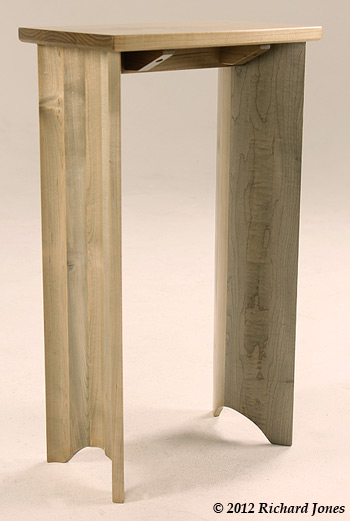
love the look of the wood treatment and the leg design... very cool look...
Re: A table called Tweed
#3Re: A table called Tweed
Bob Entwisle in NJ
Richard,
Very nice table.
I especially liked your writeup on the wood treatment. Both the ferrous sulphate as well as the good description of applying plaster of Paris as a filler.
Thanks
Bob in NJ
Re: A table called Tweed
#4Nice Work!
Ken Krawford
I really like the design. How in the world did you do the flutes on a concave surface?
Re: A table called Tweed
#5Re: A table called Tweed
Sgian Dubh
Thanks Bob. I'm glad you got something useful out of it. Slainte.
Re: A table called Tweed
#6Re: Nice Work!
Sgian Dubh
The working of the flutes is really fairly straightfoward Ken. If you look carefully after the following short description you'll be able (I think) to see how obvious it is. First of all the curved slab legs are made of a series of staves assembled cooper style. Secondly, now you know this, essentially what you do is take long sticks, let's say 40 X 20 mm in section. Then you cut the narrow edges at an angle, say 87º, so that the bits fold together to create a curve-- each face of each stave at this point is flat on both sides. Next you set up a moulder, router, or whatever, and you run a flute centred on the wide face of each stave that shows on the concave side of the assembly.
Finally, you simply cut the staves to length and glue the narrow edges together using masking tape, stretchy packing tape, or whatever is to hand, although a bit of hand planing may be required to get the edges matching tightly. All that's left to do is make a mullet that closely matches the flute profile, wrap some abrasive paper around it and tidy the flutes up and blend the joint lines together. Lastly I made a rig to carry the concave/fluted side of the slab in place between bench dogs whilst I got at it on the convex side with planes to remove the facets so that it looks like the arc of a circle, even though it isn't an exact arc.
I hope you've got the gist of it, but if not, ask again. Slainte.
Re: A table called Tweed
#7Re: A table called Tweed
don stephan
Rather nice grain pattern matching across the boards in the top, too.
Re: A table called Tweed
#8Re: Nice Work!
Ken Krawford
Makes perfect sense. My brain was trying to make it much harder than necessary!
Thanks.


