router shank depth
mike mcnerney
Is 1" deep good enough to put the shank in the collet for a 1.25" di. bowl bit, If I take shallow cuts?
MM
Knowledge You Can Build On — Est. 1998
router shank depth
mike mcnerney
Is 1" deep good enough to put the shank in the collet for a 1.25" di. bowl bit, If I take shallow cuts?
MM
Re: router shank depth
doug f, san clemente, ca
Mike - my habit has been to bottom the router bit, then edge it out about 1/8", tighten the collet and you're good to go. Has always worked for me.
My $.02.
Doug
Re: router shank depth
Carol Reed, Strawberry, AZ
Mike, the correct answer is the entire collet must be occupied by the router shank, whatever that length is. Half inch shank diameter bits are always long enough to meet this requirement. Quarter inch shank diameter bits, not so much, as they are best used in a trim router - much shorter collet.
If you meed more depth, then purchase a bit with a longer shank. Much better than having the bit come out under load. Also much less expensive than a trip to the emergency room. BTDT - vicariously though a woodworking student. Not pretty.
The reason is simple. The bit is locked into the collet via compression. If part of the collet has nothing in it, compression goes to the part with least resistance, leaving the occupied part with less than it ought to have. Also distorts the collet.
Reminder everyone, collets are considered to be consumable items. They do distort under compression. When the bit creeps out and you've eliminated collet nut tightness and dirty shank/collet, consider that it is time for a new collet.
FWIW from the retired Router Lady.
Re: router shank depth
Hal
If you use Doug's method, you're sure to be safe although in my opinion and from what I read, one inch should be adequate. Katana bits (from MLCS) have marks on the shank, and the mark they say is the minimum depth is about 3/4". There are times when I can't use Doug's method because I can't get the bit far enough above the table top, and I'm leery of bit extenders.
Re: router shank depth
Hal
Carol is correct.
Re: router shank depth
del schisler
I bottom the bit . Than about 1/8" out and tighten up the nut. It has work for me for about 50 yr's of so . I wouldn't bring the bit out much past that. If the bit doesn't come up to the height you need. Check the bit see if it is a short?? If so get a longer bit. I don't belive i would use a bit extention tho. I have never had any problum with that. If that happen's look at the table or the router plate ? to thick ?? The lift or router lift ? I use the bosch router their is a adjustment that you can adjust so that the router will raise the nut above the table. I belive their are a couple adjustment's on their. I know with that one i have never been to low with the bit. my 2 cents
Re: router shank depth
Rick Christopherson
I have never understood why so many woodworkers practice the habit of bottoming out their router bits in the collet. Once the shank reaches the bottom of the collet's gripping surface, any further insertion will not increase the grip. Most collets are only about 3/4" deep, although some of the newer ones might be 1" deep.
All you need to do is make sure it is fully inserted up to the end of the gripping surface. The only other reason to insert it farther is if it has a small shank but a large head, and you need to keep the shank more stable. However, this isn't really an issue because most shanks aren't long enough to even allow that.
There are so many stories on the internet about woodworkers ending up with bit problems because they over-inserted the bit. If it wasn't for over-inserting their bits, there wouldn't be any of these problems. Some of the example stories I have heard are:
♦ couldn't loosen the nut because it hits the head,
♦ the carbide got chipped when the nut or wrench got too close,
♦ the bit came loose because it clamped against the fillet at the top of the shank,
♦ the bit came loose because it was bottomed-out on the inside of the arbor,
♦ and many more.
Rarely is there anything to gain by over-inserting the bit, but more often than not, there will be problems at some point when you do.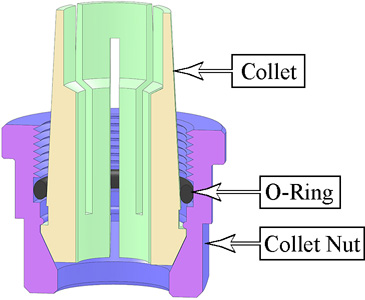
By the Way...
Rick Christopherson
By the way, this statement by Carol is not correct:
"The reason is simple. The bit is locked into the collet via compression. If part of the collet has nothing in it, compression goes to the part with least resistance, leaving the occupied part with less than it ought to have. Also distorts the collet. "
The collet uses a Morse taper, so the compression along the interior of the collet is parallel. This is the whole reason why Morse taper exists, because it bites down on the part that it can't compress, not the other way around.
Re: router shank depth
mike mcnerney
OK, I know what I'm going to do. I'll let you know.
thanks to all.
mike
Re: router shank depth
Mark Mandell - Gone Round In Jersey
The grip of all of my collets (Bosch, Ryobi, and DW) is exactly 3/4" long (deep) thus, inserting a shank more than that is completely useless from the standpoint of a secure grip on the bit. The shank length on my 1/4" bits is about 1-1/4" (the 1/2" shanks are longer) and the boring on the router's spindles are all 1-15/16" deep. Consequently, it's not possible to have a shank inserted to the bottom, they can't reach unless I want the cutters into collet as well (not).
I put rubber "o" rings on all my bits, set at 3/4" from the end of the shanks. That gives me uniformity and enables me to properly tighten the collets without the bits slipping deeper into the spindles.


