Home Articles Forums Gallery Marketplace Videos

WoodCentral Forums

Knowledge You Can Build On — Est. 1998

Support WoodCentral when buying things you need

Loose tenon question *LINK*

Posts

Loose tenon question *LINK*

#1

Loose tenon question *LINK*

Nathan

I just read Glen Huey's blog entry "Slip-fit Corrects a Slip in Planning" (over at the Popular Woodworking blog), where he discusses how he overcame a "premature assembly" problem.

For anyone who has read it, or would like to (see link), I wanted to pose a question: couldn't Glen have solved the problem using a loose tenon?

The integral tenon on the front of the runner is very stubby, and he explicitly states the tenon on the other side of the runner goes clear through the back. He describes several options that he considered, but a loose tenon is not one of them. In my mind, he could made a mortise in the end of the runner, then drop the runner in at an angle from above (stubby tenon first), and then tap the loose tenon in through the back of the base.

What am I missing?


Slip-fit Corrects a Slip in Planning blog entry

Re: Loose tenon question *LINK*

#2

Ellis Walentine

I'm with you, Nathan

Ellis Walentine

A loose tenon would have been a lot easier.

Ellis

Re: Loose tenon question *LINK*

#3

Re: I'm with you, Nathan

Bob Lang

There are two kinds of people, those who think loose tenons are the solution to everything, and those who never consider loose tenons at all. There doesn't seem to be any middle ground on this subject.

Bob Lang

(type 2 when it comes to loose tenons)

Re: Loose tenon question *LINK*

#4

Ellis Walentine

Design solutions

Ellis Walentine

Bob, this isn't an issue of dogma, it's one of design. I can't think of a better place to use a loose tenon, where it's perhaps the only simple solution, and completely valid.

Ellis

Re: Loose tenon question *LINK*

#5

I 'm with Bob

Bill Tindall

There is no rational reason why but I never consider using a loose tenon. It may trace back to my unsatisfactory biscuit experience.

If I had a machine to cut them I might be more likely to use them. As I think about it doing them by hand is not handy. It involves chopping two mortises and I am not fond of mortise chopping.

Re: Loose tenon question *LINK*

#6

Think "Router"

Mark Mandell - Gone Round In Jersey

Don't need a $500 machine to do them. 3/8" straight bit is fine and it takes all of 60 seconds to round over the edges of the l-t on a belt sander.

Re: Loose tenon question *LINK*

#7

JL

Re: I 'm with Bob

JL

I had some "scrap" leftover from resawing several boards. I planed it down to 1/4", 3/8" and 1/2". It is my loose tenon stock.

I use my 1/4", 3/8" and 1/2" router bits in a loose tenon jig (courtesy of Bill Hylton's plans) and I saw my stock to width and length.

In the rare cases when I make tenons (rather than loose tenons), I still use the jig to cut the mortises. I can square up the mortise rather easily. I usually don't make them more than 1" deep anyway.

Re: Loose tenon question *LINK*

#8

Re: Loose tenon question

Thomas S Stockton

Interesting post, I think the main thing being missed is how important it is to think your projects through. If he had dry clamped the project and tried to fit the piece he would have found out the piece wouldn't go in as planned. I know this from experiencing a very similar situation.

I think his solution is overly complicated and Nathan is correct a sort of floating tenon would work well. My solution was to fit a tenon in the mortise that stuck out about 3/4" and glue it in place. I then put a mortise in the end of the board that was closed one one end and open on the other so that I could slide the piece in sideways. Their are two ways to hide the slot the first is to fit a plug, the second way is to make the tenon wider than the mortise so it will be flush with the edge of the piece and the trim and sand it. Since it is in a spot that is rarely seen nobody will ever notice it. I have used a similar technique to replace stretchers on chairs that were ruined by puppies and also to add a stretcher to a desk that needed it for design reasons after the base was glued up.

Ellis is right it is not about dogma and more about finding an easy solution to a screw up. I had an employee who told me the most important thing to do when you make a screw up is to stop what you are doing and switch to something else for a while or take a walk and the rethink the problem when you are in a better mood.

Tom

Re: Loose tenon question *LINK*

#9

Speaking of Bill

Mark Mandell - Gone Round In Jersey

I use a self-centering base plate on my plunge router to cut the end grain and edge mortices. I think there's a plan for one in Bill's Router Magic.

Very simple to make and use.

Re: Loose tenon question *LINK*

#10

Ellis Walentine

You got it, Bill

Ellis Walentine

"If I had a machine to cut them I might be more likely to use them."

Nobody's advocating doing something more difficult without the right machines/jigs/fixtures. My partner and I used floating tenons for the majority of our M&T joinery, but we had two horizontal mortisers in our shop, so cutting the mortises was a snap.


There are many good reasons to use loose tenon joinery. In the photos above, you can imagine how difficult it would be to cut tenons on the ends of 6'-long by 4"-thick rails, not to mention the difficulty of cutting 4"-deep quadruple mortises. On frame work, it is a lot easier to cut rails to exact shoulder-to-shoulder length than to add in the lengths of the tenons and then cut back to the shoulder lines. Plus, tablesaw tenons are time-consuming themselves to cut, but you can make loose tenons by the carload, in every thickness and width you need, and cut them to length for specific projects.

The bottom line is that every shop needs to gear up for the operations that work best. For us, and a lot of other craftsmen I've known, is that loose tenons are a preferable way to handle a lot of mortise-and-tenon joinery. Further, you don't need to limit yourself to this method; regular tenons are perfectly fine when you are geared up to make them efficiently and where they are preferable for whatever reason.

Ellis

Re: Loose tenon question *LINK*

#11

Re: Design solutions

Bob Lang

Personal preference, not dogma here. I've tried loose tenons a few times, didn't care for it, and so it's not included in my bag o'tricks.

Bob Lang

Re: Loose tenon question *LINK*

#12

Re: Loose tenon question

Tony - Memphis

Hmm, I built a lowboy via Phil Lowe and we put all the runners in during assembly. The runners fit into a through mortise in the back. Wedging them in place was an option. I wedged mine becasue I liked the look and it kept them from moving around. Phil's article on the same piece in FWW shows how he does it.

Tony

Re: Loose tenon question *LINK*

#13

Alan Young

A Middle grounder

Alan Young

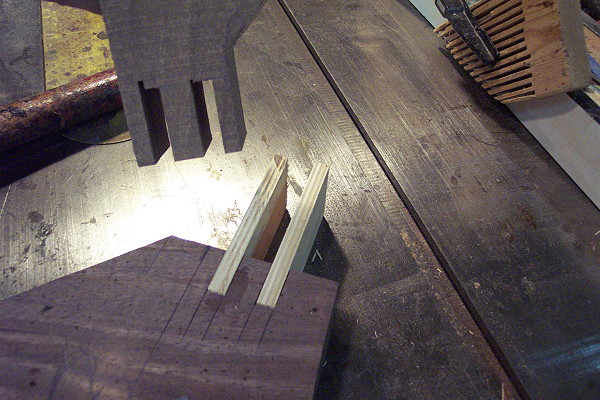
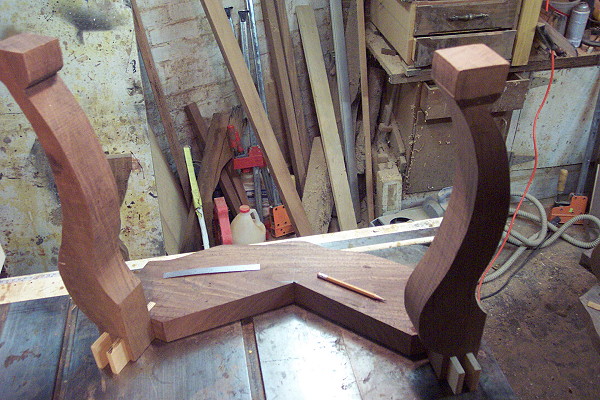
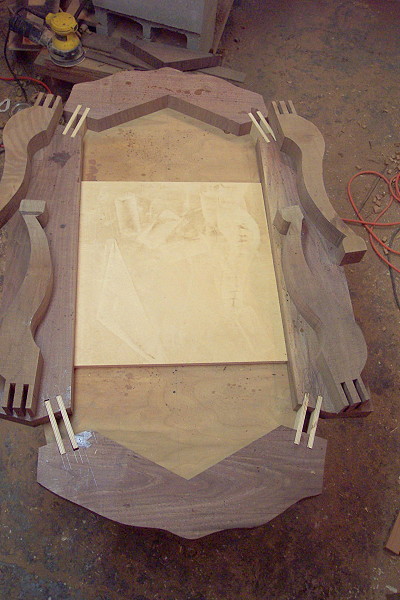
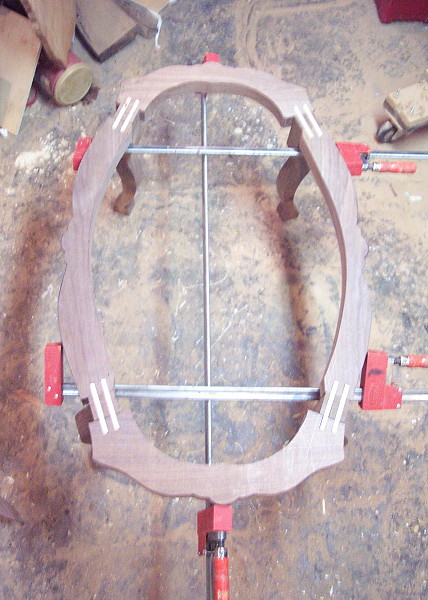
I use plenty of regular M&T joints but there are occasions were loose tenons are a big help...such as when I made a coffee table that needed legs glued to an irregular curved apron


I cut the "mortises" for the legs and aprons on my bandsaw and used baltic birch ply wood for the loose tenon material


-Alan