We value your privacy.
We use cookies to enhance your browsing experience, analyse site traffic, and personalise content.
By clicking “Accept all”, you consent to our use of cookies. You can also choose
“Essential only” or learn more.
I especially like the legs and the care you took to orient the leg grain. I am also fond of beaded aprons. Lovely color. How did you apply finish? Sand between coats?
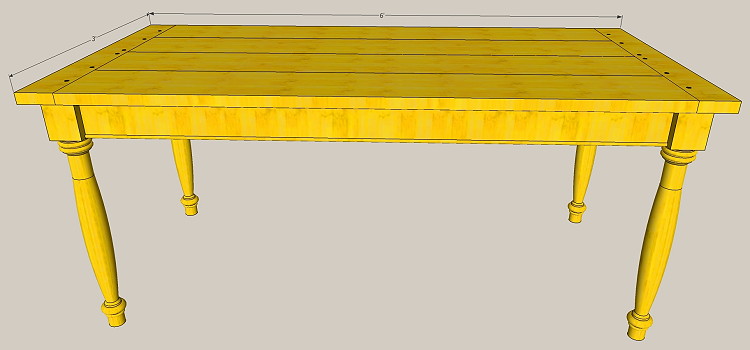
Allen, that is one sweet looking table. Did you use plans or design it yourself? I have been thanking about building a new dining room table. Yours looks perfect.
I tried a product mentioned to me by David Yoho-Charles Neil's Blotch control. I am very please with the results. This product is designed for use under a stain-A clear finish doesn't require the product. I used two coats-light hand sanding after the second coat according to the directions then applied the Minwax Stain-Ipswitch pine-as desired by the client. I brushed on the first four of five coats of the poly-the first three-gloss the last two-satin. I hand sanded between the first three coats-Then between the 4th and 5th I used a ROS then applied the last coat with a wetted cloth rag. A final light buffing with a scotch-brite pad after the 5th coat.
I'd like your take on how the blotch control worked for you. I know we exchanged a few emails about it and I see you tried it, so I'm curious about what you thought. Did you try staining a sample without the blotch control to see the difference?
The pictures look to me to have a very uniform coloration throughout the entire surface. That would indicate the CN Blotch Control did its job. Nice work on the finish!
For those that may not know, Alan used a fairly new-to-the-market product developed by a good friend of mine and professional furniture maker in New Market, VA, Charles Neil. He worked closely with a manufacturer until he finally achieved a formulation that would give him what he was looking for in a pre-stain blotch control. It's like no other on the market because it's water-based and it's simple to use. Not only does this stuff prevent blotching but it cures something else that folks who work woods like cherry may have run into. If you've ever assembled a panel and, for whatever reason, it contained a piece that was darker or lighter than the surrounding field, that difference in tone always shows through in the end. This product solves that problem. Good stuff, as you can see from Alan's pictures! If you haven't already a method for avoiding blotch in your shop this might be something to look at trying. I know its benefits from use and know it's worked for me.
Alan, lastly, did the table rock any on that wood floor and were you prepared to deal with that at delivery if so? It appears there are some metal pads attached to the end of the legs, which could lend a hand in that effort.
Charles Neil's Pre-Color Conditioner - Blotch Control sure does work. I use on things that i want a evin stain on the wood. Work's on the end grain keeps the t=stain even. and no blotching. good stuff here is a link to the Charles Neil's Pre-Color Conditioner - Blotch Control
i am grateful for you directing me to the Charles Neil product-I am very pleased with the results. The chosen stain is rather rather light in tone but even so the Blotch Control gave a very even tone. I am certain it is even more advantageous for darker stains and dyes.
As to the lay of the table to the floor-I did place levelers on each leg but they were all set tight to the end of each leg and the table sat perfectly flat. Perhaps the floor and table are equally mis matched?! :^)
To be sure, it is another great looking effort on your part. I read with interest the blotch blocker blurbs, obviously effective in your application. That is a table to be proud of.