glue clamp time
Jerry Gibbs
Didn't want to hijack a prior thread. OK, at 60 degrees, how long in the clamps for aliphatic (yellow glue) type glues?
Knowledge You Can Build On — Est. 1998
glue clamp time
Jerry Gibbs
Didn't want to hijack a prior thread. OK, at 60 degrees, how long in the clamps for aliphatic (yellow glue) type glues?
Re: glue clamp time
Bill Houghton, Sebastopol, CA
For my own peace of mind, I always leave work clamped overnight, although I think this is probably way more than needed for yellow glue.
Re: glue clamp time
Jerry Gibbs
So do I, but others have said I can remove the clamps much sooner to clean up rubbery glue. Jerry
from the Titebond FAQ *LINK*
Bruce, a MN Galoot
"What is the clamping and drying time of Titebond Wood Glues?
For most of our wood glues, we recommend clamping an unstressed joint for thirty minutes to an hour. Stressed joints need to be clamped for 24 hours. We recommend not stressing the new joint for at least 24 hours. For Titebond Polyurethane Glue, we recommend clamping for at least forty-five minutes. The glue is completely cured within 6 hours."
Titebond FAQ
depends....
Bill Tindall
on moisture content of wood and of course temperature and what you intend to do after the clamps are off. Good joint(no stress), KD wood, light handling and I would not hesitate to remove clamps after an hour at 60 degrees if pressed for clamp time. Joint is not at max strength though. I wouldn't be running the panel through a planer though in less than 4 hours, about.
and
Bill Tindall
it depends on glue type. My only experience is with Titebond Regular. Others have longer cure times.
This is interesting....
Barry Irby
My shop time ranges from leisurely to intense and pushed for time.
When I can i leave the clamps on over night but I have developed the habit of not pressing the panel against the bars of the clamps so that I can clean the joints after an hour or maybe less.
When I am pressed for time or clamps, I have left the clamps on for as little as 20 minutes. When making multiple panels and rotating the clamps through the project, 20 or 30 minutes and they get moved to the next panel. I have been known to rob them sequentially, If there are five clamps on two panels, I may remove two of them and use them on the next panel. I have run panels through the planer after an hour. Usually shoot for three or four hours, but have never lost one. This is for joints that were nicely cut and required almost no clamp pressure to close the joints and create a little squeeze out. I am suspicious of any joint that does not have a little squeeze out, and have been known to open one to add a little glue.
Re: This is interesting....
john lucas
Barry pretty much echoes what I do. If I'm gluing miters I leave them at least 2 hours. Flat panels glued long grain to long grain I can remove the clamps after an hour. I prefer to do my glue ups in the evening and just let them sit overnight. I haven't used anything but titebond and titebond 11 for many years.
As a turner I've glued up pieces long grain to long grain and turned them after an hour. The forces didn't pull them apart. If end grain is envolved I leave them longer before turning but can still remove the clamps after an hour. I will have slight glue line problems later. If I want to eliminate any glue lines raising then I wait as long as possible before turning. A week would be best. It takes a long time for the glue line to stabilize. I'm told it's the moisture in the glue swelling the wood, then you sand and later the wood shrinks and glue line shows as a slight bump. If you wait long enough before final sanding the glue line doesn't come back up.
Re: glue clamp time
Dave Paine
I am using the Titebond III which does state longer minimum clamping time, of I think 40+ mins.
I look for the excess glue to have a good skin, which is 40 - 60 mins and then will remove the clamps to allow cleanup with sponge and scraper. If I have enough clamps I will re-clamp, but with fewer clamps.
I can attest to the glue not being cured. I have experienced incidents when I did not re-clamp and the joint moved.
I have also used this to my advantage if the initial clamping did not get all the pieces level, I will re-clamp the offending pieces and can normally see some movement to be closer fit.
A big factor is "murphy" who decides when a piece or pieces will use the small amount of moisture in the glue to cause the piece to swell or warp due to not having a clamp on the exact spot.
What's the rush?
Barry
What's the rush? When I do a glue-up, I always leave it in the clamps overnight, then you don't have to worry about clamp time.
Re: glue clamp time
Rick Christopherson
QUOTE ==========================================================
I can attest to the glue not being cured. I have experienced incidents when I did not re-clamp and the joint moved.
I have also used this to my advantage if the initial clamping did not get all the pieces level, I will re-clamp the offending pieces and can normally see some movement to be closer fit.
A big factor is "murphy" who decides when a piece or pieces will use the small amount of moisture in the glue to cause the piece to swell or warp due to not having a clamp on the exact spot.
===============================================================
From these statements, it sounds like you are not applying enough clamping force to your joints. With a proper joint, it should be locked solid in a matter of seconds, and after 5 minutes should require a hammer to break the joint. If you are able to slide your joint after a few minutes (let alone the half hour you suggest) then you have way too thick of a glue line due to inadequate clamping pressure.
The same is true about the observation of wood swelling from the moisture. A properly clamped joint will not have enough liquid in the joint to cause the wood to swell.
I believe Norm Abram is possibly the leading cause for so many woodworkers to under-clamp their joints. As testament to how prevalent this problem is, is the number of discussions from woodworkers on how to deal with visible glue lines. Glue manufacturers even capitalize on this by making wood-colored glues.
In reality, a properly jointed and clamped joint should be totally invisible. The picture below wasn't a special panel I glued up just to take a picture of. It was from a leftover panel from a large project 15 years ago that was still sitting in the workshop. This was back in the heyday of my shop when I was clamping 30 to 40 panels an hour for projects.
The bottom line is that if you can move your joints after a few minutes, or if you are experiencing visible glue lines, then you are not applying enough clamping pressure to your joints. Contrary to what Norm Abram has taught so many woodworkers, it is virtually impossible to starve a glue joint when using hand clamps.
===============================================
To the original poster, at 60 degrees, your panels can come out of the clamps for light handling at 45 minutes, but 1 hour would be preferred. I would give them 2 hours before an aggressive process, such as wide belt sanding. However, above 70 degrees, these numbers are cut in half, and I pull panels from the clamps in 30 minutes and wait 1 hour for wide belt sanding.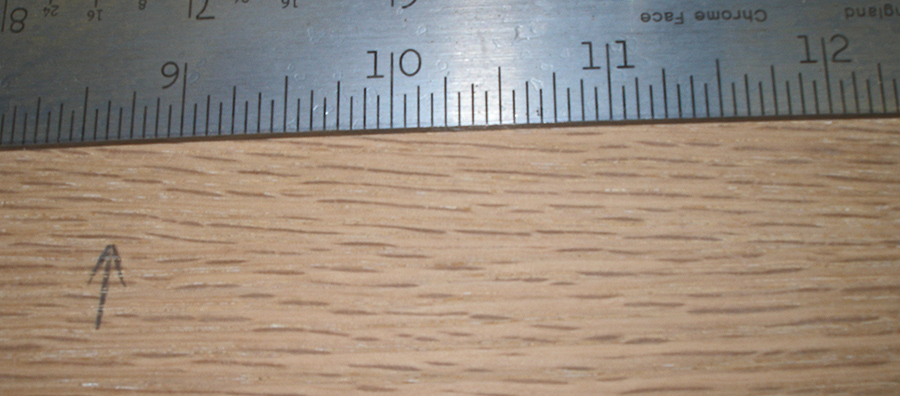
Re: glue clamp time
Dave Paine
I agree a good glue line should be almost invisible, except for obvious grain differences.
I may not have the strength of Popeye, but I have never watched any of Norm's programs, and will tighten my clamps as much as I can. I normally use parallel bar clamps and pipe clamps if I need extra.
My comments are based on my own experience with my projects.
Perhaps I should have used the term "creep" instead of "move".
Most glues will creep under pressure. Some will creep even after cured. Pressure / forces will vary.
Re: glue clamp time
FredD
In addition to Rick's points on clamping time , I would add that the joint should fit closely before the appilcation of glue and clamps.
Cranking up the pressure to bring a poorly fitted joint into alignment , locks a stress into the joint that shouldn't be there.
Later on the stress may win out and then you will see what should have avoided.
FredD
Re: What's the rush?
Steve Schoene
You rush so you can use the same clamps for the next panel. It's definately a clamp multiplier.
Re: What's the rush?
Barry
Tell Santa you need more clamps..........it's the season!
When I rush, I am always sorry. Why is it there is always time to re-do something, but never enough time to do it right in the first place?


