We value your privacy.
We use cookies to enhance your browsing experience, analyse site traffic, and personalise content.
By clicking “Accept all”, you consent to our use of cookies. You can also choose
“Essential only” or learn more.
>I have a client that has some left over T&G cherry flooring-about 2.75" in width and random lengths from 6" to 30". He would like to have this flooring glued together in a parqueted order to two layers each 48" square then glue the layers together and trim the sides to leave an octagon shape. The end use being a card/poker table top. I told him I though the gluing could be done but there could not be any edgbanding to cover the t&g profile. He OK with the edges showing the profiles. Are there any other concerns before I proceed with this plan?
>Alan, I'm not picturing the parquet pattern you describe, but I think there are two areas that need to be carefully evaluated before you proceed. First, parquetry chops up the wood and removes some amount of strength or stiffness across the table. Depending on how the pieces are arrayed, this could lead to eventual sagging. What I have done on game table tops is to make an octagonal frame with an octagonal piece of plywood glued into it all around, with a recess at the top. Then you can drop any finish treatment you want in the recess. I've most often filled the recess with leather-covered plywood, but you should be able to use parquetry as well.
The other caveat is that you won't be able to effectively glue the parquetry pieces together, at least not in a way that is likely to keep the surface unbroken. Consider what kinds of things might get into any holidays in the surface -- drinks, coins, dirt, etc.-- and you might opt for a surface that will be continuous and impervious.
Sorry, but I'm not feeling comfortable with your plan.
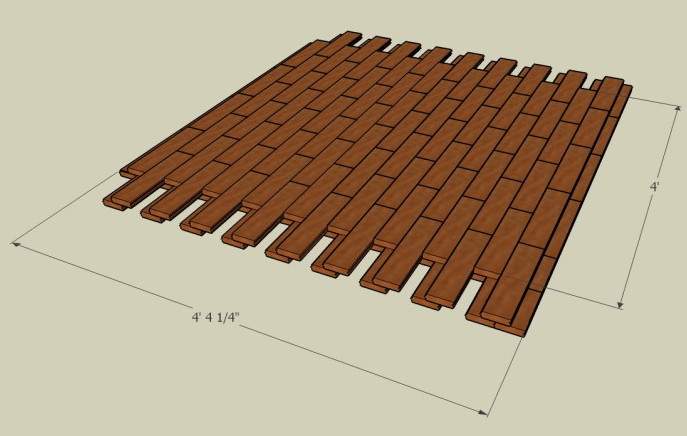
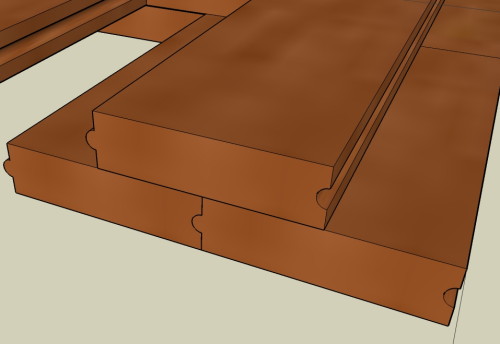
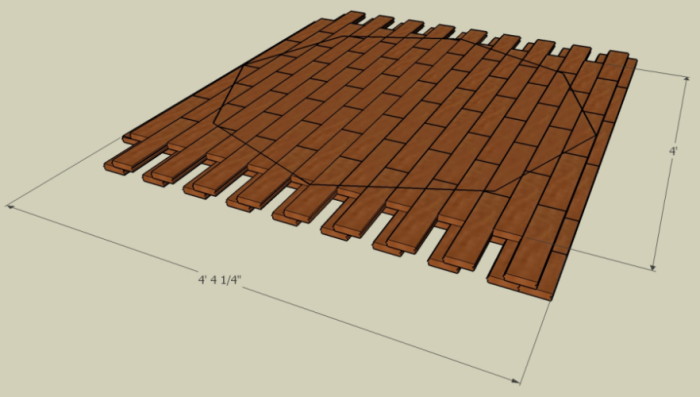
>Parqueted might be the wrong word. Here are a few pics of what I am after. The flooring pieces are in random lengths. For purposes of the drawing I made them all 12" long. There are two layers.
Each layer is glued together across it's width to a +48" and a length of +.48". After the individual layers are glued up.
I would place one layer over the other and glue the upper layer to the lower layer-off-setting the seams by half the width-
After the layers are glued togther I would draw an Octagon lay-out centered on top. Then cut on those lines.
>You won't need to worry about wood movement and you'll have something stable for the top. I think there would still be some "flop" in your piece as presented.
>I think you're overworking the situation with the double layer and running bond pattern. I've used Ellis' approach of working a concentric pattern of squares inside a square border, bedding the strips in epoxy on 3/4 plywood.
In your case, since laying out concentric octogons would be a bit of a challenge, I would probably lay out the strips in a concentric square pattern in epoxy on plywood, then clip the corners to create the octogon, then finish with a border.
>I hope your client isn't expecting to save money by reusing some flooring leftovers. Whatever they save in materials will be eclipsed by the labor costs to deal with all that and make it work. I'd tell the client to save the leftovers for patching the floor should they ever remodel or have damage etc.
>Most of the T&G flooring I have dealt with has the bottom shoulder on then "relieved" so that the underside of the boards is narrower than the top face. This makes it easier to pull the top face tight without interference from the lower shoulders. Also, the bottom surface often has channels cut in it. All these things, if your flooring is cut that way will make your glue up difficult.
The reason we install flooring in strips is that we know the wood moves with changes win moisture content. If the crack in you dining room floor open a hundredth of and inch or two, its not a disaster, but on a card table that could be very annoying. I would go with Ellis on this and use plywood and leather or vinyl.