Mortises,tenons and Shakers
Andy Lincoln,in Dearborn,MI
>Hi All,
As part of my ongoing project, making Shaker style end tables a private discussion has come about regarding the mortise and tenon construction.
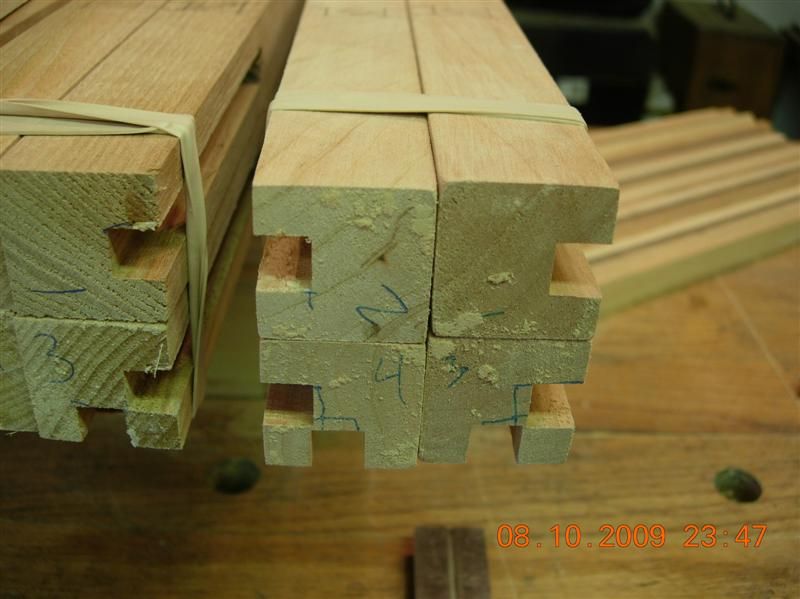
I was following a plan in Woodworking Magazine that essentially advocates a very quick one tool set-up (router & router table) that makes the mortises extend
from the top of the leg down with no upper shoulder.
In a private email I received this note:
�Hi Andy,
Hey, I noticed in the photos that your tenons look to be about half an inch long, if I'm reading the scale of the legs correctly (~1 1/2"?). Typically, on a table that size, the Shakers used tenons that were from 3/4" to 1 1/16" long and about 3/8" wide. Depending on how they meet inside the leg, they would be mitered. There would also be top and bottom shoulders, usually 1/4" to 1/2" on the bottom and 9/16" or so on the top.
This is all just arcana that I felt compelled to spout. Your tenons will probably be plenty strong enough, unless Uncle Festus takes a dive on the table or something. But, I'd suggest some small pegs to reinforce those glue joints.
I didn't want to post this on the board for fear of seeming critical�.
Author of this will remain unnamed, at least by me, as to not rat anyone out. But I will say that this person is very well respected by me and I assume many, many others.
I would like to say that I did not receive or interpret the email as criticism, nor am I offended by it, I would now like to take it as a learning experience and also share it so others may benefit as well.
The legs are 1 1/8� square, mortise is 3/8� w x 3/8� d. Tenons are 3/8�
 |
| From Shaker Style End Tables |
The argument is that the top of the leg being open leaves a small sliver of unsupported material on the inside corners of the legs. In the article in Woodworking Magazine the author, Chris Schwarz explains his rationale as this:
�Of course, the logical objection to a joint like this is that if the mortise is open on one end then the table won�t resist racking. I argue that a properly fitted tabletop takes the place of that mortise wall, constraining the tenon�s edge cheek and keeping it from racking. And, as you�ll see later, you can easily reinforce this joint with a well place peg for added insurance.� CS, Woodworking Magazine, Autumn 2004
Since I am at the point of no return I intend to peg the mortises with a small piece of bamboo rod to help strengthen the joint. I also wonder if the top and bottom drawer guides, which are notched around the legs, will also help to support/strengthen the inside corner.
Thanks,
Andy


