Home Articles Forums Gallery Marketplace Videos

WoodCentral Forums

Knowledge You Can Build On — Est. 1998

Fast and affordable laser cutting – so you can make the parts you can’t find anywhere else

Experimental resaw fence

Posts

Experimental resaw fence

#1

William Falberg

Experimental resaw fence

William Falberg

>This is for the re-sawers out there. It's the seventh attempt at a

do-all rip, true, veneer, slice, and dice variable height, precision fence for big timbers and burls. It's come down to: you don't usually need a solid vertical wall and less square footage is less friction. What works for slicing should also work for truing. For big projects you need to anchor both ends and the top; adjustably - in fine increments. And it has to set up accurately, in seconds -without a box of tools. This one has an effective height of 16" and expands from 0" to 13.25" . It's dead-on accurate throughout its range. I'm still working on slicknes and appearance but what do you think about the general concept? Worth pursuing?


img

Re: Experimental resaw fence

#2

Re: Experimental resaw fence

Paul Waddle

>I LIKE it! Looks strong and is light wt. Keep on truckin! I'll need one... I didn't notice the clamps to hold it on table?? pw

Re: Experimental resaw fence

#3

Left handed bandsaw

Lee Schierer - McKean, PA

>What sort of band saw is that. It looks like either your photo is mirror imaged or you have a left hand bandsaw. Most bandsaws have the neck on the left as you push wood into them, the one in the photo has it on the right.

With regard to your design, the biggest problem I have when ripping wood on a bandsaw is blade drift. Your fence doesn't appear to allow compensation for drift that occurs during a cut.

Lee

Re: Experimental resaw fence

#4

William Falberg

Re: Experimental resaw fence

William Falberg

>The two slides have four thumbscrews which lock onto the edges of the tabletop. It only takes one twist to turn a slide into a lock and when you tighten the top rail (the angle attached to the saw frame) it pushes the fence down further, reinforcing the whole fence. For me, the fence (as well as the blade, the saw, and everything else) has to withstand "nudges" from 200 lb. chunks of whatever. Without that stipulation my solution would look like just about every other fence on the market. Likewise, the blade's angle to the table becomes critical when you're working with 14 -16 inch cut depths. And that's the crux of the matter. The fence has to be strong, yet micro-adjustable throughout the throat's width range for the professional woodworker to take it seriously. On top of all that it has to be a quick and easy set-up. Previous prototypes have satisfied the strong and the micro-adjustable requirements, but the quick-and-easy part remains problematic when you demand accuracy throughout the full range of cut width. The ultimate goal here is to take a big piece of driftwood, a burl, or stump and square it off, true it, and cut it up into veneer without makling a career out of it. If I can figure that out it would make a cool after-market fence kit for those who already have the riser but still can't get good, wide veneer. I'll keep posting these prototypes and responding to criticism until the design is worked out enough to start producing them. That's how I did the saws. My customers designed them, I just make them. I really do appreciate criticism. I have thick skin so don't even try to be "nice". Like that robot in the movie, I run around "input, input, must have input!"
Re: Experimental resaw fence

#5

Re: Left handed bandsaw

Joseph Mulherin, Sr

>Lee, there is a very good video online at the Woodonline.com which will show you very clearly how to setup your saw to keep from having blade-drift. Wood magazine #180 is where the article is.

Re: Experimental resaw fence

#6

William Falberg

Re: Left handed bandsaw

William Falberg

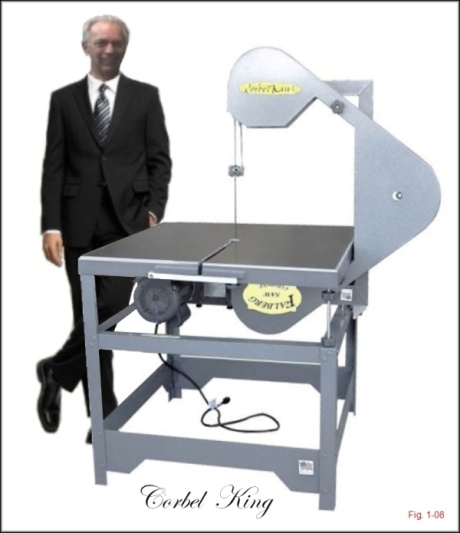
>"What sort of band saw is that.It looks like either your photo is mirror imaged or you have a left hand bandsaw. Most bandsaws have the neck on the left as you push wood into them, the one in the photo has it on the right." It's a portable timber framing saw and it's upside down when mounted on the Corbel King table as shown. That's a good point though and I'll keep that in mind when I do the dedicated two-wheeled resaw (that's been under my bench for a year now).

"With regard to your design, the biggest problem I have when ripping wood on a bandsaw is blade drift. Your fence doesn't appear to allow compensation for drift that occurs during a cut." Another good point! No, it doesn't. The last one, the modular prototype, did, but it required a lot of re-alignment and fidgeting every time I moved it. My saws don't drift but the aftermarket fences will have to account for that. It will probably involve some sort of parallel arms to lock in individual drift settings-maybe some sort of banana slots on the slides which one could set-and-forget. I'm just getting into narrow kerf cuts with this arrangement and may yet have to do that myself. It's certainly a concern that needs dealt with. Thank you!

Re: Experimental resaw fence

#7

JL

Re: Experimental resaw fence

JL

>I can't see the "working end" of the fence.

Do you foresee this as a total replacement fence somewhat like the the Kreg? If so, how easy is to adjust (both vertically and horizontally?

Do you want to put rails on the front and back? I don't know if the thumbscrews would fit my Rikon :).

Re: Experimental resaw fence

#8

Re: Experimental resaw fence

Thomas Skaggs, Foothills of Mount Level

>I think it looks very promising and certainly worth pursuing. In a dream world I'd love to have a sliding feature on a bandsaw table to support long boards, similar to a table saw. I do use roller stands but not quite the same. But I think you do have a good idea with that fence.

Tom

Re: Experimental resaw fence

#9

Re: Experimental resaw fence

Chuck in ND

>Looks pretty good. I do wonder however how much deflection is at the top corners of the fence on the infeed and outfeed. Keep up the good work.

Re: Experimental resaw fence

#10

William Falberg

Re: Experimental resaw fence

William Falberg

>"I can't see the "working end" of the fence."

Another angle shown below.

"Do you foresee this as a total replacement fence somewhat like the the Kreg?"

Yes.

"If so, how easy is to adjust (both vertically and horizontally?"

Vertically: -You have to pull the two thumbscrews (SoftTouch knobs actually) on the fence top rail and move it up or down to desired height and re-attach.

Horizontally: -You have to loosen the four thumbscrews (SoftTouch Studs) on the tabletop slides; measure spacing to the blade; and re-tighten (a half turn does it) to re-clamp. The slide bars double as clamps- it works surprisingly well for so simple an arrangement.

"Do you want to put rails on the front and back?"

Yes(?)

"I don't know if the thumbscrews would fit my Rikon :)"

I don't either. I'd probably have to adapt each conversion kit to fit specific brands and models. It's going to take me going out to build custom fences for friends who have the various common saws and finding the attachment points common to them all. For instance: they all have a backplate the top wheel mounts to-so make a universal adapter that can clamp or screw on. The devil's in the details but I'm sure it can be done somehow.

You wouldn't believe the amount of aluminum I scrap out trying this stuff.


img

Re: Experimental resaw fence

#11

William Falberg

Re: Experimental resaw fence

William Falberg

>"I do wonder however how much deflection is at the top corners of the fence on the infeed and outfeed."

It doesn't seem to matter. The corners can flex, but as long as the blade retains its vertical orientation parallel to the fence you get a straight cut. If you push your workpiece into the corner(s) it will automatically kick the center portion (where the blade is working) away from the fence at the bottom of your cut. If you press into the blade with one hand and apply feed pressure with the other as (intuitively) most guys do-this shouldn't be a problem. You'd have to push the corner out pretty hard to kick the bottom of your cut out. It's very rigid. But I'll watch that and see if it's a problem.

Re: Experimental resaw fence

#12

Re: Experimental resaw fence

Chicago Bob

>William,

Very nice, robust looking and promising. I would strongly suggest that you protect your intellectual property (copyright, possible patent app, etc) before additional public disclosure. You may have already �poisoned the well� with displaying your photos without a copyright mark but I don�t know how else you would get the valuable input from this board.

Best of Luck

Bob Haines

Re: Experimental resaw fence

#13

William Falberg

Re: Experimental resaw fence

William Falberg

>Thanks for your concern Bob but I've been down the patent route too many times to spend any more time, money, or energy protecting IP that doesn't have a proven sales track record. Ramjack Tool Corp. will no doubt rip off the idea when they see me selling millions of my widgets but by then I'll have mine perfected, branded, and still be generations ahead of them in development. Does anybody out there have a lever-action tensioner that goes back before 2003 when I introduced mine? I'm not sure. I don't care. I tried to get my saws manufactured by Ramjack and couldn't even get an estimate. They just don't do research and they're not interested in improving anything. They'll re-do their logo, call it a major breakthrough, and get press releases praising their ingenuity for introducing their bold new color scheme. They watch guys like me, and if I make something they can profit from they'll use it - patent or no patent. They're scavengers that way. They won't ever make a mistake, nor trash a piece of aluminum, trying something stupid like I do. Here I go on a rant again. Excuse me.

The point is: patents only protect your IP if your lawyers are better than their lawyers and you can afford the battles. Small (micro) entities like myself have no dog in that hunt and I resigned myself to serving the niche of specialty tools for industrial clients. When the fence evolves to the status of a limited production specialty tool they'll incorporate whatever design attributes they can make cheaply into their own products. Free of charge. We'll both survive in business; but I'd appreciate it being called the "Falberg Fence." For my ego's sake.