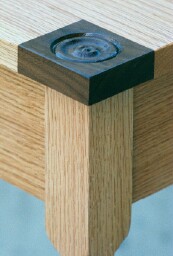
>What woods would you folks say are good complements for red oak. The context is a segmented turning, but I'm just thinking about things that generally would look good next to the oak. Like I think maple/cherry/walnut look good together, I'm wondering what woods work for oak. Could be either domestic or exotic, as I won't need much of whatever it is. Perhaps one species, or maybe two.
>There are many dimensions to this decision: hue, texture, figure, grain pattern, value (lightness/darkness), etc., plus the functional aspects such as durability, hardness and workability. Every project has its own requirements. I generally start from a picture in my mind's eye of what I want the piece to look like when it's done. Should it have starkly contrasting woods or subtly contrasting woods? contrasting textures or similar textures? a strong grain pattern or a diffuse one? high figure or subtle figure?
Red oak has reddish hue. To my mind, it doesn't go as well with brown-brown hues as it does with reddish-brown ones, but as the designer, it's up to you to decide. The contrast with brown-hued woods actually improves over time as the oak gives up its reddish cast and begins to yellow. Also, red oak has a coarse texture and strong grain patterns, so you have to be careful not to choose companion woods that clash or compete with these attributes; for example, white ash wouldn't work too well.
Value is another really important consideration. If you think of a scale of 1 to 10, with black ebony being a 1 and holly being a 10, all your other woods (regardless of hue) fall somewhere on this lightness/darkness range. Strong contrasts (say, where the value difference is 3 or more) have a certain personality to them -- maybe boldness is a reasonable description -- that makes a certain statement to the perception of the person looking at the piece. If you want the piece to contain such a wide range of values, sometimes it is a good idea to choose a third wood, of a different value, to act as a transitional visual element. Feature strips, inlay bandings and other transitional elements can help the piece flow better visually.
Also think about where the piece will live when you've finished it. Your choice of materials should complement the surroundings and any other furniture in the same vicinity. And what kind of visual weight should the piece have -- heavy, light, etc. -- and where should the darker elements be in relation to the lighter elements.
So, you see it's possible to drive yourself crazy with choices. I suggest squinting your eyes and imagining the finished product in light of some of the things I've mentioned. That should make your decision easier.
>I've never done the turning " thing ". I do have a question for a " turner " as I've no idea . . . When you do such things can you marry hard wood with soft ? Probably REALLY stupid question.
>I was looking thru my "Wood Identification & Use by Terry Porter
and saw a couple of interesting woods that had a nice contrast to red oak. You see Walnut used so offen that its nice to see something different. But don't get me wrong; walnut does look great with Oak too.
Kingwood- rich violet brown 75 lbs/sq.ft. from Brazil
Coachwood- sapwood light brown & slightly darker heartwoood 39 lbs./ft. from Austrailia
Australian red mahogany red to darkred(very pretty) 60 lbs./ft.
I don't know how easy it is to buy these, but there are many alternates you could pick from.
I buy 8/4 by 8-11" x 2 ft. lg. splits of Satine(Bloodwood) and
the same size or longer splits of Paudauk for reasonal prices.
The Pauduck is not as strong as the Saltine. These pieces have cracks her and their. I have to work around them or hide the cracks if I can in my Bulldozer toys.
Thanks a lot for the lengthy and well-thought post. That is a really helpful way to look at things. I'm not experienced in woodworking, nor am I coming at this from any real artistic background, so the framework is good.