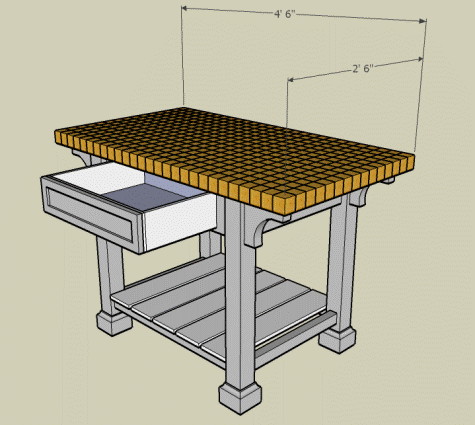
>I may or may not be building this piece. The base is made from Poplar and will be painted. The top is to be made from quartersawn white oak with the end grain at the surface(and therefore secured to the base)
So I am wondering, aside from accurate cutting of the white oak blocks,
(2" square)--What joinery/movement issues must I concern myself?
The requested overall thickness is 2.25". I wonder if the entire glued-up white oak structure can be glued to a substrate of say BB plywood? I'd rabbet the outer edge and glue in a white oak frame to cover the plywood edges....Or would an entire white oak structure be sufficient?ie blocks 2" square and 2.25" deep with no-substrate.
>While not as porous as Red still has many pores on end. The traditional wood is hard maple. Cleaning and hygiene may be factors if the surface is used for cutting meat, etc., ie. it would be difficult to keep clean. Just a thought....
>Be aware of a couple of things. First, as said, oak is not a good choice for a butcher block if wet stuff (meats, veggies, etc) are going to be cut. The traditional small pored woods are maple, birch and beech.
Next, quarter sawn lumber makes no difference but consistency of grain pattern does. (see following instructions).
Next, as to movement, the panel will expand/contract in both surface directions. The only way it won't move is in the up and down direction. So, you will have to engineer a method for fastening the chopping block to the support system. IMO, the best is to make a frame that the board can sit in with only its own weight holding it in. That way is can be removed for re-surfacing and/or turned over.
Finally, you can NOT glue the chopping block to another surface. As said above, the chopping block will expand/contract and the plywood or composition material won't. The result is warping and/or joint failure.
Here are the directions for making a chopping block or end grain cutting board.
There is a little engineering that needs to be considered when building an end grain butcher block or cutting board. First, choose wood where the growth rings (viewed from the end) run as close to 90 degrees or parallel to one edge. Remember, the expansion/contraction is about double along the annular rings verses perpendicular to the rings. You've got to keep the grain running in the same direction as you glue up your strips. In other words, don't glue a flatsawn edge to a quartersawn edge.
Next, the way butcher blocks are made is to glue up strips of wood like you were making a laminated type cutting board. These laminated panels are then run through a planer to flatten them and bring them to equal thickness. Then the panel is crosscut into strips of blocks equal to the thickness that you want the butcher block to be. These block strips are then glued together again keeping the grain running in the same directions.
Not paying attention to the grain orientation will lead to the block cracking and/or joints being pulled apart.
A type II adhesive will work just fine however, you need to be sure you do everything right to get good adhesion. Your glue faces should be flat and freshly cut. It they were cut more than a few days earlier, freshen them up with about three swipes with 320 sandpaper and block to keep the faces flat.
Generally, threaded rod is not used as maple has quite a bit of movement when it's moisture content changes. Threaded rod would restrict this movement and either deform the block or pull the nut/washers into the wood when it expanded leaving the rod performing no function when the wood later shrinks. Proper gluing will keep the block together.
>If you do some research, most woods, including oak will kill food bacteria. As long as the butcher block is not going to be chopped on, as white oak splits easy, as in firewood splitting.
>How are you going to secure the cutting board, block to the cart and allow for wood movement. Maybe the wood movement thingy is why you stated you MAY/may not take this project one(?)
>Yes Dale that was part of questioning for this piece. The original plan was drawn up by an architect-who is probably not a woodworker. I redrew it according to the dimensions and specs asked for-so I could decide how I would accomplish the joinery....for example:those brackets on the ends I decided would be part of the entire upper stretcher and would be insert over the posts/legs via saddle or bridle joints. Any way I turned in a rough estimate. If they call back I'll discuss some of the more dicey issues before agreeing to take on the project.
>Sorry, Alan, that's what I get for speed reading, : ' >. Please let us know how you will attach the top if you decide to accept the job (sliding dovetails?). Dale