Home Articles Forums Gallery Marketplace Videos

WoodCentral Forums

Knowledge You Can Build On — Est. 1998

Price drop on over 1300 Rockler items

RAS Splitter—Attn: DanD

Posts

RAS Splitter—Attn: DanD

#1

RAS Splitter—Attn: DanD

Rod Peterson -- Ormond Beach

>As promised, I got out in the shop today and rolled the RAS into view. Here are some pics for Dan in particular, but others may find the info useful. I wish I could tell you I've used this a lot recently, but although it was my only large saw from 1971 until about 1986, once I got a table saw, I found the RAS relegated to the role of a flat surface, which for me is fatal, as I can find all sorts of ways to clutter such an opportunity.


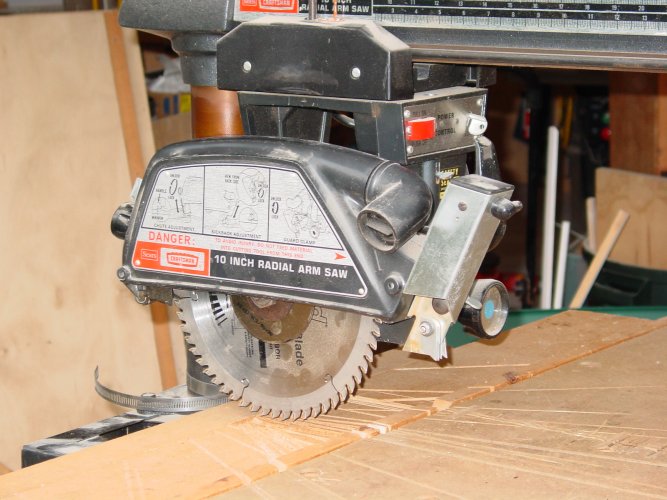
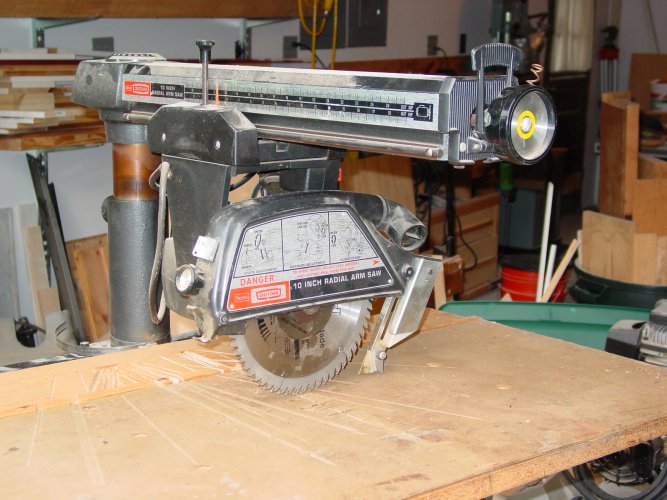
This is your basic oblique view of a Sears Radial Arm Saw, vintage 1971. The splitter is raised (only partially in this shot) as it customarily is for normal crosscut operation.


Ibid, but a closer view. Also, the splitter is raised to full height, normal for crosscutting. Pay no attention to the seriously battered hardboard sacrificial top, or the even more abused intermediate MDF table behind the fence. I was young and foolish once.


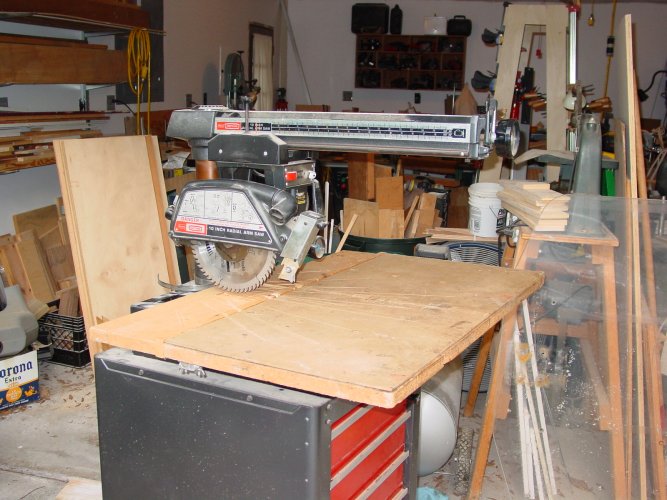
The carriage in the out-rip position. Out-rip provides for the greatest ripping capacity (and there are varying combinations of fence position along with the two intermediate tables), but there are times when in-ripping is called for, in which the carriage is rotated 180° and the stock is fed from the other direction. When out-ripping, the stock is fed from left to right in this view (in-rip, as should be obvious, is fed from right to left). There is no other correct or safe way to rip

The knob visible at the front of the hood is the locking device for a sliding shroud that can be lowered from the hood to not only assist in dust collection when ripping, but serves as a hold down, too.


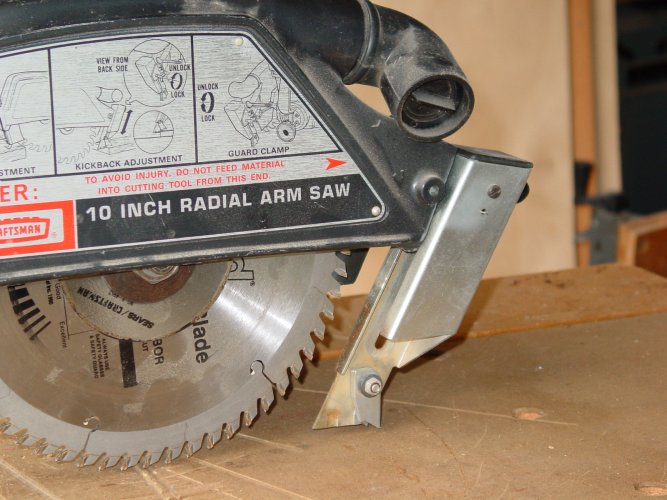
This is a sort of closeup of the splitter with the housing lowered as it would be to not only get the splitter into the kerf, but is also adjusted so that the anti-kick back pawls are properly positioned (not too high, not too low) to do their work should events call for them (following which will almost certainly an hour or so of realignment—DAMHIKT).

I did a lot of stuff on this saw. I was never intimidated by it (or any other machine), which is not to say I didn't have a healthy respect for it (and all other machines). I believe that to be central in all the debates about dangerous tools.

I'm not perfect. I did one really stupid thing with this saw, which I'm not telling anyone. However, I escaped without an actual event, and obviously no injury. That doesn't make it a dangerous tool. At that moment, it was a dangerous operator. He knows a lot more, now.

Rod


Re: RAS Splitter—Attn: DanD

#2

Re: RAS Splitter�Attn: DanD

Mike Baker

>Also if you notice on the opposit end of the guard from the splitter, there is that little spring hook, that when the guard is rotated, or that spring hook is lowered down to just kiss the top of the material as you rip, it keeps the board from lifting.

With that adjusted correctly, and the splitter and anti-kickback pawl adjusted too,, Its a perty safe machine to rip with!!

Mike

Re: RAS Splitter—Attn: DanD

#3

Re: RAS Splitter�Attn: DanD

Rod Peterson -- Ormond Beach

>Yes, I mentioned that in the narrative under Pic 3. I agree, it was pretty effective.

I don't know if anyone would notice—one would have to have a real familiarity with this saw, but there's a plug barely visible in the elbow at the splitter end of the shroud. The elbow is for dust ejection away from the operator. When the accessory dust shroud (available for a short time in the late '70s/early '80s) was attached, you inserted the included plug to attempt to direct more of the stuff toward the shroud.

I had mixed results with it—I never had a true DC system to attach to it and I never seemed to get the shop vac over there for the odd cuts, so eventually when I packed up everything to move, I scooped about a peck of sawdust up off the floor behind the saw. Does anyone even measure with pecks anymore?

Rod

Re: RAS Splitter—Attn: DanD

#4

Also…

Rod Peterson -- Ormond Beach

>…the guard on mine doesn't rotate. There's a boss on the motor housing and a corresponding notch on the guard which prevents it from rotating. In other models of Sears' the guard rotates about the axis of the motor housing to position the hold down.

Rod

Re: RAS Splitter—Attn: DanD

#5

Hey Rob, Do you earn your living with your shop?

Keith Newton

>And maybe an even more important question would be if yes, do you ever have helpers?

You know there is a big difference between the work that some of the readers and posters on these forums do with their tools, and the amount of time one can spend on each task.

So let me ask you. When you choose to rip lumber. Do you change to a rip blade each time, or do you use the cross-cut blade for everything. Ok, If you have a rip blade on, and need to crosscut, are you tempted to use the rip blade for just a few crosscuts.

Have you ever answered a phone call in the middle of changing from cross to rip, and maybe forgot to tighten one of locking knobs? Now would be a good time to send in the helper into the equation. Crosscutting with a rip blade and one loose knob.

Back when I was using my little RAS like yours, there were times that I might need to spend a half hour standing in front of it ripping 2" thick lumber. You know, there are going to be some boards that just like to cause trouble. I just hated finding myself trying to push a board through, that was bowing around, pushing out from the fence, slowing the blade, needing to get through a knot or something, and not being able to back out of the cut, because the kerf is now off to one side, and those pawls wouldn't allow it anyway.

Wouldn't it be nice if that switch which is now on the back of the motor to where you are feeding from was in reach now.

What do you do when faced with the above situation? Do you just turn loose of the work, and walk around to the other side and turn it off before the blade is burnt toast?

Could you post some photos showing the safest way to rip with the blade tilted to the table at 45�.

I am glad that you guys like ripping with a RAS, but I suspect that none of you are having to earn your living with your tools. These tools are meant for you. But don't kid yourself. When you are puttering around in your shops, you are not likely to be faced with the same conditions of needing to turn out a lot of work in the least time. Fooling with all of those adjustments, changing blades, setting everything just right, then needing to use some crud lumber to get the job finished.

I am just very glad that I am not still using a tool like that.

Re: RAS Splitter—Attn: DanD

#6

I have a $150 flashlight....

Barry Irby

>Rides in my car in a charger. In fact I have two of them. But them I am a Home Inspector and earn my living with them. I would bet you don't have one as good and convenient as that.

I also have a $3500 watch and don't care what time it is. When I want to know, I look at my cell phone.

Until I got my table saw, I ripped lumber on my RAS. Until I got my RAS I ripped it with a skilsaw.

I have a Performax drum sander. Its not ten percent as good as my friends Timesaver or whatever that giant belt sander is called. Its better. It cost about 4% of what that machine cost, takes up less room and is in my shop, so I don't have to drive over to his ship to use it, and that was free. It's all relative. I sure am glad I don't have to use that free sander anymore.

Re: RAS Splitter—Attn: DanD

#7

Re: Hey Rob, Do you earn your living with your sho

Rod Peterson -- Ormond Beach

>> Hey Rob, Do you earn your living with your shop?


Is this the start of one of those if you aren't making a living doing blah, blah, blah, you can't possibly know what you're talking about rants?

> And maybe an even more important question would be if yes, do you ever have helpers?

Why, yes, it appears it is.

> You know there is a big difference between the work that some of the readers and posters on these forums do with their tools, and the amount of time one can spend on each task.

But please explain how that translates to any one particular tool being particularly dangerous at a particular task.

> So let me ask you. When you choose to rip lumber. Do you change to a rip blade each time, or do you use the cross-cut blade for everything. Ok, If you have a rip blade on, and need to crosscut, are you tempted to use the rip blade for just a few crosscuts.

No, I don't always change to a rip blade to rip, however if I do, I never cross cut with a rip blade. One of the early lessons I learned was how important it was to have a second (or third, or fourth) saw of some kind available for the odd offcut that needs to be made when your main saw is set up for some specialty operation.

> Have you ever answered a phone call in the middle of changing from cross to rip, and maybe forgot to tighten one of locking knobs? Now would be a good time to send in the helper into the equation. Crosscutting with a rip blade and one loose knob.

Never, for all of those. Those would be poor practices in any shop. Is it acceptable in a shop where you earn your living? But tell me—do any of those circumstances somehow make a RAS uniquely poorly adapted for ripping?

> Back when I was using my little RAS like yours,…

Condescension alert! Condescension alert!

> …there were times that I might need to spend a half hour standing in front of it ripping 2" thick lumber.

Sounds like a variation on the if you aren't making a living doing blah, blah, blah, you can't possibly know what you're talking about theme.

> …You know, there are going to be some boards that just like to cause trouble. I just hated finding myself trying to push a board through, that was bowing around, pushing out from the fence, slowing the blade, needing to get through a knot or something, and not being able to back out of the cut, because the kerf is now off to one side, and those pawls wouldn't allow it anyway.

Well, duh. Is there a wood shop anywhere, hobby or pro, that hasn't encountered those circumstances at one time or another? How does that make a RAS particularly poorly suited for ripping?

> Wouldn't it be nice if that switch which is now on the back of the motor to where you are feeding from was in reach now.

At the risk of repeating myself, how does that make a RAS particularly poorly suited for ripping? Ever have a 4x8 piece of sheet goods (going the long way) start to bind up on the table saw? Where's that On/Off switch? Oh, I'll bet there's a big panel saw where you make your living and you don't have to cut sheet goods on the table saw. Does that mean the table saw is particularly unsafe for cutting sheet goods?

> What do you do when faced with the above situation? Do you just turn loose of the work, and walk around to the other side and turn it off before the blade is burnt toast?

Again, isn't this a circumstance that can arise with any of several tools? How does that make a RAS particularly poorly suited for ripping?

> Could you post some photos showing the safest way to rip with the blade tilted to the table at 45�.

Could you? And how does that relate to the canard that a RAS is allegedly particularly poorly suited for ripping?

> I am glad that you guys like ripping with a RAS, but I suspect that none of you are having to earn your living with your tools. …

Condescension alert! Condescension alert!

> …These tools are meant for you. But don't kid yourself. When you are puttering around in your shops, you are not likely to be faced with the same conditions of needing to turn out a lot of work in the least time. Fooling with all of those adjustments, changing blades, setting everything just right, then needing to use some crud lumber to get the job finished.

My lord, did you invent woodworking or something? Even hobbyists (oops, I seem to have slipped in a little denigrating of my own) face all of those circumstances from time to time. Does having to work under pressure somehow make a RAS particularly poorly suited for ripping?

> I am just very glad that I am not still using a tool like that.

Everyone has their own prejudices about their “little” tools. Some are well founded, some are based on bad information, some might even be based on experience. Whether one makes a living doing something or not has little to do with acquiring prejudices or experience, except, perhaps, in how quickly one does it.

I have seen and heard some appalling stories of unsafe work practices from the pros and I've heard some appalling stories of safe practice theory from people who were frightened of their tools. I've heard appalling conjecture based on the misapplication of one set of conditions to another, completely ignoring scale or circumstances. My principal interest is in illuminating the foundations of published prejudices. If you say ripping on a RAS is inherently dangerous by design then I say you are doing so from an unfounded premise.

Ro(b)d
Re: RAS Splitter—Attn: DanD

#8

Re: Hey Rob, Do you earn your living with your sho

Mike Fitterling

>I make part of my living in my shop. Time is even more critical in my situation as woodworking jobs are fit in after my main job, my second job and family duties, so when I am in the shop doing "pro" work, it is crucial I don't "waste" time. But I do change from a crosscut blade to a rip blade and follow practical steps to prevent injuries, and I don't take "chances" because I am under pressure. If I did, then it is a matter of time before I am the "victim" of an accident. If I had an apprentice that would not do likewise, I would soon have a different apprentice.

The point is, is the RAS inherentaly unsafe for ripping and other procceses it is designed to do? I say, no. The RAS is indeed designed to rip and is equipped with features that make it a relatively safe operation. If someone is unwilling, for whatever reason, to learn safe procedures and take the time to follow them, then that person is at fault, not the machine, and that person is likely to suffer injury eventually. If someone was to ignore safety precautions using a cabinet saw, it is certainly not the saw's fault if that person gets hurt. Wally Kunkel comments on that issue noting that most people assume that on a table saw if someone is injured it is the operator's fault, on the other hand if a person is injured while using a RAS it is the saw's fault.

If you feel uncomfortable ripping on the RAS, then by all means don't use it for that, but IMO the blanket condemnation is undeserved.

Cheers,

Mike

Re: RAS Splitter—Attn: DanD

#9

Hey Rob, and Others

Keith Newton

>Sorry for the Dumb remarks. I wish I could take them back. I am sure that I must have chapped some asses here.

Probably a better way of posting would have been to point out that while I was starting out, and that was my first stationary tool, I probably made every mistake that could be made, and still come out with all ten. I feel lucky, because I felt the need to crank out a lot of work, and usually did not use every precaution, and found myself in a lot of situations that I wished I had not gotten myself in. You are probably are more cautious and organized than I am or was.

Once again, I am sorry. Keith

Re: RAS Splitter—Attn: DanD

#10

You seem to be a real good guy....

R. Lance in GR, Michigan

>to me...very knowledgable and intelligent...just the kind of guy one would want participating in this forum so I and others can learn something...theres always a risk in posting because someone might take offense or take a cheap shot at you (like pointing out there is a difference between a fence post and a blanket chest)...but people need to remember that we are really here to share our knowledge and to help each other if we can and that we are not our tools.

Re: RAS Splitter—Attn: DanD

#11

Now THAT's a reasoned response.

Rod Peterson -- Ormond Beach

>It might not have been obvious, but the idea we've all learned from mistakes we've made (emphasis on “we've made”) is what's important. It's also fair to observe (and I don't think I made this point at all) that my comfort level on a particular tool and your comfort level on that tool may not at all be the same. Yet another tool might suit you right down to the ground while I'd look for some other way to accomplish the task than use it.

As I said in my original contrarian response to you down below, I've seen too many posters over the years denigrate the RAS on no more basis than poor user application or the legend ensuing from same. I'm not saying your opinion is in that category, but the effect is the same. The machine thus gets an undeserved bad rap. Still, not all users are going to have the same comfort level with it as I might have.

So, let's say we have different views on the subject and leave it at that. Your response here shows a really positive approach, welcome here at WoodCentral. I hope you continue to participate.

Rod

Re: RAS Splitter—Attn: DanD

#12

Re: Hey Rob, Do you earn your living with your sho

Mike Baker

>I worked for my Dad during the summers when I was a young man. He made his living as a Interior trim Carpenter trimming out Large custom homes. He did well at it too. We never hurt for anything.

Many times ,the only saw he had at the job site was a RAS!

He ripped with it all the time. 4x8 sheet goods, plowed dado's for adjustable shelf track, (saw set up in the RIP mode AND with a DADO head on the arbor!! This was back in the day when the trim carpenter BUILT the kitchen cabinets.Not installed premade factory units. No PREHUNG DOORS He made the Jambs sets up on the job, and hung the doors using a hinge mortising jig. He HAD to be fast,, or he wouldnt get the next quote for a house. Worked all by himself all the time, except for me during the summer.

I learned much from him. I have no FEAR of a RAS, but I do respect it. Its proly a good thing that previous posters that have such a silly view of the tool,,, dont use them. If your that unsure of your skill with a tool your headed for disaster, I dont care how ya make your living!

Oh by the way,, his Table saw was a Boice Crane tilting arbor saw that was just a Monster to move! he did that by himself also!

Mike