Home Articles Forums Gallery Marketplace Videos

WoodCentral Forums

Knowledge You Can Build On — Est. 1998

Build it. Rock it. Rockler has your woodworking tools.

Metric Plywood questions/ Sort or OT

Posts

Metric Plywood questions/ Sort or OT

#1

Metric Plywood questions/ Sort or OT

Barry Irby

>For those of you who know and live with the metric system.

In this country we have plywood that is usually 48 by 96" or 4' by 8'. It used to come as 1/4, 1/2, and 3/4" thickness. Now it seems to come in most anything they happen to be making thickness wise. I've seen luan plywood that is 5mm and other that is 5.2mm being sold as 1/4" We have had endless discussions here at WC about how to deal with this.

What I am wondering is has the industry settled on new standard dimensions or do they really just make and sell whatever is close? Could I buy a set of bits and blades that match the standards and be reasonably sure they would continue to be 'correct' for a few years?

Also, does the metric world use the 48 by 96" dimensions or are there other sizes that dominate in the rest of the world? IE. Will they be featured at HD and the other Borgs near me soon?

And, on a construction note, we commonly space studs, joists, trusses and other components at either 16" or 24". What is common in the metric world?

PS. I know that some MDF comes 49 X 97, but that is not metric, it's so you can trim the ratty edges.

Re: Metric Plywood questions/ Sort or OT

#2

All over the map, size wise.

Ray Thompson - Middletown,IN

>I put my dado blades away and don't get them out anymore because ply thicknesses are not consistant. With manufacturing being worldwide and quality standards not what they used to be don't expect change anytime soon. I went to a router sled and use a 1/2 bit for the "near" 3/4, a 3/8 for the "near" 1/2, and 1/8 for "near" 1/4. I no longer measure or care what the thickness is, I set the sled to the thickness of the ply, make two passes and I'm done. The setup is 1/4 the time it took to drag out the dado set and dial it in.

Ray

Re: Metric Plywood questions/ Sort or OT

#3

Re: All over the map, size wise. *LINK*

Mark McC

>We have been Metric in Canada since the 70's,I am not 50(yet), but I am still a 4' x 8' plywood guy, Farenheit for the temperature, and gallons versus litres.

My 11 year old though is centimetres, litres, kilometers, celsius. etc.

Problem is virtually the rest of the world is the same as him.

As more and more products are sourced from the Global marketplace we are all going to have to deal with more and more metric.

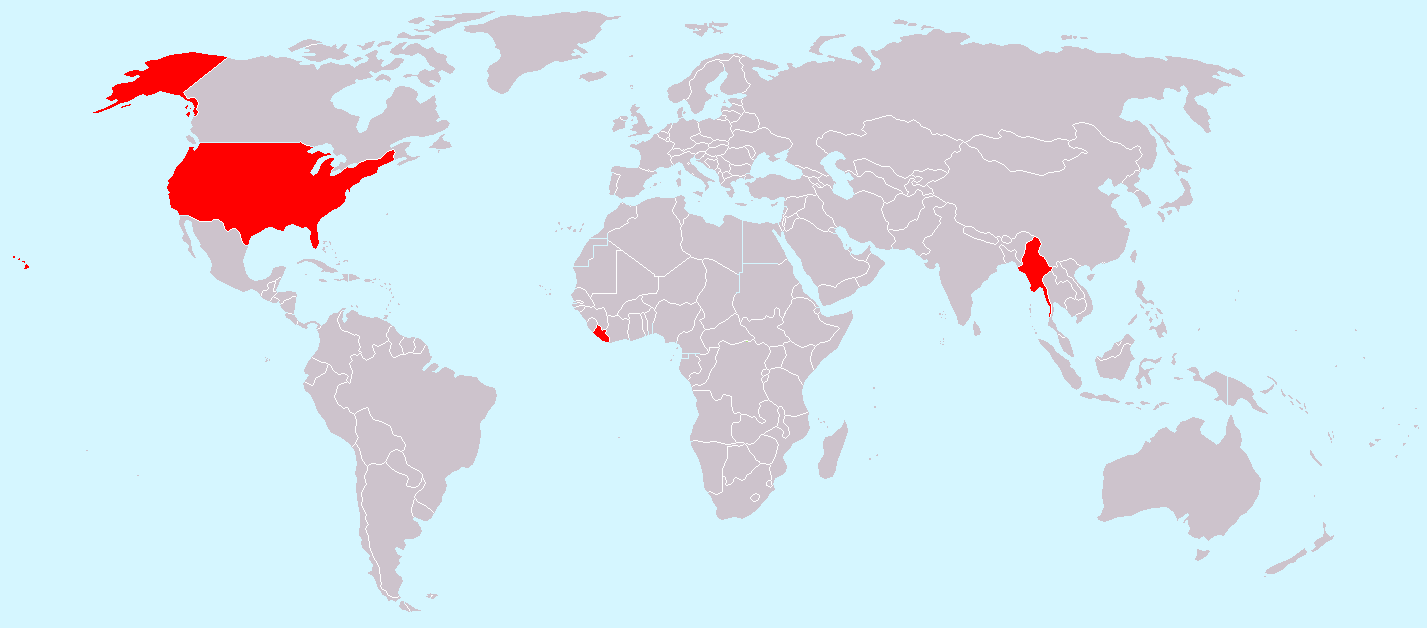
Here's an interesting picture of who isn't metric in the world today.


http://upload.wikimedia.org/wikipedia/commons/1/17/Metric_system.png

Re: Metric Plywood questions/ Sort or OT

#4

Jesper, Denmark

Re: Metric Plywood questions/ Sort or OT

Jesper, Denmark

>European sheet goods are also in the same size as the American - we call it 1220 x 2440 mm, which is within a scoche of the 48 x 96 inches.

The thickness is another matter. The US sold plywood has been undersized for years - nothing to do with metric or not. � inch is always a little less than 0.5000 inches thick.

Cabinet grade birch and other types are often in different dimensions to construction grades. Some materials of Russian origin are also often in completely different dimensions.

Re: Metric Plywood questions/ Sort or OT

#5

Jesper, Denmark

You all seem to be in a minority.....

Jesper, Denmark

>But it is not really a true picture. In the US, many industries have been on metric standards for decades. The auto industry for one is all metric and so are bearings, pharmaceuticals, aerospace and any science based endeavour.

Re: Metric Plywood questions/ Sort or OT

#6

Note sure

Dan Donaldson

>I am not sure that merice is necessarily the total issue. It seems that some plywood is not sized to either true metric, OR English units. Could be cost factors to make it a bit thinner, or just poor quality control.

I don't have any real preference for either system. I am comfortable with either and use both systems at various times, depending on what I am doint at the time.

Re: Metric Plywood questions/ Sort or OT

#7

"I put my dado blades away"

Dave Bair, Eaton Rapids, MI

>Actually, I didn't. But I use them the same way you use your router bits: I simply get close using the 2 outer blades, and a chipper or two, and run the piece through, move the fence and run it again. It's simply easier, and more accurate, (for me) to set up the table saw than to set up the router for this task.

Re: Metric Plywood questions/ Sort or OT

#8

It is a mixed bag.

Ray Thompson - Middletown,IN

>True, the auto parts are metric, but the tooling to make the parts is still inches and feet. Not only are we not metric, we still build using fractions.

Ray

Re: Metric Plywood questions/ Sort or OT

#9

Not always...

John in New Mexico

>A bearing supplier once told me that even if the bearing specs were in inches it was manufactured by machine calibrated in metric. CNC machines don't care how weird the number looks. Presumably this is primarily true for parts made overseas. If you can find an onshore parts manufacturer, they might still use SAE.

Re: Metric Plywood questions/ Sort or OT

#10

Re: Metric Plywood questions/ Sort or OT

Steve Schoene

>And some of the "big box" import plywood isn't the same thickness on both edges of the sheet.

Re: Metric Plywood questions/ Sort or OT

#11

here in Australia we went metric 30 years ago

Ian (in Sydney, Australia)

>sheet goods are 1220 x 2440, which is the metric equivalent of 8ft x 4ft to within a few hundreths of an inch.

thickness is always quoted in millimetres.

for some sheet goods 18mm is the substitute thickness for 3/4in (3/4in is actually 19mm)

It might be my age, but I find it still common for people to ask for 8 x 4 sheets (but it's never described this way in the stock catalogue)

studs and the like are spaced to suit the sizes of the sheets goods, which for some flooring is 900mm wide

as to ply thickness, I don't use enough to have noticed, but I suspect that unless you are buying furniture grade material the quoted size is only nominal � the manufacturer is buying logs and it is in his interest to maximise the number of plies he gets from each one. Slicing thinner plies translates to the more sheets of ply from each log. And it's only furniture makers who notice.