WoodCentral Forums

Est. 1998 — 27 years of woodworking knowledge

Subject for demo LONG

Posts

Subject for demo LONG

#1

Keith Tompkins

Subject for demo LONG

Keith Tompkins

>I recently attended a major woodworking show in Saratoga,NY. The show included a juried competition, including cabinet work, chairs, carving, even canoes! Of course, woodturning.

As a trained, professional cabinetmaker, I enjoy the competition a great deal. I crawl under each piece, examining the most minute details. I like to understand the makers intent, from joint selection to overall execution, to the amount of imagination applied in a piece. I check for fatal flaws. I compare my winning choices to the judge's final decisions, just for fun.

It seems the same people win the top honors consistantly, year after year. This year, especially, there was a lot of grumbling and complaining, and there was even talk of eliminating the award process all together!

This gave me the idea for a new demonstration...."How to create an award-winning piece" The demo could apply to turnings or flat work, but only turning would apply in this forum.

I could bring good and bad forms to compare, and brave souls could bring their own pieces to be critiqued. I could stress the importance of ATTITUDE. The willingness to change and try new ideas.....the benefits of the critique.....learning from your mistakes...etc.

This demo would not be for the faint of heart. Blunt, to the point, no ambiguity in this one! A winning piece is produced long before the lathe is switched on. Personally, I don't start turning a piece and then see what evolves. I have a specific idea in mind from the beginning. When I create a piece, I'm striving to produce something better than anything else I've done, to push myself to the limit.

I know this sounds a bit arrogant, but it's not.This just my thought process. In fact, the whole demo would be designed to help others become sucessful turners.

Would you attend this type of talk? why or why not? I would like you input on this one. Thanks, Keith
Re: Subject for demo LONG

#2

Re: Subject for demo LONG

Molly Winton

>I'd be there Keith. I really like the idea of getting a critique by master craftsmen. It can be one of the quickest ways to learn and get new ideas. I always welcome critiques, and in particular from individuals I respect and admire both personally and their work. Hearing ideas of what makes an award winning item is also of value.

Re: Subject for demo LONG

#3

Re: Subject for demo LONG

John Lucas

>Keith

I have a tough skin. Would love to learn more. Years ago I went to my first symposium. I had been turning on my own and doing segmented work. I was proud of the work. It went on the instant gallery table.

Betty Scarpino picked it up and said(don't remember exactly) this piece has been well crafted but the parts don't fit together. The top doesn't match the carved feet, the shape is clunky etc, you get the point. I was a little put off at first but went home and looked at the piece and she was right. I didn't think about what I was doing. I just threw it together.

Well I took it to heart and started trying to learn what makes a good form and how do you get parts to go together. Do I achieve that all the time. No. Am I willing to learn. Yes. The only way to learn is to have others critique your work.

I think it will be fun and hopefully will help those who aren't brave enough to submit a piece.

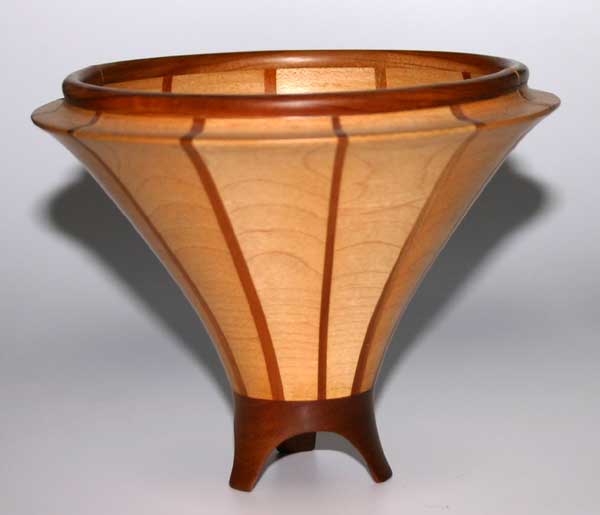
below is the bowl the Betty criticed. I saved it all these years to remind me to be critical about my work. Sorry for the bad photo. This is what the camera does in auto with on camera flash.


img

Re: Subject for demo LONG

#4

Re: Subject for demo LONG

Phil Joines Krum, Texas

>I have asked a bunch of professionals to do a critique demo for our club. Gallery owners, college art professors, etc. No joy. Don�t know why,

Re: Subject for demo LONG

#5

Re: Subject for demo LONG

RonZ

>Hi Keith,

I hope you're not of the faint of heart. =o)

In my opinion, this demo might produce the very results you disliked in your last judging.

>It seems the same people win the top honors >consistantly, year after year. This year, >especially, there was a lot of grumbling and >complaining, and there was even talk of >eliminating the award process all together!

Beside possible other drawbacks to contests, I propose that the same ones might win because you have the same people judging with the same criteria.

While I see your demo idea as good for beginner to intermedeate level, it doesn't allow for the intermedeate to professionals to grow too much.

Also, while it is always good to plan ahead, some of my best pieces have come about 'by accident'. The bowl I use as my logo expounds the axiom I learned from Raffan. 'If you slip up or make a mistake, always go on as you never know what you may end up with.'

A good example would be David Eaves bowl below. He calls them wings and you suggest he uses legs. I have a bird and the wings are located in the middle and the corners are rounded. Hence the accidental chipping of a corner has helped lead to a breakthrough in design by making a bowl that looks like it might fly away. Also, in an average, not thinking out of the box type judges would pass up his piece because he doesn't have the accepted legs or the traditional square top.

Just my two shekels worth,

Ron

Re: Subject for demo LONG

#6

Re: Subject for demo LONG

Gary Bills in NC

>I think you have a great idea Keith. After being in and participating in a highly competitive camera club for several years, I learned to shoot competitively. This helped me make better day-to-day photos. Although I think I learned the most by participating and listening to what the judges had to say about my work. I believe the same would apply to woodturning. I would definitely want to see your demo.

I recently viewed a National AAW Symposium Instant Gallery and Critique tape. I think it may be along the lines of what you have in mind for your demo. It may give you some ideas for your demo.

Re: Subject for demo LONG

#7

Re: Subject for demo LONG

John Lucas

>Ron

That's why I think this group as a whole should be doing the critic. I think we'll get a more honest opinion of how the general public (albiet biased toward turning) will view the piece.

As far as contests are concerned it depends on the judges. Years ago our camera club decided to enter the state fair photo contest. This was a group of very talented photographers many of whom are now professionals. We entered some incredible photos but took very few places. Babies, Butterflies and fireworks still won even though these weren't that great a photo. The judges were not art oriented at all just liked cute photos.

This can lead to the problem you suggest of not accepting a bowl that is out of the norm. The general public may love the piece (which is good if you want to sell) however the judges may not. The only way to consistently win contests is to enter pieces that the judges will like. Ideally you do research to find out who the judges are and what type of work they produce. Then you enter a piece that fits thier style. I know this isn't always possible and is not 100 percent but it hedges the bet.

Re: Subject for demo LONG

#8

Re: Subject for demo LONG

Bill Grumbine, Kutztown PA

>Hi Keith

I am somewhat ambivalent about a contest. I don't mind reading about contests, or looking at work others submit to contests, but I rarely enter them myself. A discussion similar to this one came up on another forum. Some of the same points are being raised here.

It is one thing to submit a piece for critique by people who you respect - or at the least, submitting it to the group in general and taking to heart advice from people you respect! It is quite another to submit a piece for judgement in a contest. I have seen many contests where the very same phenomenon you describe is repeated. Judges are biased people just like the rest of us, and contests are political. Even if you were to make it a "blind contest", where names are left off of the entries, there are enough people who have developed a particular style to the point where they are recognized by the piece they have submitted. Our sailing club has a food contest for one of the picnics every year, and the same guy wins every single year for the same dish! Talk about a rut! The worst part is, while it tastes okay, it isn't that great.

A lot of "advanced" turners pan my work because it does not fit their preconceived notions of what it should look like. Since none of them are actually buying my work, I really don't pay much attention to them on numerous points. I pay attention to what my customers are buying. If I make a certain shape and thickness, and people are buying it for a price that we both like, I make more. If I make something that just sits, and it either gathers dust or I have to unload it at a substantial discount, I don't make more.

I agree with you completely about setting my mind to what I am going to make before the wood is installed on the lathe. I also see Ron's point about fixing a mistake and perhaps coming up with a success despite adversity. I think tht should be the exception rather than the rule. When someone stands up in a show and tell session and starts out saying, "I put this on the lathe and just started fooling around to see how this shape would look", it is usually butt ugly. Like a good piece of furniture, a good turning needs to be planned.

I am all for critiques, and have submitted my own work for critique in the past, but I'm not much for contests. I am judged by my customers every day, and they are the ones who count. Now, having said all of that, I will probably be entering the guitar stand contest over on the flat board side, but only because I already have a guitar stand about 3/4 built. If I had to think one up and build it from the start, there would be no question of not participating, but see, I have already violated my own rule. ;-)

Bill

Re: Subject for demo LONG

#9

Re: Subject for demo LONG *LINK*

Fred Holder

>Having had the "honor" of being a judge in four competitions (two in Canada and two in New Zealand), I found it very easy to judge the beginning to intermediate work. There were always a few pieces that simply stood out way above the rest.

When it comes to judging the more experienced woodturners work, it becomes very difficult. A score sheet doesn't work, because they are all winners. In the final analysis, it is what the judges like that determines who wins.

In New Zealand, one of the competitions I was the only judge. I picked a winner. Then they asked me to pick a second one or runner up. The other piece I picked was made by the same fellow that I had picked as a winner. I did not know any of the people or their work.

Incidentally, that same fellow won the "Best of Show" in the other competition that I judged while in New Zealand and there I wasn't the only judge.

Just remember on high quality stuff, the winners are people who produce pieces that the judges like and any high quality piece in a competition may become the winner depending upon who the judges are.

Fred Holder


Fred Holders Domain Site

Re: Subject for demo LONG

#10

Brad Vietje

Re: Subject for demo LONG

Brad Vietje

>I like Keith's idea, though I also like Bill's point that we can have useful critiques without a contest, per se.

Let's take John's brave example as a start ... Hmmm..., I'm trying to figure what would have made it better, even in light of Betty Scarpino's comments. I don't like the sharp angle below the opening, and I'm wondering why the mouth comes in at all. I could imagine it with a smooth curve instead of the sharp angle, coming in to a slightly closed form, but that would be quite a reversal of the outflowing curve. I suggest it would look better with the dark rim on top at the widest extent, and there seems to be a little discontinuity in the curve. I might prefer it a little narrower, overall. I usually think with pencil and paper, or sometimes go out and turn smaller versions of the same shapes out of scraps just to explore the shapes and curves, so I can't suggest much without playing a bit.

JOHN: did you ever go back and make a "new and improved" version ?

Safe Spinning,

Brad Vietje

Thetford, VT

Re: Subject for demo LONG

#11

Re: Subject for demo LONG

David Eaves

>Hi Keith,

It's an interesting idea and I would be interested in listening. As many others have echoed there is a lot of personal preference that can often skew things in stuff that is judged though.

I think having people point things out really helps, that's why I keep posting plenty of stuff here. It's always interesting to hear other peoples views and even better a range.

On the photography topic a few have mentioned I think when your learning just a few things pointed out can go a long way. For example a friend pointed out one of my early photos had a slanted horizon.. I hadn't really noticed. Once I had that thought my composition consideration went up a level etc..

David

Re: Subject for demo LONG

#12

Re: Subject for demo LONG

John Lucas

>Brad

I actually made quite a few of these. Almost all of them had the lip installed on the outer edge which looked a lot better. I left the feet off. It seemed to lift off the table better when the bottom was fairly small with no foot.

I made most of them with sides that were more or less straight going from the bottom to the wide lip. I finally found that they looked better when I had a flaring curve. I eventually got away from the segemented forms and made the same forms out of solid wood which I liked better. They sold for the same prices and were much easier to make. In my market segmented work doesn't bring the money it should.

Re: Subject for demo LONG

#13

Keith Tompkins

Re: Subject for demo LONG

Keith Tompkins

>HI Ron, I found your comments interesting.

Yes, my demo would be primarily aimed at the novice to intermediate turner who sincerely wants to improve his work. However, anyone can improve their work, even the experienced professional. the top turners didn't get that way by taking the conservative route, generally they envisioned a piece, then found a way to create it,and managed to create their own "voice" in the process.

In fact, if you spend some time with some top-notch turners(which I am fortunate enough to do) often a synergy is produced, which leads to whole new directions in thinking. The top-notch turner can take a new concept and bring a piece to fruition because of the level of skill he has acquired.

I must stand by my opinion that masterpieces are created long before the wood is chucked up. Yes, an occasional piece may turn out to be a pleasant surprise, this would be the exception, not the norm. What I am refering to is the ability to turn out sucessful pieces consistantly, one after the other,any one of them capable of winning top honors.

I seldom take a piece of wood, for example, and try to produce something from it. I know what I want to produce, then find the right piece from which to make it.

Re: Subject for demo LONG

#14

Keith Tompkins

Re: Subject for demo LONG

Keith Tompkins

>Hi Gary, the AAw tapes offer the kind of critique I am referring to. The person doing tthe critique may offer a suggestion that would make an ordinary piece into something spectacular.

Far too often, a turner takes a critique as a personal insult. After all, he has put everything he has into it.

How many times have we seen a sports team consistantly wind up near last place; a new coach with a proven track record can usually turn the team around in a short period of time. Same players, new attitude. THAT is the idea behind the demo idea.....

Re: Subject for demo LONG

#15

Keith Tompkins

Re: Subject for demo LONG

Keith Tompkins

>Hi Fred, I agree, sometime the judge(s), will have a preconceived idea of what a winning piece should look like.

I took a chance at our last show, exhibiting a piece that was really pushing it a bit. (photos soon, no digital camera)A conservative judge would probably dismiss such a piece, but this was the piece I liked best, and thought was most representative of my work.

I spoke to one of the judges at length about my turning and woodturning in general.

As a well-known turner, he sees lots of average turnings, few innovative pieces. The innovative pieces he usually sees have major flaws, as the maker doesn't posess the skills to execute his idea as he invisioned it.

When the judge spotted my piece, he immediated was drawn to it, but fully expected to see the usual flaws upon closer inspection. He didn't find any.

My point is, a innovative piece must consider form first, and must be executed flawlessly if it is to succeed. A fine line indeed!

Re: Subject for demo LONG

#16

Keith Tompkins

Re: Subject for demo LONG

Keith Tompkins

>well stated, Bill. I think a furniture background is a great advantage to a turner....the same thinking process can be applied. After all, who would buy expensive lumber, and proceed to cut it up with no final product in mind?

Sometimes,I mistakenly assume all turners are capable of imagining a piece, then making it. I am constantly reminded that many turners need help in creating a form. Like yourself, I've seen a few of those "see what happens" turnings. no comment.

I'd love to see your guitar stand! will you post a photo? Keith

Re: Subject for demo LONG

#17

Re: Subject for demo LONG

Doug Trembath

>Keith, I think this may be true for the type of work you do, the assemblages and fine geometric patterns you create. Your tops are well received and deserve their praise. I, on the other hand, seldom know what the final shape will be when I chuck up a blank. I remove some of the top, and some of the lower section, then evaluate the grain patterns and structure of the blank, and go from there. Routinely, the piece will dictate the final shape. If I could get my digital camera to cooperate, I could show you some of the pieces I'm talking about. Here's a photo that was recently on the front page of the local newspaper recently. Most of these pieces are sold.


img

Re: Subject for demo LONG

#18

Re: OOOOOPPSSS!!!!!

Doug Trembath

>First pic posting, I pressed preview button, got a screen telling me the photo was too big, and it posted instead of reverting to the message creation screen. I don't know how to make the image smaller, so I'll have to do some investigation before I can post. Hopefully you'll trust me that the vessels are as lovely as I say they are. Sorry I didn't get a chance to edit the wording, either.

Doug Trembath

Studio in the Woods

Re: Subject for demo LONG

#19

Approaches to the craft

Bob Hackett

>I don`t think it`s safe to say that all successful turners approach the craft in the same manner.While you have a preconcieved plan when you approach the lathe,others have been successful starting with nothing but a lump of wood,and they too have been consistantly successful.I may be wrong but isn`t that how the Lindquist`s and others who use natural edges/voids to advantage work?

From what I`ve read and seen Richard Raffan also approaches much of his work this way.He has enough confidence in his abilities to know that whatever the material throws his way he can either adapt or recover from it.He makes radical departures in mid piece as defects show up or grain needs to be re-oriented.This sort of thing is near impossible when you`re tied to a set plan.

I don`t do segmented turning but I can see where what you say holds true for this type of turning.It would be an invitation to disaster to start glueing up without a plan,I would think.I also work from a sketch or plan when using rather homogenous blanks to explore form.Other than that,I rarely am tied to a plan till I`ve trued up the blank,removed the defects,surveyed the possibilities and I`ve seen what the wood has to offer.From there I develope a good form out of what remains.

I have enough faith in my abilities and skills to roll with it and buyers seem to enjoy what I do.I think we need to keep an open mind and not be tied to the idea that there is only one way to successfully approach the craft.Just my opinion.

Mainely,Bob

Re: Subject for demo LONG

#20

Re: Subject for demo - A different view??

Russ Fairfield

>This may be a different view on the topic of your demonstration.

This is something that has already been done many times, and by many people. The presentation may be different, but the message is the same.

There are two definite and separate periods in our life as a woodturner - that of the technique, and of the artistic. These are the craft and the art of our woodturning.

As we progress from the beginner through the intermediate levels of woodturning, we are learning how to turn wood. At some point we start learning something about the "art" of woodturning. What happens next will, to a great degree, determine our development as an artist in the medium of woodturning.

The choice we have to make is one of who we are trying to please. We can seek the admiration of other woodturners, or we can seek that of the larger art community outside of woodturning. We can have our developing "art" critiqued by other woodturners, or we can have it critiqued as art by those who are not familiar with the techniques of woodturning or its limitations. One contributes to the inbreeding of woodturning as an art form. The other is an infusion of new blood that is needed before we can progress into the greater world of art as individual artists.

The critique by another woodturner can limit us to the "known", while the critique by an artist in another medium can challenge us to the "unknown".

For the most part, a critique by another woodturner is one of technique. If it happens to be a critique by one of our recognized Masters of turned wood art, it is always a comparison with their particular style or mission of the moment. An example is Ellsworth showing a definite preference for round-bottomed "footless" bowls during his critique at the Providence Symposium. The proliferation of round bottomed bowls that followed was predictable.

On the other hand, a critique by someone unfamiliar with the techniques of woodturning can offer an insight into the "art" of our work that is not restricted by the real or imagined limitations of the medium. It can go far beyond whether a bowl has a foot or not.

In the end, it becomes a question of whether we are going to do more of the same or will we be breaking new ground with our inovation. I see your demonstration as being more of the same.

Re: Subject for demo LONG

#21

Keith Tompkins

Re: Subject for demo LONG

Keith Tompkins

>Hi Doug, even with only half a photo, the pieces look great!

Please don't misunderstand my intentions. Many turners are capable of creating beautiful pieces using all kinds of methods. You are doing what many turners are envious of.....envisioning a pieces while it progresses.

Most flat woodworkers build using plans they purchase as a guideline. Without a plan, a project may seem overwhelming. At least with the plans, they should end up with a respectable final result.

Many turners are no different. This is a craft that relies heavily on form. With no plan or guidelines, they may be overwhelmed, stuck at a certain level, and unable to progress....they need help. THIS is the type of turner who would benefit from a demo (or class) that I described.

I don't know if my demo would succeed....but there must be a way to inspire someone to produce better forms, to look at their own work objectively, realize the good and bad points, and strive to improve.

My style is a bit different than most, I admit. I approach my pieces just as I would a cabinet or a Windsor chair, for example. But, I think this method of work has some merits that can be applied to the teaching of woodturning. ( Hey, I think I just said what I have been TRYING to say all along)

My most successful pieces, it seems just pop into my head, then I hurry to sketch them down before I forget. Then I figure out how to make it.

thanks for the input, post your photos again! Keith

Re: Subject for demo LONG

#22

Keith Tompkins

Re: Approaches to the craft

Keith Tompkins

>Hi Bob, good post!

The turners you mention are already producing successful forms.....they wouldn't benefit from a demo such as the one I proposed. They are already past that point.

The turners who would most benefit are the ones who have ceased to progress and need a little push in the right direction.

For instance a turner is producing straight-sided bowls with flat bottoms. He has two choices(in my opinion) stay where he is, and continue producing the same form time after time, or make the decision to change and improve. Maybe a structured approach such as mine would be helpful.

Re: Subject for demo LONG

#23

Keith Tompkins

Re: Subject for demo - A different view??

Keith Tompkins

>Hi Russ, I had to go back and re-read your post a couple of times, just to be sure I get your point correctly.

I think you are correct; if woodturning is to be accepted as a viable art form then we must expand our thinking a bit.

I think the problem (as I see it) with many turners is they allready think of themselves as artists, creating highly embellished pieces, yet, they haven't mastered the basic concept of good form, composition, color compatability, etc.

I can't expect my demo to make an artist out of anyone. I just want to help others reach for the next higher level. Instead of a mediocre form, strive to produce a supurb one. I think art forms should be attempted only after the basic skills are achieved.

One thing about the Ellsworth "round bottom" critique.....a lot of turners approached their lathe with the intention of producing the form David referred to. Maybe for the first time, they envisioned a piece before they began to turn. That is the concept I am proposing; know what form you intend to produce beforehand, then attempt to produce it.

I think the demo idea has merit.... I hope it doesn't end up on the scrap-heap of good intentions.

Re: Subject for demo LONG

#24

Total immersion teaching

Bob Hackett

>Keith,

Awhile back there was a discussion on teaching form as it applies to turning.One of the suggestions was to start new turners off by not only practicing technique but to immerse them in all things turning,to include being able to tell a good form from a bad one.I`ll say upfront that I agree with this approach.

To say that one should only explore form after mastering technique risks placing new turners into an almost apprenticeship atmosphere,"want to be a good turner?Learn to sweep the floor first."How would you go about applying this to an artist who comes from a different media and wants to turn?

I`m one of a group who will be teaching a series of classes starting in the fall which will completely cover the basic skills needed to turn whatever object desired.During our instruction we plan to incorporate proper form,proportion,etc.

It`s been my experience that the frustration for a beginning/intermediate turner comes mostly around the time he has grasped the technical and yet is unable to produce quality pieces that look right,the flat bottomed,straight sided pieces you talked about.

I`m also involved with a group that`s putting together a gallery to showcase local artisans.We all worked together to rehab the building the gallery will occupy.During this rehab I was amazed to find that many of these artisans who turn out beautiful work have no grasp of elementary concepts like visual continuity,flow,and proper proportioning.During the jury process it was discovered that some hadn`t gained a true understanding of the technical aspects of thier craft.Things such as wood movement,appropiate joinery,safety and stability in ulitity pieces,even proper finishing techniques needed to be adressed.Learning thru immersion instead of emphasis on compartmented instruction will help to avoid this,at least this is my hope.The gallery group is fortunate in that everyone involved is surrounded by others who want to help,share,and do all they can to bring everyones work to the next level,much like the turning world.I`ve gained access to a tremendous amount of experience and knowledge by being involved with this group which includes stoneworkers,blacksmiths,and glass artists.The energy is high and the creativity is thru the roof.We are all looking forward to completing our own works so we can start combining our talents.Exciting times are ahead and many of us will grow as never before.

In my mind,total immersion and teaching or being instructed in all aspects of a craft simultaneously with a knowledgable instructor/mentor/artisan as a facilitator is the way to learn.Couple that with an agressive self study course and practice and you have a winning combination.Once again,just my opinion.

Mainely,Bob

Re: Subject for demo LONG

#25

Keith Tompkins

Re: Total immersion teaching

Keith Tompkins

>Hi Bob, good luck with the gallery. I think you are taking the right approach. I am also teaching at a well known craft school, where a student can gain exposure to all sorts of artists.

When I was young and single, I worked at a craft village, where I worked with world-class artisans in glass , ceramics, etc. It was a great learning experience.

I may e-mail you privately with some ideas....Keith

👍 This page answered my questions

Your vote helps other woodworkers quickly find the answers and techniques that actually work in the shop.