WoodCentral Forums

Est. 1998 — 27 years of woodworking knowledge

Some thoughts on internal chucking (long)

Posts

Some thoughts on internal chucking (long)

#1

Some thoughts on internal chucking (long)

David Eaves

>Hello there,

There have been a few posts recently about the problem of internal dovetail chucking having a tendacy of spliting the recess out. Fortunatly, out of 17 bowls I've done so far I've only split one out. I thought I knew why at the time it had happened. However, inspired by the other posts and a desire not to do it again I thought I would conisder what is happening. Both force wise and consider some real numbers and strengths. I'm new to this game and don't have the years of experience others have, so feel free to add comments or disagree with my reasoning.

Simplified plan view of turning a bowl
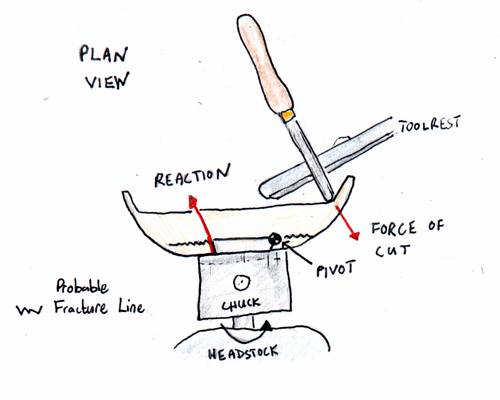


This drawing shows the cutting forces simplified. In reality the force will be a 3 dimensional direction due to the resistance to cutting. That will be the dominant direction in the event of a catch too. The general idea is still the same, the recess will be effectively pivoting around the side nearest the tool, and the material from that point onwards will be resisting spliting in tension. (In compression it won't want to split)

From my materials knowledge and the way the force is applied I believe the resistance to split out will be proportional to the area, of the "foot" width and not the distance. I had a good idea what the relationshoip was so I worked the maths out.

Relative strengths for different "Foot" widths


This diagram shows the key dimensions.
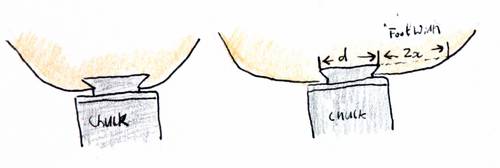


In these diagrams d is the chuck diameter, this was assumed to be 2" (50mm)

The distance x I have called the "foot" width. This is the width from the edge of the chuck to the edge of the bowl. In the diagram on the left it is x and on the right it has increased to 2x.

By working out what area is available to resist splitting, the strength relative to a starting diameter can be determined. In the calculations I started with 0.5" (12.5mm) as the minimum, and worked it out up to 1.5" (75mm).

This graph shows the results.
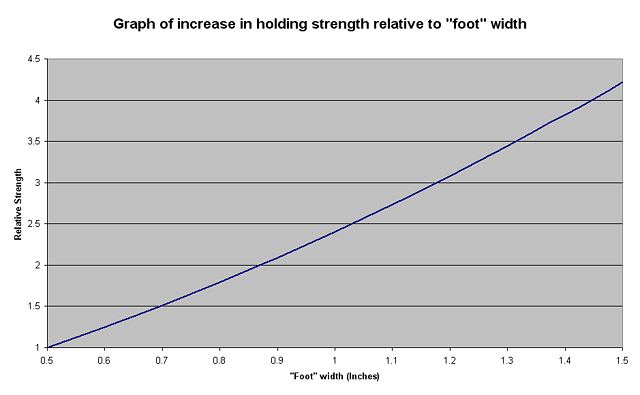


The diameter is plotted along the horizontal scale, and the strength at 0.5" is taken as 1. The vertical scale then gives the strength relative to this. For example, if x is doubled the relative strength increases by a factor of 2.4.

Key Observations


You can use this chart to work out the relative increase in strength. The relationship is not entirely linear, in all cases the strength increase is greater than the increase in foot width (this effect would be more pronouced if smaller dimensions were considered too)

Additional Notes


I've also thought about the depth of the recess. It goes without saying if it is more shallow there will be less strength. But what if you go deeper and there is a void. Is this a problem?
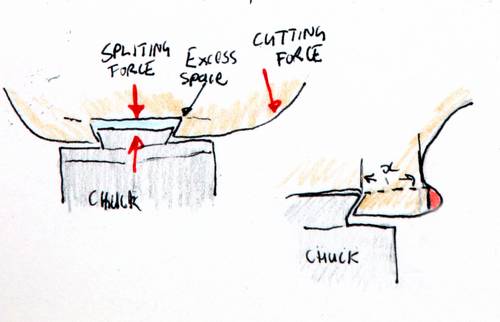


In the above left diagram, the illustation shows the void created by a dovetail deeper than the chuck depth. If you consider a force from cutting pushing backtowards the headstock, the red arrows show what happens. This pushing has the efefct of wanting to push the chuck into the wood, this will have a tendancy to make it want to split open, and/or move around. Therefore I think it is best if the chuck contacts the base as closely as possible. This failure is what I believe caused my bowl to jump out. I had cut a recess deeper by mistake than the recommended depth for my jaws.

Finally, the above right diagram just shows that if you use that profile, the red shaded section does not contribute to suporting the bowl.

Assumptions


There are a number of simplifications, in the model. For a start as wood is not homogeneous and the stresses generated will not be uniform (which will cause other effects). Also the grain aligment will affect how it stays in. This model assumes normal bowl alignment. If the internal recess was into end grain it would be highly unstable and likely to split out. In that case a compression grip would be much safer and stronger.

Okay, I hope this is helpful. Please let me kow if you think this is useful or not.

David

Re: Some thoughts on internal chucking (long)

#2

Re: Some thoughts on internal chucking (long)

Glenn Hodges

>David, when I first started using my Stronghold chuck I tried the expansion method. I lost a few bowls after I had roughed them out, let them dry, and remounted them. I think mine failed because I applied to much pressure when I expanded and/or there might have been a crack in the bottom of the bowl that I did not see. Anyway I quit using the expansion method and now only use the gripping use of the Stronghold. Shoot, if I had to thing about all that math before I mounted a bowl with this mind of mine, I never would get to turn a bowl.

Nashville, Georgia

Re: Some thoughts on internal chucking (long)

#3

Re: Some thoughts on internal chucking (long)

Rodney Jenkins

>You've given this some thought!

Raffan says to use 1/2" between chuck jaw and outside of the foot as a minimum for internal chucking.

I've found that there are a few keys to not having a blowout: 1- make sure the wood is strong/thick enough to withstand the force. 2- Make sure the gouge is as sharp as you know how to get it. 3- light cuts 4- NO catching allowed.

Also, the holding ability of the chuck is in inverse proportion to the depth of the bowl (deeper bowl=greater stress). Most of the failures I've experienced were the result of poor technique, i.e. catches.

The internal grip is a great way to save overall depth and I found that as my technique improved, the failures seemed to go away. But you never say never.

Re: Some thoughts on internal chucking (long)

#4

Re: Some thoughts on internal chucking (long)

David Eaves

>Hi Glenn,

Sorry for putting math on the forum, once done it is just reference though.

I wonder if your problem when remouting rough turned bowls, was due to distortion of the recess. If it isn't perfectly circular it will apply the pressure unevenly.

David

Re: Some thoughts on internal chucking (long)

#5

Re: Some thoughts on internal chucking (long)

David Eaves

>Hi Rodney,

Thanks for your comments.

I must be doing okay if I can agree with Richard Raffan without trying :o)

I complety agree with all your points and should have added the comment about the forces increasing as the depth gets larger. The further out you are the greater the leverage, and reaction the wood has to support.

I like the internal grip too, and like you say you can never be certain. One of the great joys of wood is the variation and unknown :o)

Thanks again

David

Re: Some thoughts on internal chucking (long)

#6

Re: Some thoughts on internal chucking (long)

Arch

>Hi David, Even if the mathematics that got you there is Greek to me, I applaud your contribution. Anecdotes often become gospel when repeated over and over. A refreshing approach and a nice balance to repetitive (tho certainly necessary & helpful) Q's & A's.

When there are differing opinions,I think objectivity is a good thing and is an ornament to the craft.

Thanks for your thoughts.

The lathe is the King of machine tools, but Mathematics is the Queen of all sciences. Arch

Re: Some thoughts on internal chucking (long)

#7

Re: Some thoughts on internal chucking (long)

Fred L. - North Carolina

>Thank you for your research and contribution. Your work resulted in a very good and useful guideline for internal chucking. You did all the calculations so I won't have to. Mishaps will happen, but it is better to start with a firm footing . . .

Regards,

FredL

Re: Some thoughts on internal chucking (long)

#8

Re: Some thoughts on internal chucking (long)

David Eaves

>Thanks for your comments Arch.

Your right, if it wasn't for maths.. the whole of science and engineering would fall down :o)

David

Re: Some thoughts on internal chucking (long)

#9

Re: Some thoughts on internal chucking (long)

David Eaves

>Thanks Fred, I appreciate your comments.

David

👍 This page answered my questions

Your vote helps other woodworkers quickly find the answers and techniques that actually work in the shop.