Photo credits
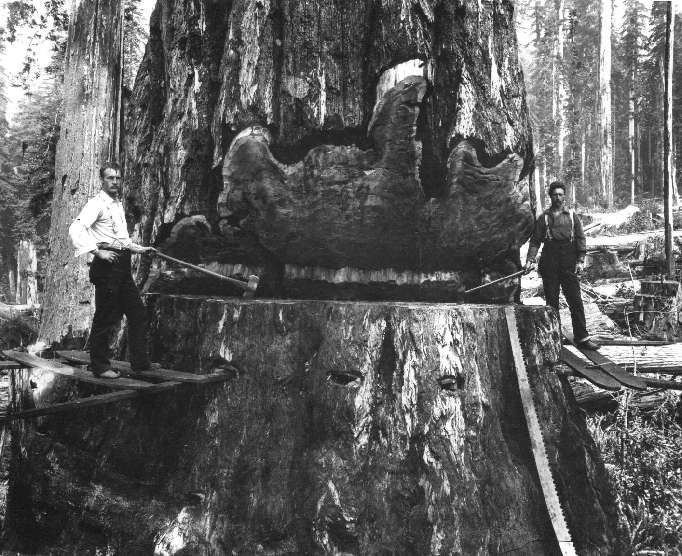
"Fallers" like these were the backbone of the logging boom in the Pacific Northwest, which began in the last half of the 19th Century. Armed with double-bladed "falling axes" and two-man "falling saws," these sturdy lumberjacks could bring down a mighty redwood in a day or two.
They began the falling operation by installing scaffolding around the tree several feet off the ground where the diameter was smaller. There was good reason to cut the tree some distance above ground. The first diameter above ground wasn't marketable because of the taper, and it took three times as long to fell the tree because of the volume of wood removed from the undercut and the back cut.
The scaffolding supports were called "spring boards." They were 4-ft.-long, tapered hardwood 2 x 6s with a fitted steel claw at the tree end. The bottom of the claw was smooth and slightly rounded and the top had a cleat that was forced into the wood by the fallers weight. The notches were cut with five or six blows from a "falling ax." A good faller could work his way 40 ft. up a tree in a few minutes, cutting springboard notches as he went.
Notice how smooth the chopping is on the undercut in the photo. A good ax faller gets a half pound chip for every blow once the cut is established.
"Chockers," a logging Spoonerism for "choker setter," had a particularly grueling but critical responsibility on the logging crew. Their job description derives from "choker," a wire or rope arranged in an eye that is designed to slip and tighten automatically on a load--in this case, the log--when tension is applied to the running part. One who "sets" or nooses the choker around the load is called a "choker setter." A chocker typically spent half his career dragging 1-in.-dia. wire chokers hundreds of feet uphill through mud, brush and tanglefoot slash.
By the way, there's no such thing as a fat faller or choker setter. These are still the most strenuous jobs on the work rolls.
A friend of mine set chokers in the hills behind Grey's Harbor in the early 1960s. His wife made him two lunches every day: three meat and three PBJ sandwiches on whole wheat, a quart of soup, a quart of coffee and half of a home made pie--per lunch. He ate the first lunch at ten o'clock and the second at two in the afternoon. He slept during the regular lunch hour. Despite these enormous lunches--along with huge logger breakfasts and suppers--his weight never climbed above 165 lbs. His biceps were as big as his hatband.
How did the pitsaw get its name?

This photo was actually taken much later, probably in the mid-1900s, as evidenced by the hard hat and the chain saw marks on the butt of this redwood log, a relatively small specimen by 19th-Century standards. After the advent of the railroads, Pacific Northwest lumber was shipped eastward to the treeless Plains states, where it was used to build entire towns on the prairie.
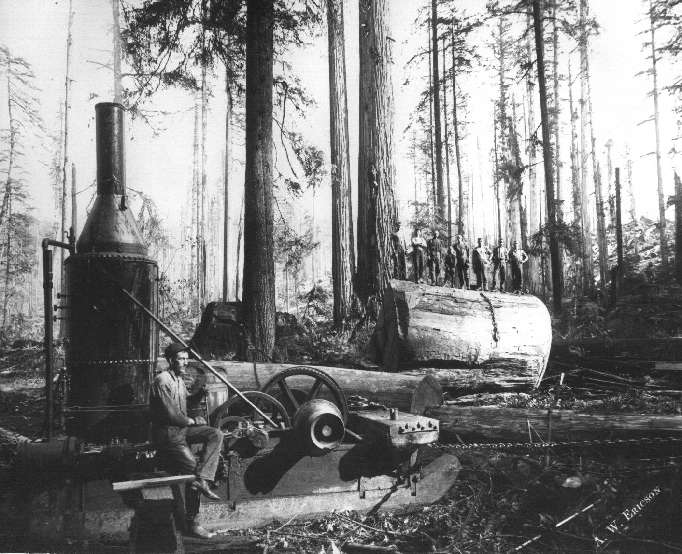
Ox-and-horse logging was phased out in the 1870s by a combination of technological innovations. The invention of safe portable steam boilers, reliable wire rope and "high-lead" logging led to the development of the mechanical marvel called a "steam donkey," which revolutionized log handling.
The steam donkey consisted of a boiler and three steam-powered winches mounted on a skid. It was operated by a "skinner," who worked the winches, and a "swamper," who fired the boiler, pumped feed water and kept the machinery lubricated. Anchored to a tree by one of its cables, the donkey dragged itself along the forest floor by its own power. consisted of a boiler and three steam-powered winches mounted on a skid.
These innovations--along with the development of narrow-gauge railroading, the application of steam technology to sawmills and the capitalist exploitation of cheap immigrant labor--reduced the cost of construction lumber and made possible the building of post-Civil-War urban infrastructure as they made working-class housing more affordable.
Comments (0)
No comments yet. Be the first!
Leave a Comment