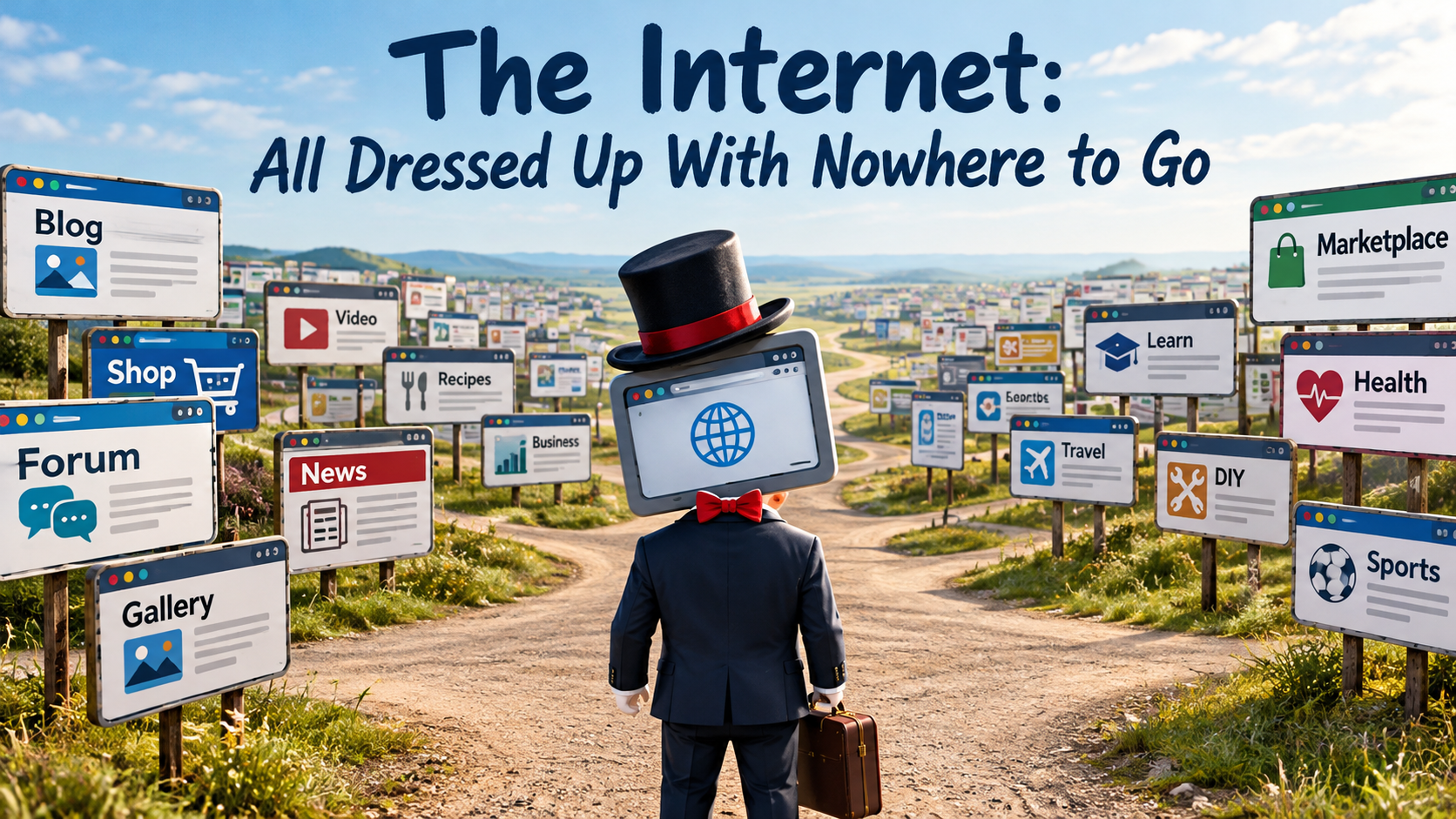
One of the fundamental problems of the modern web: the cost of creating a website has collapsed, but the difficulty of attracting an audience has not. In fact, the flood of inexpensive, instantly generated websites may make attracting an audience harder than ever.
Twenty-five years ago, building a website required a certain amount of technical knowledge. You needed to understand HTML, find hosting, configure a domain, upload files, and learn enough about servers to keep everything working. Those requirements created friction. They also discouraged many people who might otherwise have created a website.
Today, a person can describe a business idea to an AI service, select a template, and have a functioning website in minutes. SaaS platforms take care of hosting, security, databases, and much of the underlying infrastructure. AI can generate the content and code, too.
The result is a fundamental change in the economics of publishing.
The new problem: abundance without attention
Consider how the landscape has changed.
| Then | Now |
|---|---|
| Building a website required technical skills. | AI can generate a site from a description. |
| Hosting and server administration presented obstacles. | SaaS handles most of the infrastructure. |
| Publishing substantial content required effort. | AI can generate thousands of articles. |
| A useful website could distinguish itself by existing. | Millions of sites compete for the same attention. |
| Search engines helped people discover independent websites. | Search engines, social platforms, and AI services increasingly mediate discovery. |
| Technical expertise offered a competitive advantage. | Technical execution is becoming a commodity. |
The important distinction is that the supply of websites and content can grow much faster than the supply of human attention.
There are only so many hours in a day. There is only so much time people can spend reading articles, participating in discussions, watching videos, or browsing products.
When the supply of content increases dramatically while attention remains relatively fixed, the value of simply producing more content declines.
This is not entirely new. Publishing, photography, music production, and video production have all experienced similar transitions. The internet has now taken that process much further.
So what makes a website successful now?
I think the answer is increasingly found in five things that are much harder to manufacture than a website.
1. History and accumulated content
A website that has existed for decades may contain material that cannot easily be recreated: original discussions, documented experience, historical records, practical solutions, and contributions from people who are no longer active.
A new website can reproduce the appearance of an established one. It cannot instantly reproduce its history.
This is particularly important in specialized fields. A woodworking site with decades of discussions about machinery, joinery, wood species, finishing problems, and shop-made solutions has an accumulated body of knowledge that a newly generated website simply does not possess.
2. Authentic expertise
AI makes it easy to publish plausible information. It does not automatically make that information original, tested, or trustworthy.
A person who has spent 40 years working wood may have insights that never appeared in a book or online article. A machinist may know why a particular machine vibrates under certain conditions. An experienced restorer may recognize a problem that generic advice overlooks.
That experience has value precisely because it comes from somewhere.
The opportunity is not merely to publish information about a subject. It is to preserve and make accessible knowledge that comes from actual experience.
3. A reason to return
A website that answers a single question may attract a visitor who never returns. A website that offers a continuing reason to visit has a different kind of value.
That reason might be:
- New material worth reading.
- Discussions that develop over time.
- A useful archive that people consult repeatedly.
- A collection of resources unavailable in one convenient place.
- A marketplace connecting buyers and sellers.
- A specialized tool that solves a recurring problem.
The goal is to become a destination rather than merely another result in a search engine.
4. Recognition and trust
People return to sources they recognize and trust. That trust can be built through consistent quality, transparent ownership, accurate information, and a record of serving a particular audience.
It is much harder to create this than a logo, a template, or a collection of AI-generated articles.
A recognizable name with a long history can be an asset, even if its current traffic is modest. The challenge is to turn that history into a compelling reason for people to visit today.
5. Distribution and discoverability
A website can be excellent and still remain invisible.
Search engine visibility, links from other relevant sites, referrals, newsletters, specialist publications, and word of mouth all help connect useful material with its intended audience.
AI is changing this process, too. People increasingly ask AI systems for answers instead of clicking through a list of search results. That makes it important for websites to publish material that is distinctive, accessible, well structured, and worth citing or recommending.
But there is a catch: being discoverable is not the same as building an audience. A search visitor may arrive, get an answer, and leave in seconds. An established audience consists of people who have a reason to come back.
The paradox of the modern website
Here is what I find most interesting about this change.
As the technical barrier to creating a website approaches zero, the relative value of technical skills declines. But the value of the things that technology cannot readily supply may increase.
The changing value of a website
Technical construction
HTML, templates, hosting, routine programming
Commoditizing
Unique knowledge
Original material, experience, historical archives
Differentiating
Established relationships
Trust, returning visitors, reputation, recognition
Differentiating
This also explains why simply launching a new site and filling it with content is not necessarily a sensible business strategy. The startup costs may be negligible, but the cost of earning attention and trust remains substantial.
In some respects, the situation resembles a gold rush in which everyone has been given a shovel. The availability of shovels does not increase the amount of gold.
What this means for established websites
An older website has an advantage that a newcomer cannot buy instantly: accumulated material and a track record. However, age alone is not enough. An old website that is difficult to navigate, poorly maintained, or no longer useful can lose its audience just as readily as a new one can fail to find an audience.
The opportunity lies in combining that accumulated value with modern accessibility and functionality.
For example, a longstanding specialist site can become much more than its original format. An old discussion forum can be part of a broader resource that includes searchable articles, photographs, videos, classified listings, expert assistance, and tools for solving practical problems.
Each component serves a different purpose. Together, they give visitors more reasons to arrive and more reasons to return.
The archive provides depth. New material keeps the site relevant. Interactive features give people something to do. A consistent identity gives them somewhere to return.
That is a more defensible position than competing with every new website for a generic search term.
There is also an important commercial distinction here: a site with a modest audience but a highly relevant, loyal readership can be more valuable than one with substantially more transient visitors. The quality of the audience, its interests, its engagement, and the site’s reputation all matter.
My conclusion
I would not say that building an audience has become impossible. I would say that the internet has shifted from a shortage of publishers to a shortage of reasons to pay attention to them.
In the early web, having the technical ability to publish could itself be an advantage. Today, publishing is easy. Being worth visiting is the hard part.
The winners are unlikely to be the people who can generate the most pages in the least time. They will be the people and organizations that possess something difficult to duplicate: original knowledge, genuine expertise, a valuable archive, a trusted identity, or a service that people actually need.
And this leads to a particularly interesting question for anyone maintaining an established website: Is the objective to attract more visitors to individual pages, or to build a resource so useful that people remember it, recommend it, and return to it?
Those are two very different goals. The first is largely about traffic acquisition. The second is about building a lasting asset.
Reply below or in our forums with your thoughts.


