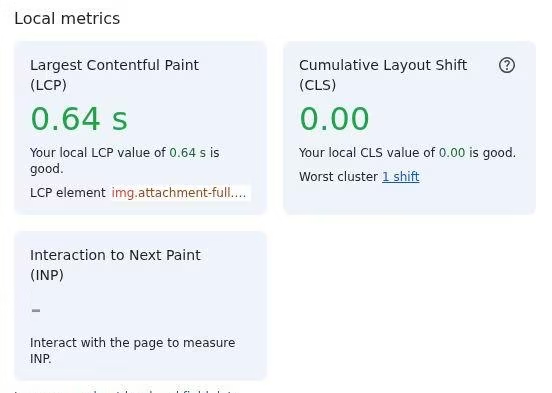
Lighthouse scores

Lighthouse is an open-source, automated tool developed by Google to audit and improve the quality of web pages. It evaluates websites across multiple categories: Performance (speed and responsiveness), Accessibility (usability for people with disabilities), Best Practices (security and modern web standards), SEO (search engine optimization), and Progressive Web App (PWA) capabilities. It generates a score from … Read more

Nu Html Checker

The HTML Checker, such as the W3C Markup Validation Service, identifies errors in HTML code that violate web standards. When a webpage fails this validation, users may encounter several issues that negatively impact their experience, accessibility, and interaction with the site. Below are the primary problems users may face, based on how invalid HTML affects functionality, … Read more

HTML form methods GET and POST

The HTML form methods GET and POST define how data is sent from a form to the server. Here’s the difference: Summary: Use GET for safe, idempotent requests where data visibility isn’t an issue. Use POST for secure, non-idempotent operations or when sending large/sensitive data.

Review and analysis of the lyrics of “The Stairs” by INXS

“The Stairs” is a track from INXS’s 1990 album X, a record that solidified their global presence with a blend of rock, funk, and introspective lyricism. Written by Michael Hutchence and Andrew Farriss, the song stands out for its poetic depth, atmospheric delivery, and thematic exploration of existential longing and human connection. Below is a … Read more

The World According to Garp: typecasting and tragedy in Robin Williams’ portrayal

John Irving’s The World According to Garp (1978) is a sprawling, tragicomic novel that defies easy categorization, much like the life of its protagonist, T.S. Garp. The 1982 film adaptation, directed by George Roy Hill, brought this complex story to the screen with remarkable fidelity, largely due to the inspired casting of Robin Williams as … Read more

What happened to Shareware?

The shareware concept hasn’t disappeared entirely, but it’s certainly evolved and faded from its heyday in the 1980s and ’90s. For those unfamiliar, shareware was a software distribution model where developers released programs—often games or utilities—for free, with a catch: users were encouraged (sometimes nagged) to pay a fee if they liked it or wanted … Read more

Licensed under CC BY-NC 4.0

Site Index

👍 This page answered my questions

Your vote helps other woodworkers quickly find the answers and techniques that actually work in the shop.